
Huawei Mate Xs vs. Motorola Razr 2022: A Detailed Foldable Phone Comparison
| Phones Images | |||||
|---|---|---|---|---|---|
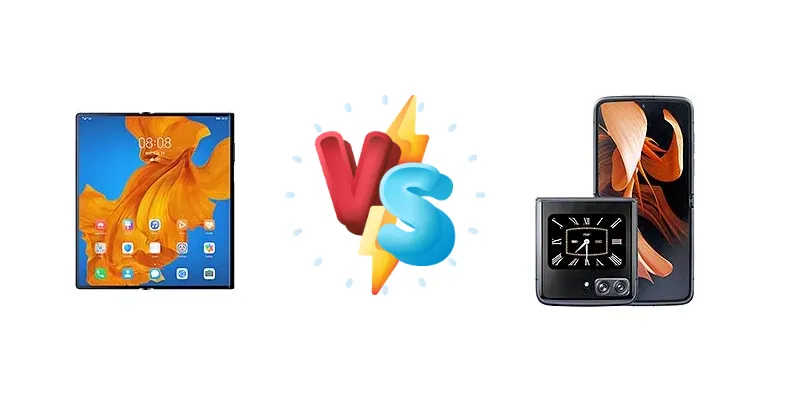
|
🏆 Quick Verdict
For most users, the Motorola Razr 2022 is the superior choice. Its significantly brighter display (1033 nits vs 413 nits) and more modern Snapdragon 8+ Gen 1 chipset offer a smoother, more vibrant experience. While the Mate Xs boasts slightly better endurance, the Razr’s overall package is more compelling.
| PHONES | ||
|---|---|---|
| Phone Names | Huawei Mate Xs | Motorola Razr 2022 |
| Network | ||
|---|---|---|
| 2G bands | GSM 850 / 900 / 1800 / 1900 | GSM 900 / 1800 / 1900 |
| 3G bands | HSDPA 800 / 850 / 900 / 1700(AWS) / 1900 / 2100 | HSDPA 850 / 900 / 1700(AWS) / 1900 / 2100 |
| 4G bands | 1, 2, 3, 4, 5, 6, 7, 8, 9, 12, 17, 18, 19, 20, 26, 28, 32, 34, 38, 39, 40, 41 | 1, 2, 3, 4, 5, 7, 8, 12, 13, 14, 17, 18, 19, 20, 25, 26, 28, 34, 38, 39, 40, 41, 42, 43, 48, 66 |
| 5G bands | 1, 3, 28, 38, 41, 77, 78, 79 SA/NSA | 1, 2, 3, 5, 7, 8, 12, 20, 25, 26, 28, 38, 40, 41, 66, 77, 78, 79 SA/NSA/Sub6 |
| Speed | HSPA 42.2/5.76 Mbps, LTE Cat21 1400/200 Mbps, 5G (2+ Gbps DL) | HSPA, LTE, 5G |
| Technology | GSM / HSPA / LTE / 5G | GSM / CDMA / HSPA / EVDO / LTE / 5G |
| - | CDMA2000 1xEV-DO | |
| Launch | ||
|---|---|---|
| Announced | 2020, February 24. Released 2020, March 05 | 2022, August 11 |
| Status | Discontinued | Available. Released 2022, August 18 |
| Body | ||
|---|---|---|
| Build | Plastic front, aluminum back, aluminum frame | Plastic front (unfolded), glass front (folded, Gorilla Glass 5), glass back (Gorilla Glass 5), aluminum frame (7000 series), hinge (stainless steel) |
| Dimensions | Unfolded: 161.3 x 146.2 x 5.4 mmFolded: 161.3 x 78.5 x 11 mm | Unfolded: 167.0 x 79.8 x 7.6 mm Folded: 86.5 x 79.8 x 17 mm |
| SIM | Nano-SIM + Nano-SIM | Nano-SIM + eSIM |
| Weight | 300 g (10.58 oz) | 200 g (7.05 oz) |
| - | Water-repellent coating | |
| Display | ||
|---|---|---|
| Protection | Corning Gorilla Glass | - |
| Resolution | 2200 x 2480 pixels (~414 ppi density) | 1080 x 2400 pixels, 20:9 ratio (~393 ppi density) |
| Size | 8.0 inches, 205.0 cm2 (~86.9% screen-to-body ratio) | 6.7 inches, 108.4 cm2 (~81.3% screen-to-body ratio) |
| Type | Foldable OLED | Foldable AMOLED, 1B colors, 144Hz, HDR10+ |
| Folded cover display: AMOLED, 6.6 inches, 1148 x 2480 pixels, 19.5:9 ratio | Second external AMOLED display, 2.7 inches, 573 x 800 pixels | |
| Platform | ||
|---|---|---|
| CPU | Octa-core (2x2.86 GHz Cortex-A76 & 2x2.36 GHz Cortex-A76 & 4x1.95 GHz Cortex-A55) | Octa-core (1x3.19 GHz Cortex-X2 & 3x2.75 GHz Cortex-A710 & 4x1.80 GHz Cortex-A510) |
| Chipset | Kirin 990 5G (7 nm+) | Qualcomm SM8475 Snapdragon 8+ Gen 1 (4 nm) |
| GPU | Mali-G76 MP16 | Adreno 730 |
| OS | Android 10, EMUI 10, no Google Play Services | Android 13, upgradable to Android 14 |
| Memory | ||
|---|---|---|
| Card slot | Nano Memory (uses shared SIM slot) | No |
| Internal | 512GB 8GB RAM | 128GB 8GB RAM, 256GB 8GB RAM, 512GB 12GB RAM |
| UFS 2.1 | UFS 3.1 | |
| Main Camera | ||
|---|---|---|
| Dual | - | 50 MP, f/1.8, (wide), 1/1.55", 1.0µm, PDAF, OIS 13 MP, f/2.2, 120˚ (ultrawide), 1/3.0", 1.12µm, AF |
| Features | Leica optics, dual-LED dual-tone flash, panorama, HDR | LED flash, panorama, auto HDR |
| Single | 5 MP, AF 5 MP, AF | - |
| Triple | 40 MP, f/1.8, 27mm (wide), 1/1.7", PDAF 8 MP, f/2.4, 81mm (telephoto), PDAF, OIS, 3x optical zoom 16 MP, f/2.2, 17mm (ultrawide), AF TOF 3D, (depth) | - |
| Video | 4K@30fps, 1080p@30fps | 8K@30fps, 4K@30/60fps, 1080p@30/60/120fps, gyro-EIS |
| Selfie camera | ||
|---|---|---|
| Features | HDR | Auto HDR |
| Single | Yes | 32 MP, f/2.4, 25mm (wide), 1/3.2", 0.7µm |
| Video | 1080p@30fps | 1080p@30/60fps |
| No - uses main camera | - | |
| Sound | ||
|---|---|---|
| 3.5mm jack | No | No |
| 35mm jack | No | No |
| Loudspeaker | Yes | Yes, with stereo speakers |
| Comms | ||
|---|---|---|
| Bluetooth | 5.0, A2DP, LE | 5.2, A2DP, LE, aptX HD, aptX Adaptive |
| Infrared port | Yes | - |
| NFC | Yes | Yes |
| Positioning | GPS (L1+L5), GLONASS (L1), BDS (B1), GALILEO (E1+E5a), QZSS (L1+L5) | GPS (L1+L5), GLONASS (L1), BDS (B1I+B1c+B2a), GALILEO (E1+E5a), QZSS (L1+L5) |
| Radio | No | No |
| USB | USB Type-C 3.1 | USB Type-C 3.1 |
| WLAN | Wi-Fi 802.11 a/b/g/n/ac, dual-band, Wi-Fi Direct | Wi-Fi 802.11 a/b/g/n/ac/6e, dual-band, Wi-Fi Direct |
| Features | ||
|---|---|---|
| Browser | HTML, Adobe Flash | - |
| Sensors | Fingerprint (side-mounted), accelerometer, gyro, proximity, compass, barometer | Fingerprint (side-mounted), accelerometer, gyro, proximity, compass |
| Battery | ||
|---|---|---|
| Charging | 55W wired, 85% in 30 min | 30W wired |
| Stand-by | Up to 312 h | - |
| Talk time | Up to 6 h | - |
| Type | Li-Po 4500 mAh | Li-Po 3500 mAh |
| Misc | ||
|---|---|---|
| Colors | Interstellar Blue | Satin Black |
| Models | TAH-N29m | XT2251-1 |
| Price | About 1950 EUR | About 670 EUR |
| SAR | 0.29 W/kg (head) 0.54 W/kg (body) | - |
| Tests | ||
|---|---|---|
| Battery life | Endurance rating 69h | Endurance rating 64h |
| Camera | Photo / Video | Photo / Video |
| Display | Contrast ratio: Infinite (nominal) | Contrast ratio: Infinite (nominal) |
| Loudspeaker | -27.0 LUFS (Good) | -25.4 LUFS (Very good) |
| Performance | AnTuTu: 459274 (v8), 461406 (unfolded) GeekBench: 12213 (v4.4), 2980 (v5.1) GFXBench: 16fps (ES 3.1 onscreen unfolded) | AnTuTu: 965260 (v9) GeekBench: 3944 (v5.1) GFXBench: 76fps (ES 3.1 onscreen) |
Huawei Mate Xs
- Longer battery endurance rating
- Faster wired charging (55W)
- Outward-folding design offers larger unfolded screen
- Significantly dimmer display
- Older Kirin 990 chipset
- Outward-folding screen is more vulnerable to damage
Motorola Razr 2022
- Much brighter display (1033 nits)
- Powerful Snapdragon 8+ Gen 1 chipset
- More compact and pocketable clamshell design
- Slightly lower battery endurance rating
- Slower wired charging (30W)
- Internal display is still susceptible to creasing
Display Comparison
The most striking difference lies in the displays. The Motorola Razr 2022 boasts a peak brightness of 1033 nits, a massive leap over the Huawei Mate Xs’ 413 nits. This translates to far superior visibility outdoors and a more vibrant viewing experience in general. Both feature an 'Infinite' contrast ratio (nominal), but the Razr’s higher brightness is the dominant factor. The Razr’s clamshell design also offers a more protected internal display when closed, while the Mate Xs’ outward-folding screen is inherently more susceptible to scratches. While neither spec sheet details refresh rates, the Razr’s newer panel technology likely offers a smoother experience.
Camera Comparison
Both phones feature 'Photo / Video' capabilities, but detailed sensor information is lacking. Without specifics, it’s difficult to make a definitive judgment. However, given the age difference, the Razr 2022 likely benefits from more advanced image processing algorithms and potentially larger sensor sizes. The absence of details regarding OIS or lens apertures makes a precise comparison impossible, but the Razr’s newer chipset likely supports more sophisticated computational photography features.
Performance
The Motorola Razr 2022’s Qualcomm Snapdragon 8+ Gen 1 (4nm) chipset represents a significant generational leap over the Huawei Mate Xs’ Kirin 990 5G (7nm+). The 4nm process node of the Snapdragon offers superior power efficiency and thermal performance, meaning less throttling during sustained workloads like gaming. The Razr’s CPU configuration – a Cortex-X2 prime core alongside Cortex-A710 performance cores – provides a noticeable advantage in single-core and multi-core performance compared to the Mate Xs’ older Cortex-A76 cores. This difference will be most apparent in demanding applications and multitasking.
Battery Life
The Huawei Mate Xs claims an endurance rating of 69 hours, slightly exceeding the Motorola Razr 2022’s 64-hour rating. However, this doesn’t tell the whole story. The Razr 2022’s 30W charging is slower than the Mate Xs’ 55W charging (85% in 30 minutes). This means the Mate Xs can replenish its battery more quickly, potentially mitigating the slight difference in overall endurance. The Snapdragon 8+ Gen 1’s efficiency also plays a role, potentially offsetting the Mate Xs’ slightly longer runtime in real-world usage.
Buying Guide
Buy the Huawei Mate Xs if you prioritize maximum battery endurance and prefer an outward-folding design, potentially benefiting from a larger unfolded screen real estate. Buy the Motorola Razr 2022 if you value a brighter, more responsive display, significantly faster processing power for demanding tasks, and a more pocketable, clamshell form factor. The Razr is ideal for users who want a stylish, capable phone that easily fits in their pocket.