
Huawei Mate Xs 2 vs Xiaomi Mix Fold 2: The Ultimate Foldable Face-Off
| Phones Images | |||||
|---|---|---|---|---|---|
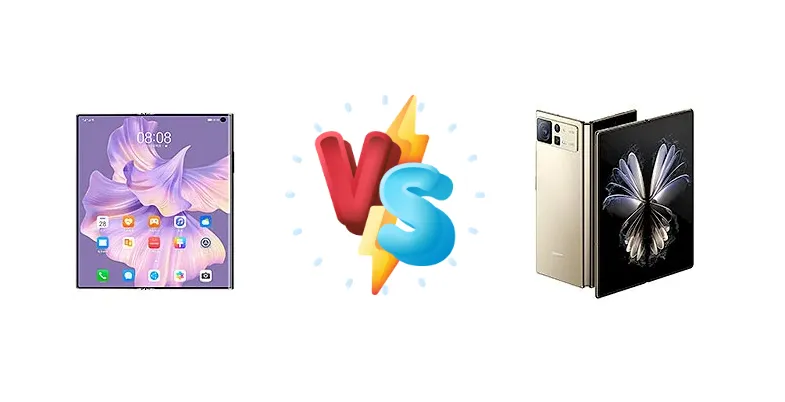
|
🏆 Quick Verdict
The Xiaomi Mix Fold 2 emerges as the stronger contender, boasting a brighter display, a more powerful chipset, and significantly better battery life. While the Mate Xs 2’s outward-folding design is unique, the Mix Fold 2’s refined performance and features make it the more compelling choice for most users.
| PHONES | ||
|---|---|---|
| Phone Names | Huawei Mate Xs 2 | Xiaomi Mix Fold 2 |
| Network | ||
|---|---|---|
| 2G bands | GSM 850 / 900 / 1800 / 1900 | GSM 850 / 900 / 1800 / 1900 |
| 3G bands | HSDPA 800 / 850 / 900 / 1700(AWS) / 1900 / 2100 | HSDPA 850 / 900 / 1700(AWS) / 1900 / 2100 |
| 4G bands | 1, 2, 3, 4, 5, 7, 8, 12, 17, 18, 19, 20, 26, 28, 34, 38, 39, 40, 41 | 1, 2, 3, 4, 5, 7, 8, 12, 17, 18, 19, 20, 26, 28, 34, 38, 39, 40, 41, 42 |
| 5G bands | - | 1, 3, 5, 8, 20, 28, 38, 40, 41, 77, 78, 79 SA/NSA |
| Speed | HSPA, LTE | HSPA, LTE, 5G |
| Technology | GSM / CDMA / HSPA / EVDO / LTE | GSM / CDMA / HSPA / EVDO / LTE / 5G |
| CDMA2000 1xEV-DO | CDMA2000 1xEV-DO | |
| Launch | ||
|---|---|---|
| Announced | 2022, April 28 | 2022, August 11 |
| Status | Available. Released 2022, May 07 | Available. Released 2022, August 26 |
| Body | ||
|---|---|---|
| Dimensions | Unfolded: 156.5 x 139.3 x 5.4 mmFolded: 156.5 x 75.5 x 11.1 mm | Unfolded: 161.1 x 144.7 x 5.4 mm Folded: 161.1 x 73.9 x 11.2 mm |
| SIM | Nano-SIM + Nano-SIM | Nano-SIM + Nano-SIM |
| Weight | 255 g / 257 g (8.99 oz) | 262 g (9.24 oz) |
| Display | ||
|---|---|---|
| Protection | - | Schott UTG glass |
| Resolution | 2200 x 2480 pixels (~424 ppi density) | 1914 x 2160 pixels (~360 ppi density) |
| Size | 7.8 inches, 195.8 cm2 (~89.8% screen-to-body ratio) | 8.02 inches, 206.0 cm2 (~88.4% screen-to-body ratio) |
| Type | Foldable OLED, 1B colors, 120Hz | Foldable LTPO2 OLED, 1B colors, 120Hz, HDR10+, Dolby Vision, 1000 nits (HBM), 1300 nits (peak) |
| Folded cover display: OLED, 6.5 inches, 1176 x 2480 pixels | Cover display: AMOLED, 120Hz, HDR10+, Dolby Vision, 1000 nits (HBM), 1300 nits (peak) 6.56 inches, 1080 x 2520 pixels, 21:9 ratio Corning Gorilla Glass Victus | |
| Platform | ||
|---|---|---|
| CPU | Octa-core (1x2.84 GHz Cortex-X1 & 3x2.42 GHz Cortex-A78 & 4x1.80 GHz Cortex-A55) | Octa-core (1x3.19 GHz Cortex-X2 & 3x2.75 GHz Cortex-A710 & 4x1.80 GHz Cortex-A510) |
| Chipset | Qualcomm SM8350 Snapdragon 888 4G (5 nm) | Qualcomm SM8475 Snapdragon 8+ Gen 1 (4 nm) |
| GPU | Adreno 660 | Adreno 730 |
| OS | EMUI 12, no Google Play Services (International); HarmonyOS 2.0 (China) | Android 12, MIUI Fold 13 |
| Memory | ||
|---|---|---|
| Card slot | Nano Memory (uses shared SIM slot) | No |
| Internal | 256GB 8GB RAM, 512GB 8GB RAM, 512GB 12GB RAM | 256GB 12GB RAM, 512GB 12GB RAM, 1TB 12GB RAM |
| UFS | UFS 3.1 | |
| Main Camera | ||
|---|---|---|
| Features | Laser AF, color spectrum sensor, Dual-LED dual-tone flash, panorama, HDR | Color spectrum sensor, Dual-LED flash, HDR, panorama, Leica lenses |
| Single | 10.7 MP, f/2.2 | - |
| Triple | 50 MP, f/1.8, (wide), PDAF 8 MP, f/2.4, 81mm (telephoto), PDAF, OIS, 3x optical zoom 13 MP, f/2.2, 120˚ (ultrawide) | 50 MP, f/1.8, (wide), 1/1.56", 1.0µm, PDAF, OIS 8 MP, f/2.6, 45mm (telephoto), dual pixel PDAF, 2x optical zoom 13 MP, f/2.4, 15mm, 123˚ (ultrawide), 1.12µm, AF |
| Video | 4K@30/60fps, 1080p@30/240fps | 8K@24fps, 4K@30/60fps, 1080p@30/60/120/240/960fps, gyro-EIS |
| Selfie camera | ||
|---|---|---|
| Features | HDR | HDR, panorama |
| Single | 10.7 MP, f/2.2 | 20 MP, f/2.4, 23mm (wide) |
| Video | 4K@30fps, 1080p@30/240fps | 1080p@30/60fps, 720p@120fps |
| Sound | ||
|---|---|---|
| 3.5mm jack | No | No |
| 35mm jack | No | No |
| Loudspeaker | Yes, with stereo speakers | Yes, with stereo speakers |
| - | 24-bit/192kHz audio Tuned by Harman Kardon | |
| Comms | ||
|---|---|---|
| Bluetooth | 5.2, A2DP, LE | 5.2, A2DP, LE, aptX HD, aptX Adaptive |
| Infrared port | Yes | Yes |
| NFC | Yes | Yes |
| Positioning | GPS (L1+L5), GLONASS (L1), BDS (B1I+B1c+B2a), GALILEO (E1+E5a), QZSS (L1+L5), NavIC (L5) | GPS (L1+L5), GLONASS (L1), BDS (B1I+B1c+B2a), GALILEO (E1+E5a), QZSS (L1+L5), NavIC (L5) |
| Radio | No | No |
| USB | USB Type-C 3.1, OTG | USB Type-C |
| WLAN | Wi-Fi 802.11 a/b/g/n/ac/6, dual-band, Wi-Fi Direct | Wi-Fi 802.11 a/b/g/n/ac/6e, dual-band, Wi-Fi Direct |
| Features | ||
|---|---|---|
| Sensors | Fingerprint (side-mounted), accelerometer, gyro, proximity, compass, barometer | Fingerprint (side-mounted), accelerometer, gyro, proximity, compass, barometer |
| Battery | ||
|---|---|---|
| Charging | 66W wired 5W reverse wired | 67W wired, PD3.0, QC4, 100% in 40 min |
| Type | Market-dependent versions:· Li-Po 4600 mAh (w/ 8GB RAM)· Li-Po 4880 mAh (w/ 12GB RAM) | Li-Po 4500 mAh |
| Misc | ||
|---|---|---|
| Colors | Black, White, Purple | Black, Gold |
| Models | PAL-AL00, PAL-LX9 | 22061218C |
| Price | About 2000 EUR | About 1300 EUR |
| Tests | ||
|---|---|---|
| Battery life | Endurance rating 49h | Endurance rating 82h |
| Camera | Photo / Video | Photo / Video |
| Display | Contrast ratio: Infinite (nominal) | Contrast ratio: Infinite (nominal) |
| Loudspeaker | -25.8 LUFS (Very good) | -26.2 LUFS (Good) |
| Performance | AnTuTu: 641608 (v9) GeekBench: 3131 (v5.1) GFXBench: 28fps (ES 3.1 onscreen) | AnTuTu: 1050139 (v9) GeekBench: 4368 (v5.1) GFXBench: 52fps (ES 3.1 onscreen) |
Huawei Mate Xs 2
- Unique outward-folding design
- Decent performance
- 66W fast charging
- Lower peak brightness
- Less powerful chipset
- Shorter battery life
- Potential software limitations (due to Huawei's situation)
Xiaomi Mix Fold 2
- Brighter display
- More powerful chipset (Snapdragon 8+ Gen 1)
- Excellent battery life
- Fast charging (67W, PD3.0, QC4)
- Premium price
- Inner folding design may not appeal to everyone
Display Comparison
The Xiaomi Mix Fold 2 takes a clear lead in the display department. Its measured peak brightness of 1054 nits significantly surpasses the Mate Xs 2’s 725 nits, resulting in a noticeably brighter and more vibrant viewing experience, especially outdoors. Both offer excellent contrast ratios (infinite nominal), but the Xiaomi’s superior brightness is a key advantage. The Mate Xs 2's display, while good, can appear a bit washed out in direct sunlight.
Camera Comparison
Both phones offer capable camera systems, but detailed camera comparisons require more in-depth testing. Generally, the Xiaomi Mix Fold 2 is expected to have a slight edge due to its newer hardware and potentially better image processing algorithms. Both offer versatile camera setups suitable for various shooting scenarios.
Performance
The Snapdragon 8+ Gen 1 in the Xiaomi Mix Fold 2 provides a substantial performance boost over the Mate Xs 2’s Snapdragon 888. The newer chipset offers improved CPU and GPU performance, leading to smoother multitasking, faster app loading times, and better gaming performance. While the Mate Xs 2 is still capable, the Mix Fold 2’s processing power is undeniably superior.
Battery Life
Battery life is a significant differentiator. The Xiaomi Mix Fold 2’s endurance rating of 82h comfortably beats the Mate Xs 2’s 49h. This translates to significantly longer usage times between charges, a crucial factor for foldable phones with their larger displays.
Buying Guide
The Huawei Mate Xs 2 is ideal for those who prioritize a unique, outward-folding design and are comfortable with potential software limitations. The Xiaomi Mix Fold 2 is perfect for users seeking a premium foldable experience with top-tier performance, a stunning display, and excellent battery life, especially if they value a more conventional inner-folding design.