
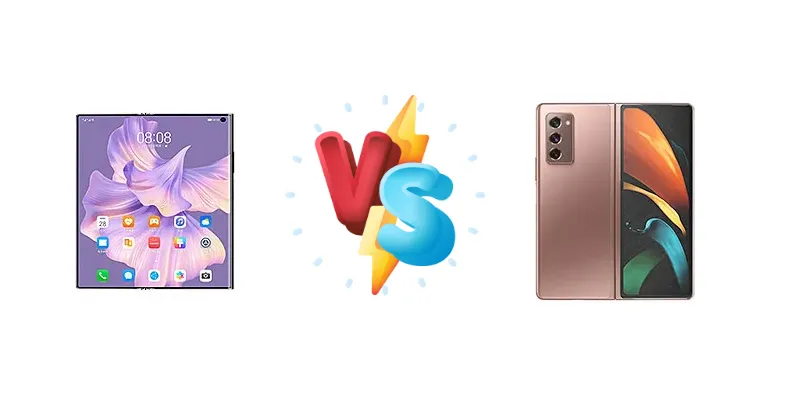
Huawei Mate Xs 2 vs Samsung Galaxy Z Fold2 5G: The Ultimate Folding Phone Battle
| Phones Images | |||||
|---|---|---|---|---|---|
|
🏆 Quick Verdict
The Samsung Galaxy Z Fold2 5G takes the crown due to its superior battery life, more versatile software experience, and generally more polished overall package. While the Mate Xs 2 boasts a unique outward-folding design and impressive display brightness, the Z Fold2’s longevity and feature set give it the edge.
| PHONES | ||
|---|---|---|
| Phone Names | Huawei Mate Xs 2 | Samsung Galaxy Z Fold2 5G |
| Network | ||
|---|---|---|
| 2G bands | GSM 850 / 900 / 1800 / 1900 | GSM 850 / 900 / 1800 / 1900 |
| 3G bands | HSDPA 800 / 850 / 900 / 1700(AWS) / 1900 / 2100 | HSDPA 850 / 900 / 1700(AWS) / 1900 / 2100 - SM-F916B |
| 4G bands | 1, 2, 3, 4, 5, 7, 8, 12, 17, 18, 19, 20, 26, 28, 34, 38, 39, 40, 41 | 1, 2, 3, 4, 5, 7, 8, 12, 13, 17, 18, 19, 20, 25, 26, 28, 38, 39, 40, 41, 66 - SM-F916B |
| 5G bands | - | 1, 3, 5, 7, 8, 28, 40, 41, 77, 78 Sub6 - SM-F916B |
| Speed | HSPA, LTE | HSPA 42.2/5.76 Mbps, LTE (7CA) Cat20 2000/200 Mbps, 5G |
| Technology | GSM / CDMA / HSPA / EVDO / LTE | GSM / CDMA / HSPA / EVDO / LTE / 5G |
| CDMA2000 1xEV-DO | 2, 3, 4, 5, 7, 8, 12, 13, 18, 19, 20, 26, 28, 38, 39, 40, 41, 46, 48, 66 - SM-F916U1 | |
| Launch | ||
|---|---|---|
| Announced | 2022, April 28 | 2020, August 05 |
| Status | Available. Released 2022, May 07 | Available. Released 2020, September 18 |
| Body | ||
|---|---|---|
| Build | - | Glass front (folded), plastic front (unfolded), glass back, aluminum frame |
| Dimensions | Unfolded: 156.5 x 139.3 x 5.4 mmFolded: 156.5 x 75.5 x 11.1 mm | Unfolded: 159.2 x 128.2 x 6.9 mmFolded: 159.2 x 68 x 13.8-16.8 mm |
| SIM | Nano-SIM + Nano-SIM | Nano-SIM + eSIM |
| Weight | 255 g / 257 g (8.99 oz) | 282 g (9.95 oz) |
| Display | ||
|---|---|---|
| Resolution | 2200 x 2480 pixels (~424 ppi density) | 1768 x 2208 pixels (~373 ppi density) |
| Size | 7.8 inches, 195.8 cm2 (~89.8% screen-to-body ratio) | 7.6 inches, 180.8 cm2 (~88.6% screen-to-body ratio) |
| Type | Foldable OLED, 1B colors, 120Hz | Foldable Dynamic AMOLED 2X, 120Hz, HDR10+ |
| Folded cover display: OLED, 6.5 inches, 1176 x 2480 pixels | Cover display: Super AMOLED, Corning Gorilla Glass Victus 6.23 inches, 816 x 2260 pixels, 25:9 ratio | |
| Platform | ||
|---|---|---|
| CPU | Octa-core (1x2.84 GHz Cortex-X1 & 3x2.42 GHz Cortex-A78 & 4x1.80 GHz Cortex-A55) | Octa-core (1x3.09 GHz Cortex-A77 & 3x2.42 GHz Cortex-A77 & 4x1.80 GHz Cortex-A55) |
| Chipset | Qualcomm SM8350 Snapdragon 888 4G (5 nm) | Qualcomm SM8250 Snapdragon 865 5G+ (7 nm+) |
| GPU | Adreno 660 | Adreno 650 |
| OS | EMUI 12, no Google Play Services (International); HarmonyOS 2.0 (China) | Android 10, upgradable to Android 13, One UI 5.1.1 |
| Memory | ||
|---|---|---|
| Card slot | Nano Memory (uses shared SIM slot) | No |
| Internal | 256GB 8GB RAM, 512GB 8GB RAM, 512GB 12GB RAM | 256GB 12GB RAM, 512GB 12GB RAM |
| UFS | UFS 3.1 | |
| Main Camera | ||
|---|---|---|
| Features | Laser AF, color spectrum sensor, Dual-LED dual-tone flash, panorama, HDR | LED flash, HDR, panorama |
| Single | 10.7 MP, f/2.2 | - |
| Triple | 50 MP, f/1.8, (wide), PDAF 8 MP, f/2.4, 81mm (telephoto), PDAF, OIS, 3x optical zoom 13 MP, f/2.2, 120˚ (ultrawide) | 12 MP, f/1.8, 26mm (wide), 1/1.76", 1.8µm, dual pixel PDAF, OIS 12 MP, f/2.4, 52mm (telephoto), 1/3.6", 1.0µm, PDAF, OIS, 2x optical zoom 12 MP, f/2.2, 123˚, 12mm (ultrawide), 1.12µm |
| Video | 4K@30/60fps, 1080p@30/240fps | 4K@60fps, 1080p@60/240fps (gyro-EIS), 720p@960fps (gyro-EIS), HDR10+ |
| Selfie camera | ||
|---|---|---|
| Features | HDR | HDR |
| Single | 10.7 MP, f/2.2 | 10 MP, f/2.2, 26mm (wide), 1/3", 1.22µm Cover camera: 10 MP, f/2.2, 26mm (wide), 1/3", 1.22µm |
| Video | 4K@30fps, 1080p@30/240fps | 4K@30fps, 1080p@30fps, gyro-EIS |
| Sound | ||
|---|---|---|
| 3.5mm jack | No | No |
| 35mm jack | No | No |
| Loudspeaker | Yes, with stereo speakers | Yes, with stereo speakers |
| - | 32-bit/384kHz audio Tuned by AKG | |
| Comms | ||
|---|---|---|
| Bluetooth | 5.2, A2DP, LE | 5.0, A2DP, LE, aptX HD |
| Infrared port | Yes | - |
| NFC | Yes | Yes |
| Positioning | GPS (L1+L5), GLONASS (L1), BDS (B1I+B1c+B2a), GALILEO (E1+E5a), QZSS (L1+L5), NavIC (L5) | GPS, GLONASS, GALILEO, BDS |
| Radio | No | No |
| USB | USB Type-C 3.1, OTG | USB Type-C 3.2 |
| WLAN | Wi-Fi 802.11 a/b/g/n/ac/6, dual-band, Wi-Fi Direct | Wi-Fi 802.11 a/b/g/n/ac/6, dual-band, Wi-Fi Direct |
| Features | ||
|---|---|---|
| Sensors | Fingerprint (side-mounted), accelerometer, gyro, proximity, compass, barometer | Fingerprint (side-mounted), accelerometer, gyro, proximity, compass, barometer |
| - | Bixby natural language commands and dictation Samsung DeX (desktop experience support) Samsung Pay (Visa, MasterCard certified) Ultra Wideband (UWB) support | |
| Battery | ||
|---|---|---|
| Charging | 66W wired 5W reverse wired | 25W wired 11W wireless 4.5W reverse wireless |
| Type | Market-dependent versions:· Li-Po 4600 mAh (w/ 8GB RAM)· Li-Po 4880 mAh (w/ 12GB RAM) | Li-Po 4500 mAh |
| Misc | ||
|---|---|---|
| Colors | Black, White, Purple | Mystic Bronze, Mystic Black, Thom Browne Edition, Aston Martin Racing Edition |
| Models | PAL-AL00, PAL-LX9 | SM-F916B, SM-F916U, SM-F916U1, SM-F916N, SM-F9160, SM-F916W, SCG05 |
| Price | About 2000 EUR | About 960 EUR |
| SAR EU | - | 0.86 W/kg (head) 1.45 W/kg (body) |
| Tests | ||
|---|---|---|
| Battery life | Endurance rating 49h | Endurance rating 81h |
| Camera | Photo / Video | Photo / Video |
| Display | Contrast ratio: Infinite (nominal) | - |
| Loudspeaker | -25.8 LUFS (Very good) | -25.2 LUFS (Very good) |
| Performance | AnTuTu: 641608 (v9) GeekBench: 3131 (v5.1) GFXBench: 28fps (ES 3.1 onscreen) | AnTuTu: 564907 (v8) GeekBench: 12607 (v4.4), 2715 (v5.1) GFXBench: 33fps (ES 3.1 onscreen) |
Huawei Mate Xs 2
- Unique outward-folding design
- High display brightness (725 nits)
- Relatively slim and lightweight
- 66W fast charging
- Shorter battery life (49h)
- Software limitations (due to Huawei's situation)
- Camera performance can be inconsistent
- No official 5G support
Samsung Galaxy Z Fold2 5G
- Excellent battery life (81h)
- Versatile camera system
- Larger, more immersive internal display
- Mature software experience
- 5G connectivity
- Bulky design
- Slower charging (25W)
- Expensive
- Crease visible on the folding display
Display Comparison
The Mate Xs 2 boasts a measured peak brightness of 725 nits, slightly edging out the Z Fold2's 714 nits. However, the Z Fold2’s larger internal display offers a more immersive experience. Both utilize dynamic AMOLED technology, providing vibrant colors and excellent contrast. The Mate Xs 2's outward folding design means the screen is exposed more often, potentially increasing wear and tear.
Camera Comparison
Both phones offer capable camera systems, but neither excels in a particular area. The Z Fold2's camera array is more versatile, with a wider range of lenses. The Mate Xs 2's camera performance is generally good, but can be inconsistent in certain lighting conditions. Image processing differs significantly between the two brands.
Performance
The Z Fold2 utilizes a Snapdragon 865+ 5G, while the Mate Xs 2 features a Snapdragon 888 4G. While the 888 is a powerful chip, the 865+ still holds its own and benefits from 5G connectivity. In real-world usage, both phones offer smooth performance for most tasks, but the Z Fold2's slightly newer chipset provides a marginal advantage in demanding games and applications.
Battery Life
This is where the Z Fold2 truly shines. With an endurance rating of 81 hours, it significantly outperforms the Mate Xs 2's 49 hours. The Z Fold2's larger battery capacity and more efficient chipset contribute to its superior battery life.
Buying Guide
The Huawei Mate Xs 2 is ideal for users who prioritize a sleek, outward-folding design and maximum display brightness. It's a good choice if you're comfortable with potential software limitations. The Samsung Galaxy Z Fold2 5G is best suited for power users who want a large, versatile display, excellent battery life, and a more mature software ecosystem.