
Huawei Mate X7 vs. Samsung Galaxy Z Fold5: A Deep Dive into Foldable Flagships
| Phones Images | |||||
|---|---|---|---|---|---|
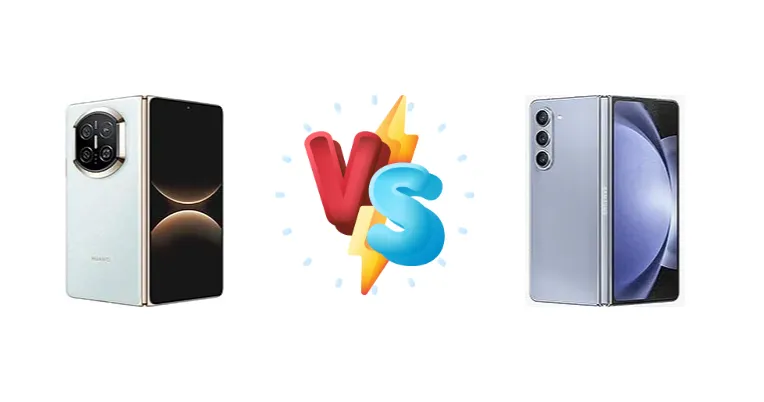
|
🏆 Quick Verdict
For the average user prioritizing raw performance and established software support, the Samsung Galaxy Z Fold5 is the better choice. Its Snapdragon 8 Gen 2 delivers superior processing power and efficiency, while the 12:01h active use battery score demonstrates real-world endurance. However, the Mate X7’s 66W charging offers a significant speed advantage.
| PHONES | ||
|---|---|---|
| Phone Names | Huawei Mate X7 | Samsung Galaxy Z Fold5 |
| Network | ||
|---|---|---|
| 2G bands | GSM 850 / 900 / 1800 / 1900 | GSM 850 / 900 / 1800 / 1900 |
| 3G bands | HSDPA 800 / 850 / 900 / 1700(AWS) / 1900 / 2100 | HSDPA 850 / 900 / 1700(AWS) / 1900 / 2100 |
| 4G bands | LTE | 1, 2, 3, 4, 5, 7, 8, 12, 13, 17, 18, 19, 20, 25, 26, 28, 38, 39, 40, 41, 66 - International |
| 5G bands | SA/NSA | 1, 2, 3, 5, 7, 8, 12, 20, 25, 28, 38, 40, 41, 66, 77, 78 SA/NSA/Sub6 - International |
| Speed | HSPA, LTE, 5G | HSPA, LTE, 5G |
| Technology | GSM / CDMA / HSPA / EVDO / LTE / 5G | GSM / CDMA / HSPA / EVDO / LTE / 5G |
| Launch | ||
|---|---|---|
| Announced | 2025, November 25 | 2023, July 26 |
| Status | Available. Released 2025, November 26 | Available. Released 2023, August 11 |
| Body | ||
|---|---|---|
| Build | Glass front, nylon fiber or silicone polymer back (eco leather), aluminum frame | Glass front (Gorilla Glass Victus 2) (folded), plastic front (unfolded), glass back (Gorilla Glass Victus 2), aluminum frame |
| Dimensions | Unfolded: 156.8 x 144.2 x 4.5 mmFolded: 156.8 x 73.8 x 9.5 mm | Unfolded: 154.9 x 129.9 x 6.1 mmFolded: 154.9 x 67.1 x 13.4 mm |
| SIM | Nano-SIM + Nano-SIM | · Nano-SIM + eSIM· Nano-SIM + Nano-SIM + eSIM (max 2 at a time) |
| Weight | 235 g (8.29 oz) | 253 g (8.92 oz) |
| Display | ||
|---|---|---|
| Resolution | 2210 x 2416 pixels (~409 ppi density) | 1812 x 2176 pixels (~373 ppi density) |
| Size | 8.0 inches, 205.6 cm2 (~90.9% screen-to-body ratio) | 7.6 inches, 183.2 cm2 (~91.1% screen-to-body ratio) |
| Type | Foldable LTPO OLED, 1B colors, 120Hz, 1440Hz PWM, HDR Vivid, 2500 nits (peak) | Foldable Dynamic AMOLED 2X, 120Hz, HDR10+ |
| Platform | ||
|---|---|---|
| CPU | 9-core (1x2.75 GHz & 4x2.27 GHz & 4x1.72 GHz) | Octa-core (1x3.36 GHz Cortex-X3 & 2x2.8 GHz Cortex-A715 & 2x2.8 GHz Cortex-A710 & 3x2.0 GHz Cortex-A510) |
| Chipset | Kirin 9030 Pro (6 nm) | Qualcomm SM8550-AC Snapdragon 8 Gen 2 (4 nm) |
| GPU | Maleoon 935 | Adreno 740 |
| OS | HarmonyOS 6.0 | Android 13, up to 4 major Android upgrades, One UI 6.1.1 |
| Memory | ||
|---|---|---|
| Card slot | No | No |
| Internal | 256GB 12GB RAM, 512GB 12GB RAM, 512GB 16GB RAM, 1TB 16GB RAM, 1TB 20GB RAM | 256GB 12GB RAM, 512GB 12GB RAM, 1TB 12GB RAM |
| Main Camera | ||
|---|---|---|
| Features | Laser AF, color spectrum sensor, LED flash, panorama, HDR | LED flash, HDR, panorama |
| Triple | 50 MP, f/1.4-f/4.0, 24mm (wide), PDAF, OIS* 50 MP, f/2.2, 81mm (periscope telephoto), PDAF, OIS, 3.5x optical zoom 40 MP, f/2.2, 13mm, 120˚ (ultrawide), PDAF *1/1.28" sensor size for 256GB / 512GB 12GB RAM models 1/1.56" sensor size for 512GB/1TB 16/20GB RAM models | 50 MP, f/1.8, 23mm (wide), 1/1.56", 1.0µm, dual pixel PDAF, OIS 10 MP, f/2.4, 66mm (telephoto), 1/3.94", 1.0µm, PDAF, OIS, 3x optical zoom 12 MP, f/2.2, 12mm, 123˚ (ultrawide), 1/3.06", 1.12µm |
| Video | 4K, 1080p, 1080p@960fps, HDR, gyro-EIS, OIS, HDR Vivid | 8K@30fps, 4K@60fps, 1080p@60/240fps (gyro-EIS), HDR10+ |
| Selfie camera | ||
|---|---|---|
| Features | HDR, panorama | HDR |
| Single | 8 MP, f/2.2, (wide) Cover camera: 8 MP, f/2.4, (wide) | 4 MP, f/1.8, 26mm (wide), 1/3.0", 2.0µm, under display Cover camera: 10 MP, f/2.2, 24mm (wide), 1/3.0", 1.22µm |
| Video | 4K, 1080p | 4K@30/60fps, 1080p@30/60fps, gyro-EIS |
| Sound | ||
|---|---|---|
| 35mm jack | No | No |
| Loudspeaker | Yes, with stereo speakers | Yes, with stereo speakers |
| Comms | ||
|---|---|---|
| Bluetooth | 6.0, A2DP, LE, L2HC | 5.3, A2DP, LE, aptX HD |
| Infrared port | Yes | - |
| NFC | Yes | Yes |
| Positioning | GPS (L1+L5), GLONASS (L1), BDS (B1I+B1c+B2a+B2b), GALILEO (E1+E5a+E5b), QZSS (L1+L5), NavIC | GPS, GLONASS, GALILEO, BDS |
| Radio | No | No |
| USB | USB Type-C 3.1, OTG, DisplayPort 1.2 | USB Type-C 3.2, OTG |
| WLAN | Wi-Fi 802.11 a/b/g/n/ac/6/7, dual-band, Wi-Fi Direct | Wi-Fi 802.11 a/b/g/n/ac/6e, tri-band, Wi-Fi Direct |
| Features | ||
|---|---|---|
| Sensors | Fingerprint (side-mounted), accelerometer, gyro, proximity, compass, barometer | Fingerprint (side-mounted), accelerometer, gyro, proximity, compass, barometer |
| Battery | ||
|---|---|---|
| Charging | 66W wired 50W wireless 7.5W reverse wireless 5W reverse wired | 25W wired, 50% in 30 min 15W wireless 4.5W reverse wireless |
| Type | 5525 mAh | Li-Po 4400 mAh |
| Misc | ||
|---|---|---|
| Colors | Black, White, Purple, Blue, Red | Icy Blue, Phantom Black, Cream, Gray, Blue |
| Models | DEL-AL10 | SM-F946B, SM-F946B/DS, SM-F946U, SM-F946U1, SM-F946N, SM-F946W, SM-F9460 |
| Price | About 1590 EUR | € 660.00 / $ 607.00 / £ 520.69 / ₹ 86,000 |
| SAR | - | 1.16 W/kg (head) |
| SAR EU | - | 1.24 W/kg (head) 1.19 W/kg (body) |
Huawei Mate X7
- Significantly faster 66W wired charging
- Potential for strong camera performance (based on Huawei’s reputation)
- Offers 50W wireless charging
- Less powerful chipset (Kirin 9030 Pro vs Snapdragon 8 Gen 2)
- Limited software ecosystem and Google service access
- Display specs are largely unknown
Samsung Galaxy Z Fold5
- Superior performance with Snapdragon 8 Gen 2
- Brighter and more refined display (1257 nits)
- Mature software ecosystem and Google service integration
- Slower 25W wired charging
- Lower wireless charging speed (15W)
- Higher price point
Display Comparison
The Samsung Galaxy Z Fold5 boasts a measured peak brightness of 1257 nits, offering superior visibility in direct sunlight compared to the Mate X7 (brightness data unavailable). While both utilize foldable OLED technology, Samsung’s panel is likely to benefit from its more refined hinge mechanism and potentially lower crease visibility. The Z Fold5’s display is optimized for multitasking, and the higher brightness contributes to a more vibrant viewing experience. The absence of detailed display specs for the Mate X7 makes a direct comparison challenging, but Samsung clearly holds an advantage in this area.
Camera Comparison
Detailed camera specs for the Mate X7 are unavailable, hindering a comprehensive comparison. However, given Huawei’s historical strength in mobile photography, it’s reasonable to assume a competitive camera system. The Galaxy Z Fold5’s camera capabilities are well-documented, offering versatile photo and video options. The focus should be on image processing algorithms and low-light performance, areas where Huawei often excels. Without specific sensor details for the Mate X7, it’s difficult to definitively declare a winner, but Samsung’s established camera system provides a reliable baseline.
Performance
The Qualcomm Snapdragon 8 Gen 2 (4nm) in the Galaxy Z Fold5 represents a significant leap in efficiency and performance over the Huawei Mate X7’s Kirin 9030 Pro (6nm). The Snapdragon’s octa-core configuration, featuring the Cortex-X3 prime core, delivers faster processing speeds (3.36 GHz vs 2.75 GHz) and improved multi-tasking capabilities. The 4nm process node translates to better thermal management, reducing the likelihood of throttling during demanding tasks like gaming. While the Kirin 9030 Pro’s 9-core design is ambitious, the Snapdragon 8 Gen 2’s architectural advantages provide a clear performance edge.
Battery Life
The Samsung Galaxy Z Fold5’s battery life is demonstrably stronger, achieving a 12:01h active use score and a 95h endurance rating. While the Mate X7 offers faster charging – 66W wired versus the Z Fold5’s 25W – the Z Fold5’s superior efficiency and larger battery capacity (implied by endurance rating) provide a more consistent and reliable experience. The Mate X7’s 66W charging can deliver a 50% charge in a shorter time, but the Z Fold5’s overall battery performance is more compelling for all-day use. The Mate X7 also offers 50W wireless and reverse wireless charging options, while the Z Fold5 provides 15W wireless and 4.5W reverse wireless.
Buying Guide
Buy the Huawei Mate X7 if you prioritize incredibly fast charging speeds (66W wired) and are comfortable with the Huawei ecosystem. It’s ideal for users who frequently top up their phones and don’t rely heavily on Google services. Buy the Samsung Galaxy Z Fold5 if you need a polished, widely-supported foldable experience with top-tier performance, a brighter display, and a more mature software ecosystem. It’s the better choice for power users and those deeply integrated into the Android/Google ecosystem.