
Huawei Mate X7 vs. Samsung Galaxy Z Fold4: A Deep Dive into Foldable Flagships
| Phones Images | |||||
|---|---|---|---|---|---|
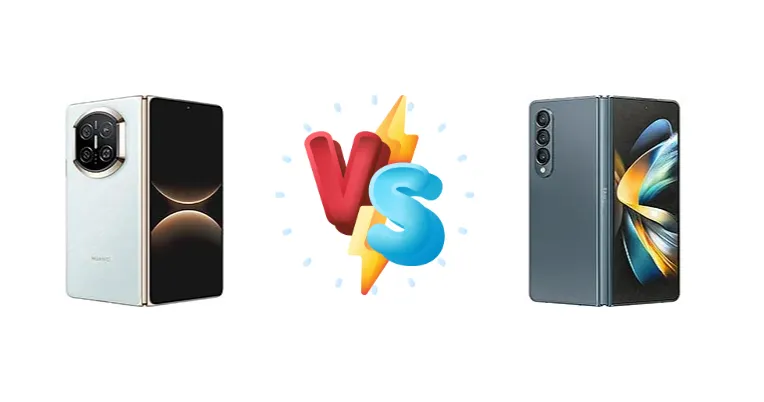
|
🏆 Quick Verdict
For the average user prioritizing raw performance and established software support, the Samsung Galaxy Z Fold4 emerges as the winner. Its Snapdragon 8+ Gen 1 delivers a more consistent experience, and the 101-hour endurance rating provides peace of mind. However, the Mate X7’s faster 66W charging is a compelling advantage for those who value speed.
| PHONES | ||
|---|---|---|
| Phone Names | Huawei Mate X7 | Samsung Galaxy Z Fold4 |
| Network | ||
|---|---|---|
| 2G bands | GSM 850 / 900 / 1800 / 1900 | GSM 850 / 900 / 1800 / 1900 |
| 3G bands | HSDPA 800 / 850 / 900 / 1700(AWS) / 1900 / 2100 | HSDPA 850 / 900 / 1700(AWS) / 1900 / 2100 |
| 4G bands | LTE | 1, 2, 3, 4, 5, 7, 8, 12, 13, 17, 18, 19, 20, 25, 26, 28, 32, 38, 39, 40, 41, 66 - International |
| 5G bands | SA/NSA | 1, 2, 3, 5, 7, 8, 12, 20, 25, 28, 38, 40, 41, 66, 75, 77, 78 SA/NSA/Sub6 - International |
| Speed | HSPA, LTE, 5G | HSPA 42.2/5.76 Mbps, LTE (7CA) Cat20 2000/200 Mbps, 5G |
| Technology | GSM / CDMA / HSPA / EVDO / LTE / 5G | GSM / CDMA / HSPA / EVDO / LTE / 5G |
| - | CDMA2000 1xEV-DO | |
| Launch | ||
|---|---|---|
| Announced | 2025, November 25 | 2022, August 10 |
| Status | Available. Released 2025, November 26 | Available. Released 2022, August 25 |
| Body | ||
|---|---|---|
| Build | Glass front, nylon fiber or silicone polymer back (eco leather), aluminum frame | Glass front (Gorilla Glass Victus+) (folded), plastic front (unfolded), glass back (Gorilla Glass Victus+), aluminum frame |
| Dimensions | Unfolded: 156.8 x 144.2 x 4.5 mmFolded: 156.8 x 73.8 x 9.5 mm | Unfolded: 155.1 x 130.1 x 6.3 mmFolded: 155.1 x 67.1 x 14.2-15.8 mm |
| SIM | Nano-SIM + Nano-SIM | · Nano-SIM + eSIM· Nano-SIM + Nano-SIM + eSIM (max 2 at a time) |
| Weight | 235 g (8.29 oz) | 263 g (9.28 oz) |
| - | IPX8 water resistant (up to 1.5m for 30 min) Armor aluminum frame with tougher drop and scratch resistance (advertised) Stylus support | |
| Display | ||
|---|---|---|
| Resolution | 2210 x 2416 pixels (~409 ppi density) | 1812 x 2176 pixels (~373 ppi density) |
| Size | 8.0 inches, 205.6 cm2 (~90.9% screen-to-body ratio) | 7.6 inches, 183.2 cm2 (~90.9% screen-to-body ratio) |
| Type | Foldable LTPO OLED, 1B colors, 120Hz, 1440Hz PWM, HDR Vivid, 2500 nits (peak) | Foldable Dynamic AMOLED 2X, 120Hz, HDR10+, 1200 nits (peak) |
| - | Cover display: Dynamic AMOLED 2X, 120Hz, Corning Gorilla Glass Victus+ 6.2 inches, 904 x 2316 pixels, 23.1:9 ratio | |
| Platform | ||
|---|---|---|
| CPU | 9-core (1x2.75 GHz & 4x2.27 GHz & 4x1.72 GHz) | Octa-core (1x3.19 GHz Cortex-X2 & 3x2.75 GHz Cortex-A710 & 4x1.80 GHz Cortex-A510) |
| Chipset | Kirin 9030 Pro (6 nm) | Qualcomm SM8475 Snapdragon 8+ Gen 1 (4 nm) |
| GPU | Maleoon 935 | Adreno 730 |
| OS | HarmonyOS 6.0 | Android 12L, up to 4 major Android upgrades, One UI 6.1.1 |
| Memory | ||
|---|---|---|
| Card slot | No | No |
| Internal | 256GB 12GB RAM, 512GB 12GB RAM, 512GB 16GB RAM, 1TB 16GB RAM, 1TB 20GB RAM | 256GB 12GB RAM, 512GB 12GB RAM, 1TB 12GB RAM |
| - | UFS 3.1 | |
| Main Camera | ||
|---|---|---|
| Features | Laser AF, color spectrum sensor, LED flash, panorama, HDR | LED flash, HDR, panorama |
| Triple | 50 MP, f/1.4-f/4.0, 24mm (wide), PDAF, OIS* 50 MP, f/2.2, 81mm (periscope telephoto), PDAF, OIS, 3.5x optical zoom 40 MP, f/2.2, 13mm, 120˚ (ultrawide), PDAF *1/1.28" sensor size for 256GB / 512GB 12GB RAM models 1/1.56" sensor size for 512GB/1TB 16/20GB RAM models | 50 MP, f/1.8, 23mm (wide), 1/1.56", 1.0µm, dual pixel PDAF, OIS 10 MP, f/2.4, 66mm (telephoto), 1/3.94", 1.0µm, PDAF, OIS, 3x optical zoom 12 MP, f/2.2, 12mm, 123˚ (ultrawide), 1/3.06", 1.12µm |
| Video | 4K, 1080p, 1080p@960fps, HDR, gyro-EIS, OIS, HDR Vivid | 8K@24fps, 4K@60fps, 1080p@60/240fps (gyro-EIS), HDR10+ |
| Selfie camera | ||
|---|---|---|
| Features | HDR, panorama | HDR |
| Single | 8 MP, f/2.2, (wide) Cover camera: 8 MP, f/2.4, (wide) | 4 MP, f/1.8, 26mm (wide), 1/3.0", 2.0µm, under display Cover camera: 10 MP, f/2.2, 24mm (wide), 1/3.0", 1.22µm |
| Video | 4K, 1080p | 4K@30/60fps, 1080p@30/60fps, gyro-EIS |
| Sound | ||
|---|---|---|
| 3.5mm jack | - | No |
| 35mm jack | No | No |
| Loudspeaker | Yes, with stereo speakers | Yes, with stereo speakers |
| - | 32-bit/384kHz audio Tuned by AKG | |
| Comms | ||
|---|---|---|
| Bluetooth | 6.0, A2DP, LE, L2HC | 5.2, A2DP, LE, aptX HD |
| Infrared port | Yes | - |
| NFC | Yes | Yes |
| Positioning | GPS (L1+L5), GLONASS (L1), BDS (B1I+B1c+B2a+B2b), GALILEO (E1+E5a+E5b), QZSS (L1+L5), NavIC | GPS, GLONASS, GALILEO, BDS |
| Radio | No | No |
| USB | USB Type-C 3.1, OTG, DisplayPort 1.2 | USB Type-C 3.2, OTG |
| WLAN | Wi-Fi 802.11 a/b/g/n/ac/6/7, dual-band, Wi-Fi Direct | Wi-Fi 802.11 a/b/g/n/ac/6e, dual-band, Wi-Fi Direct |
| Features | ||
|---|---|---|
| Sensors | Fingerprint (side-mounted), accelerometer, gyro, proximity, compass, barometer | Fingerprint (side-mounted), accelerometer, gyro, proximity, compass, barometer |
| - | Bixby natural language commands and dictation Samsung DeX (desktop experience support) Samsung Pay (Visa, MasterCard certified) Ultra Wideband (UWB) support | |
| Battery | ||
|---|---|---|
| Charging | 66W wired 50W wireless 7.5W reverse wireless 5W reverse wired | 25W wired, 50% in 30 min 15W wireless 4.5W reverse wireless |
| Type | 5525 mAh | Li-Po 4400 mAh |
| Misc | ||
|---|---|---|
| Colors | Black, White, Purple, Blue, Red | Graygreen, Phantom Black, Beige, Burgundy |
| Models | DEL-AL10 | SM-F936B, SM-F936B/DS, SM-F936U, SM-F936U1, SM-F936N, SM-F936W, SM-F9360 |
| Price | About 1590 EUR | $ 457.00 / € 511.80 / £ 485.00 / ₹ 73,899 |
| SAR | - | 0.96 W/kg (head) 0.92 W/kg (body) |
| SAR EU | - | 1.30 W/kg (head) 1.51 W/kg (body) |
| Tests | ||
|---|---|---|
| Battery life | - | Endurance rating 101h |
| Camera | - | Photo / Video |
| Display | - | Contrast ratio: Infinite (nominal) |
| Loudspeaker | - | -28.3 LUFS (Average) |
| Performance | - | AnTuTu: 964530 (v9) GeekBench: 3981 (v5.1) GFXBench: 43fps (ES 3.1 onscreen) |
Huawei Mate X7
- Significantly faster 66W wired charging
- Faster 50W wireless charging
- Potentially more versatile reverse wireless charging options
- Less efficient 6nm Kirin 9030 Pro chipset
- Software ecosystem limitations compared to Samsung
- Limited information on display specifications
Samsung Galaxy Z Fold4
- More efficient 4nm Snapdragon 8+ Gen 1 chipset
- Excellent 101-hour battery endurance
- Refined software experience and long-term support
- Slower 25W wired charging
- Slower 15W wireless charging
- Higher price point (typically)
Display Comparison
Both devices feature foldable displays, but the specifics differ. The Galaxy Z Fold4 boasts a measured peak brightness of 1000 nits, ensuring excellent visibility even outdoors. While the Mate X7’s display specs aren’t provided, Huawei typically focuses on color accuracy in its flagship devices. The Z Fold4’s ‘Infinite’ contrast ratio suggests a superior viewing experience with deeper blacks. The hinge mechanism and crease visibility are critical factors, but without direct comparison data, it’s difficult to definitively declare a winner. The Z Fold4’s display is likely more refined due to Samsung’s longer experience in foldable display technology.
Camera Comparison
Both phones offer capable camera systems, but detailed specifications are limited. Both are listed as having Photo/Video capabilities. The Z Fold4 likely benefits from Samsung’s advanced image processing algorithms and potentially larger sensor sizes, though this is speculative without specific sensor details. The Mate X7’s camera performance will depend heavily on Huawei’s computational photography expertise. Without knowing sensor sizes, apertures, or OIS implementation, a definitive camera comparison is impossible. We can assume both phones will deliver excellent results in good lighting conditions, but the Z Fold4 likely holds an edge in low-light performance due to Samsung’s established camera technology.
Performance
The core of the performance difference lies in the chipsets. The Samsung Galaxy Z Fold4’s Qualcomm SM8475 Snapdragon 8+ Gen 1 (4nm) is built on a more efficient node than the Huawei Mate X7’s Kirin 9030 Pro (6nm). This translates to better thermal management and sustained performance under load. The Snapdragon 8+ Gen 1’s octa-core configuration, with a Cortex-X2 prime core clocked at 3.19 GHz, provides a performance edge over the Kirin 9030 Pro’s 9-core setup. While the Kirin 9030 Pro is a capable chip, the Snapdragon 8+ Gen 1’s superior architecture and efficiency give the Z Fold4 a clear advantage in demanding tasks like gaming and video editing.
Battery Life
The Galaxy Z Fold4’s endurance rating of 101 hours suggests excellent battery life, despite not having a massive battery capacity. This is likely due to the efficiency of the Snapdragon 8+ Gen 1 and Samsung’s software optimizations. The Mate X7 offers faster charging with 66W wired, significantly quicker than the Z Fold4’s 25W wired charging. The Mate X7 also supports 50W wireless charging, a substantial upgrade over the Z Fold4’s 15W wireless charging. While the Z Fold4 excels in longevity, the Mate X7 prioritizes charging speed, allowing users to quickly replenish the battery when needed. The 7.5W and 5W reverse wireless charging options on the Mate X7 are also more versatile than the Z Fold4’s 4.5W reverse wireless.
Buying Guide
Buy the Huawei Mate X7 if you prioritize incredibly fast charging speeds (66W) and are comfortable with the Huawei ecosystem. It’s ideal for users who frequently need to top up their battery quickly. Buy the Samsung Galaxy Z Fold4 if you value a more refined software experience, consistently high performance thanks to the Snapdragon 8+ Gen 1, and a proven track record of software updates. It’s the better choice for power users and those heavily invested in the Android ecosystem.