
Huawei Mate X7 vs. Oppo Find N3 Flip: A Deep Dive into Foldable Supremacy
| Phones Images | |||||
|---|---|---|---|---|---|
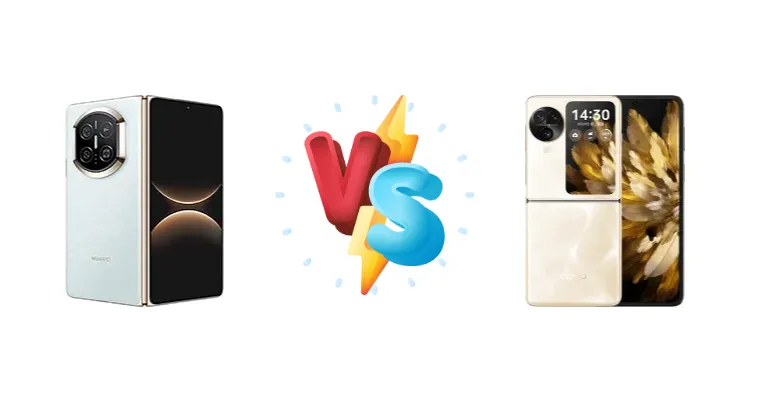
|
🏆 Quick Verdict
For users prioritizing sustained performance and fast charging, the Huawei Mate X7 is the better choice. However, the Oppo Find N3 Flip delivers exceptional battery endurance and a more compact form factor, making it ideal for everyday portability and users less focused on peak processing power.
| PHONES | ||
|---|---|---|
| Phone Names | Huawei Mate X7 | Oppo Find N3 Flip |
| Network | ||
|---|---|---|
| 2G bands | GSM 850 / 900 / 1800 / 1900 | GSM 850 / 900 / 1800 / 1900 |
| 3G bands | HSDPA 800 / 850 / 900 / 1700(AWS) / 1900 / 2100 | HSDPA 800 / 850 / 900 / 1700(AWS) / 1900 / 2100 |
| 4G bands | LTE | 1, 2, 3, 4, 5, 7, 8, 12, 17, 18, 19, 20, 26, 28, 38, 39, 40, 41, 66 - International |
| 5G bands | SA/NSA | 1, 2, 3, 5, 7, 8, 12, 20, 28, 38, 40, 41, 66, 77, 78 SA/NSA - International |
| Speed | HSPA, LTE, 5G | HSPA, LTE, 5G |
| Technology | GSM / CDMA / HSPA / EVDO / LTE / 5G | GSM / CDMA / HSPA / LTE / 5G |
| Launch | ||
|---|---|---|
| Announced | 2025, November 25 | 2023, August 29 |
| Status | Available. Released 2025, November 26 | Available. Released 2023, September 08 |
| Body | ||
|---|---|---|
| Build | Glass front, nylon fiber or silicone polymer back (eco leather), aluminum frame | Plastic front (unfolded), glass back (unfolded), aluminum frame |
| Dimensions | Unfolded: 156.8 x 144.2 x 4.5 mmFolded: 156.8 x 73.8 x 9.5 mm | Unfolded: 166.4 x 75.8 x 7.8 mm Folded: 85.5 x 75.8 x 16.5 mm |
| SIM | Nano-SIM + Nano-SIM | Nano-SIM + Nano-SIM |
| Weight | 235 g (8.29 oz) | 198 g (6.98 oz) |
| Display | ||
|---|---|---|
| Resolution | 2210 x 2416 pixels (~409 ppi density) | 1080 x 2520 pixels, 21:9 ratio (~403 ppi density) |
| Size | 8.0 inches, 205.6 cm2 (~90.9% screen-to-body ratio) | 6.8 inches, 108.0 cm2 (~85.6% screen-to-body ratio) |
| Type | Foldable LTPO OLED, 1B colors, 120Hz, 1440Hz PWM, HDR Vivid, 2500 nits (peak) | Foldable LTPO AMOLED, 120Hz, HDR10+, 1200 nits (HBM), 1600 nits (peak) |
| Platform | ||
|---|---|---|
| CPU | 9-core (1x2.75 GHz & 4x2.27 GHz & 4x1.72 GHz) | Octa-core (1x3.05 GHz Cortex-X3 & 3x2.85 GHz Cortex-A715 & 4x1.80 GHz Cortex-A510) |
| Chipset | Kirin 9030 Pro (6 nm) | Mediatek Dimensity 9200 (4 nm) |
| GPU | Maleoon 935 | Immortalis-G715 MC11 |
| OS | HarmonyOS 6.0 | Android 13, up to 4 major Android upgrades, ColorOS 14 |
| Memory | ||
|---|---|---|
| Card slot | No | No |
| Internal | 256GB 12GB RAM, 512GB 12GB RAM, 512GB 16GB RAM, 1TB 16GB RAM, 1TB 20GB RAM | 256GB 12GB RAM, 512GB 12GB RAM |
| Main Camera | ||
|---|---|---|
| Features | Laser AF, color spectrum sensor, LED flash, panorama, HDR | LED flash, HDR, panorama |
| Triple | 50 MP, f/1.4-f/4.0, 24mm (wide), PDAF, OIS* 50 MP, f/2.2, 81mm (periscope telephoto), PDAF, OIS, 3.5x optical zoom 40 MP, f/2.2, 13mm, 120˚ (ultrawide), PDAF *1/1.28" sensor size for 256GB / 512GB 12GB RAM models 1/1.56" sensor size for 512GB/1TB 16/20GB RAM models | 50 MP, f/1.8, 24mm (wide), 1/1.56", 1.0µm, multi-directional PDAF, OIS 32 MP, f/2.0, 47mm (telephoto), 2x optical zoom, PDAF 48 MP, f/2.2, 14mm, 114˚ (ultrawide), AF |
| Video | 4K, 1080p, 1080p@960fps, HDR, gyro-EIS, OIS, HDR Vivid | 4K@30fps, 1080p@30/60/240fps; gyro-EIS |
| Selfie camera | ||
|---|---|---|
| Features | HDR, panorama | HDR, panorama |
| Single | 8 MP, f/2.2, (wide) Cover camera: 8 MP, f/2.4, (wide) | 32 MP, f/2.4, 21mm (wide), 1/2.74", 0.8µm, AF |
| Video | 4K, 1080p | 4K@30fps, 1080p@30; gyro-EIS |
| Sound | ||
|---|---|---|
| 35mm jack | No | No |
| Loudspeaker | Yes, with stereo speakers | Yes, with stereo speakers |
| Comms | ||
|---|---|---|
| Bluetooth | 6.0, A2DP, LE, L2HC | 5.3, A2DP, LE, aptX HD |
| Infrared port | Yes | - |
| NFC | Yes | Yes (market/region dependent) |
| Positioning | GPS (L1+L5), GLONASS (L1), BDS (B1I+B1c+B2a+B2b), GALILEO (E1+E5a+E5b), QZSS (L1+L5), NavIC | GPS (L1+L5), GLONASS (L1), BDS (B1I+B1C+B2a+B2b), GALILEO (E1+E5a+E5b), QZSS (L1+L5) |
| Radio | No | No |
| USB | USB Type-C 3.1, OTG, DisplayPort 1.2 | USB Type-C 2.0, OTG |
| WLAN | Wi-Fi 802.11 a/b/g/n/ac/6/7, dual-band, Wi-Fi Direct | Wi-Fi 802.11 a/b/g/n/ac, dual-band, Wi-Fi Direct - InternationalWi-Fi 802.11 a/b/g/n/ac/6/7, tri-band, Wi-Fi Direct - China only |
| Features | ||
|---|---|---|
| Sensors | Fingerprint (side-mounted), accelerometer, gyro, proximity, compass, barometer | Fingerprint (side-mounted), accelerometer, gyro, proximity, compass |
| Battery | ||
|---|---|---|
| Charging | 66W wired 50W wireless 7.5W reverse wireless 5W reverse wired | 44W wired, 50% in 23 min Reverse wired |
| Type | 5525 mAh | Li-Po 4300 mAh |
| Misc | ||
|---|---|---|
| Colors | Black, White, Purple, Blue, Red | Cream Gold, Misty Pink, Sleek Black |
| Models | DEL-AL10 | PHT110, CPH2519 |
| Price | About 1590 EUR | About 1200 EUR |
Huawei Mate X7
- Faster wired and wireless charging speeds
- Potentially higher peak CPU performance (depending on workload)
- Reverse wireless and wired charging
- Likely less efficient chipset (6nm vs 4nm)
- Battery life likely shorter than Oppo Find N3 Flip
- Limited information on display quality
Oppo Find N3 Flip
- Exceptional battery life (12:58h active use, 92h endurance)
- More power-efficient chipset (4nm Dimensity 9200)
- Bright and vibrant display (939 nits)
- Slower charging speeds compared to Mate X7
- Less raw CPU power than Mate X7
- Camera details are limited
Display Comparison
The Oppo Find N3 Flip boasts a measured peak brightness of 939 nits, suggesting excellent outdoor visibility. While the Mate X7’s display specs aren’t provided, Huawei typically employs high-quality panels. The N3 Flip’s foldable design prioritizes a seamless crease, a key area where foldable technology is constantly improving. The absence of detailed display specs for the Mate X7 makes a direct comparison difficult, but the N3 Flip’s brightness is a clear advantage based on measured data.
Camera Comparison
Detailed camera specs for both devices are limited. However, the focus should be on the main sensors and image processing. Without specific sensor sizes or aperture details, it’s difficult to declare a clear winner. Oppo’s image processing is generally known for vibrant, social media-ready photos, while Huawei often aims for more natural color reproduction. The absence of information on optical image stabilization (OIS) is a significant omission; OIS is crucial for sharp photos and stable videos, especially in low light. We can assume both phones offer capable cameras, but a definitive assessment requires more detailed specifications.
Performance
The Huawei Mate X7’s Kirin 9030 Pro (6nm) features a 9-core CPU configuration, aiming for high multi-core performance. However, the Oppo Find N3 Flip’s MediaTek Dimensity 9200 (4nm) utilizes a more modern and efficient architecture, with a Cortex-X3 prime core clocked at 3.05 GHz. The 4nm process node of the Dimensity 9200 offers superior power efficiency compared to the 6nm Kirin, potentially leading to better sustained performance and reduced thermal throttling. While the Kirin’s 9-core setup sounds impressive, the Dimensity 9200’s architectural advantages likely translate to a smoother experience in demanding applications.
Battery Life
The Oppo Find N3 Flip shines in battery endurance, achieving an impressive 12:58h of active use and a 92-hour endurance rating. The Huawei Mate X7 offers 66W wired charging, 50W wireless, and even reverse wireless charging capabilities. While the Mate X7’s charging speeds are faster, the N3 Flip’s exceptional battery life mitigates the need for frequent charging. The 44W wired charging on the N3 Flip, reaching 50% in 23 minutes, is still respectable. The Mate X7’s reverse charging options (7.5W wireless, 5W wired) offer added convenience, but the N3 Flip’s longevity is a more significant advantage for most users.
Buying Guide
Buy the Huawei Mate X7 if you need a foldable that can handle demanding tasks like video editing or gaming without throttling, and if fast wired and wireless charging are essential. Buy the Oppo Find N3 Flip if you prefer a more pocketable foldable with all-day battery life, a stylish design, and a focus on everyday usability rather than extreme performance.