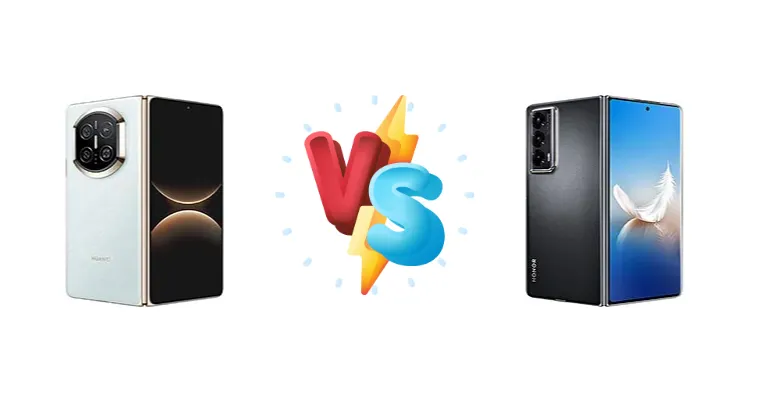
The foldable phone market is maturing, with Huawei and Honor offering compelling options. The Huawei Mate X7, powered by its in-house Kirin 9030 Pro, faces off against the Honor Magic Vs2, leveraging the Qualcomm Snapdragon 8+ Gen 1. This comparison dissects the core differences to help you choose the foldable that best suits your needs.
🏆 Quick Verdict
For most users, the Honor Magic Vs2 emerges as the stronger choice. The Snapdragon 8+ Gen 1’s 4nm process provides a noticeable efficiency advantage, translating to better sustained performance and potentially longer battery life, despite the Mate X7’s larger battery capacity. While Huawei’s software experience is refined, the raw power and thermal management of the Snapdragon give the Magic Vs2 the edge.
| Network |
|---|
| 2G bands | GSM 850 / 900 / 1800 / 1900 | GSM 850 / 900 / 1800 / 1900 |
| 3G bands | HSDPA 800 / 850 / 900 / 1700(AWS) / 1900 / 2100 | HSDPA 800 / 850 / 900 / 1700(AWS) / 1900 / 2100 |
| 4G bands | LTE | LTE |
| 5G bands | SA/NSA | SA/NSA |
| Speed | HSPA, LTE, 5G | HSPA, LTE, 5G |
| Technology | GSM / CDMA / HSPA / EVDO / LTE / 5G | GSM / CDMA / HSPA / CDMA2000 / LTE / 5G |
| Launch |
|---|
| Announced | 2025, November 25 | 2023, October 12 |
| Status | Available. Released 2025, November 26 | Available. Released 2023, October 17 |
| Body |
|---|
| Build | Glass front, nylon fiber or silicone polymer back (eco leather), aluminum frame | Glass front, glass back or eco leather back, magnesium alloy frame, titanium alloy folding mechanism |
| Dimensions | Unfolded: 156.8 x 144.2 x 4.5 mmFolded: 156.8 x 73.8 x 9.5 mm | Unfolded: 157.5 x 146.2 x 5.1 mmFolded: 157.5 x 74.4 x 10.7 mm |
| SIM | Nano-SIM + Nano-SIM | Nano-SIM + Nano-SIM |
| Weight | 235 g (8.29 oz) | 229 g (8.08 oz) |
| Display |
|---|
| Resolution | 2210 x 2416 pixels (~409 ppi density) | 2156 x 2344 pixels (~402 ppi density) |
| Size | 8.0 inches, 205.6 cm2 (~90.9% screen-to-body ratio) | 7.92 inches, 201.6 cm2 (~87.6% screen-to-body ratio) |
| Type | Foldable LTPO OLED, 1B colors, 120Hz, 1440Hz PWM, HDR Vivid, 2500 nits (peak) | Foldable LTPO OLED, 1B colors, 120Hz, HDR10+, Dolby Vision |
| Platform |
|---|
| CPU | 9-core (1x2.75 GHz & 4x2.27 GHz & 4x1.72 GHz) | Octa-core (1x3.0 GHz Cortex-X2 & 3x2.5 GHz Cortex-A710 & 4x1.80 GHz Cortex-A510) |
| Chipset | Kirin 9030 Pro (6 nm) | Qualcomm SM8475 Snapdragon 8+ Gen 1 (4 nm) |
| GPU | Maleoon 935 | Adreno 730 |
| OS | HarmonyOS 6.0 | Android 13, MagicOS 7.2 |
| Memory |
|---|
| Card slot | No | No |
| Internal | 256GB 12GB RAM, 512GB 12GB RAM, 512GB 16GB RAM, 1TB 16GB RAM, 1TB 20GB RAM | 256GB 12GB RAM, 512GB 16GB RAM |
| Main Camera |
|---|
| Features | Laser AF, color spectrum sensor, LED flash, panorama, HDR | LED flash, HDR, panorama |
| Triple | 50 MP, f/1.4-f/4.0, 24mm (wide), PDAF, OIS*
50 MP, f/2.2, 81mm (periscope telephoto), PDAF, OIS, 3.5x optical zoom
40 MP, f/2.2, 13mm, 120˚ (ultrawide), PDAF
*1/1.28" sensor size for 256GB / 512GB 12GB RAM models
1/1.56" sensor size for 512GB/1TB 16/20GB RAM models | 50 MP, f/1.9, 25mm (wide), PDAF
20 MP, f/2.4, 62mm (telephoto), PDAF, 2.5x optical zoom, OIS
12 MP, f/2.2, 16mm (ultrawide), AF |
| Video | 4K, 1080p, 1080p@960fps, HDR, gyro-EIS, OIS, HDR Vivid | 4K@30/60fps (10-bit), 1080p@30/60fps, gyro-EIS, HDR10+ |
| Selfie camera |
|---|
| Features | HDR, panorama | HDR |
| Single | 8 MP, f/2.2, (wide)
Cover camera:
8 MP, f/2.4, (wide) | 16 MP, f/2.2, (wide) |
| Video | 4K, 1080p | 4K@30fps, 1080p@30fps, gyro-EIS |
| Sound |
|---|
| 35mm jack | No | No |
| Loudspeaker | Yes, with stereo speakers | Yes, with stereo speakers |
| Comms |
|---|
| Bluetooth | 6.0, A2DP, LE, L2HC | 5.2, A2DP, LE, aptX HD |
| Infrared port | Yes | Yes |
| NFC | Yes | Yes |
| Positioning | GPS (L1+L5), GLONASS (L1), BDS (B1I+B1c+B2a+B2b), GALILEO (E1+E5a+E5b), QZSS (L1+L5), NavIC | GPS (L1+L5), GLONASS (L1), BDS (B1I+B1c+B2a), GALILEO (E1+E5a), QZSS (L1+L5) |
| Radio | No | No |
| USB | USB Type-C 3.1, OTG, DisplayPort 1.2 | USB Type-C 3.1, OTG, Display Port 1.2 |
| WLAN | Wi-Fi 802.11 a/b/g/n/ac/6/7, dual-band, Wi-Fi Direct | Wi-Fi 802.11 a/b/g/n/ac/6, dual-band, Wi-Fi Direct |
| Features |
|---|
| Sensors | Fingerprint (side-mounted), accelerometer, gyro, proximity, compass, barometer | Fingerprint (side-mounted), accelerometer, gyro, proximity, compass |
| Battery |
|---|
| Charging | 66W wired
50W wireless
7.5W reverse wireless
5W reverse wired | 66W wired
5W reverse wired |
| Type | 5525 mAh | Li-Po 5000 mAh |
| Misc |
|---|
| Colors | Black, White, Purple, Blue, Red | Black, Blue, Purple |
| Models | DEL-AL10 | VER-AN00 |
| Price | About 1590 EUR | About 910 EUR |
Huawei Mate X7
- Comprehensive charging options (wired, wireless, reverse)
- Potentially refined Huawei software experience
- 9-core CPU configuration offers multi-tasking potential
- Less efficient 6nm Kirin 9030 Pro chipset
- Potential for thermal throttling under sustained load
- Reliance on Huawei’s app ecosystem
Honor Magic Vs2
- Efficient 4nm Snapdragon 8+ Gen 1 chipset
- Superior sustained performance and thermal management
- Mature software optimization and gaming support
- Limited reverse charging options (wired only)
- May lack some of Huawei’s software refinements
- Dependence on Qualcomm’s ecosystem
Display Comparison
Both devices are expected to feature foldable OLED displays, but specific details like peak brightness and refresh rate are not provided. However, the foldable form factor inherently presents challenges with crease visibility and durability. The absence of LTPO information makes it difficult to assess power efficiency of the displays. The quality of the hinge mechanism, a critical aspect of foldable longevity, is also unknown without further testing.
Camera Comparison
Without specific camera sensor details, a direct comparison is limited. However, the chipset plays a role in image signal processing (ISP) capabilities. Qualcomm’s Snapdragon ISP is renowned for its advanced features and image quality. While Huawei’s Kirin chipsets also have capable ISPs, the Snapdragon’s wider adoption and optimization within the Android ecosystem give it an edge. The absence of information regarding OIS and lens apertures prevents a deeper analysis of potential camera performance differences.
Performance
The core difference lies in the chipset. The Honor Magic Vs2’s Qualcomm Snapdragon 8+ Gen 1 (4nm) boasts a more efficient architecture compared to the Huawei Mate X7’s Kirin 9030 Pro (6nm). The Snapdragon’s Cortex-X2 prime core, clocked at 3.0 GHz, offers a performance advantage over the Kirin’s 2.75 GHz core. While the Kirin utilizes a 9-core configuration, the Snapdragon’s optimized core arrangement and smaller node size likely result in superior sustained performance and reduced thermal throttling. The Magic Vs2 benefits from the Snapdragon’s mature software optimization and gaming support.
Battery Life
The Huawei Mate X7 offers a more comprehensive charging solution with 66W wired, 50W wireless, and both 7.5W reverse wireless and 5W reverse wired charging. The Honor Magic Vs2 matches the 66W wired charging but only offers 5W reverse wired. However, the Snapdragon 8+ Gen 1’s superior efficiency could offset the Mate X7’s potentially larger battery capacity (size not specified), resulting in comparable or even better real-world battery life for the Magic Vs2. The faster wireless charging on the Mate X7 is a clear advantage for users who frequently utilize this method.
Buying Guide
Buy the Huawei Mate X7 if you prioritize a potentially more refined software experience within the Huawei ecosystem and value the inclusion of both wired and wireless reverse charging. Buy the Honor Magic Vs2 if you demand peak performance for demanding tasks like gaming and video editing, and appreciate the efficiency of the Snapdragon 8+ Gen 1, leading to better thermal management and potentially longer real-world battery life.
Frequently Asked Questions
❓ Will the Kirin 9030 Pro struggle with graphically intensive games like Genshin Impact?
The Kirin 9030 Pro is a capable chipset, but the Snapdragon 8+ Gen 1 in the Honor Magic Vs2 is expected to deliver more consistent frame rates and lower temperatures during extended gaming sessions due to its more efficient 4nm process and optimized thermal design.
❓ How does the lack of Google Mobile Services (GMS) on the Huawei Mate X7 impact app availability?
The Huawei Mate X7 relies on Huawei Mobile Services (HMS) and the AppGallery. While many popular apps are available, some may require sideloading or using alternative versions, potentially impacting user convenience and app compatibility.
❓ Does the Honor Magic Vs2 support high refresh rate gaming?
While not explicitly stated, Snapdragon 8+ Gen 1-powered devices generally support high refresh rate gaming, and the Magic Vs2 is likely to offer a smooth gaming experience with compatible titles. However, sustained performance will depend on the device's thermal management capabilities.
❓ Is the 5W reverse wired charging on the Honor Magic Vs2 useful for charging accessories like earbuds?
While 5W reverse wired charging is slower than the Mate X7's options, it's sufficient for topping up smaller accessories like wireless earbuds or a smartwatch, providing a convenient emergency charging solution.