
Huawei Mate X6 vs Samsung Galaxy Z Fold6: A Deep Dive into Foldable Supremacy
| Phones Images | |||||
|---|---|---|---|---|---|
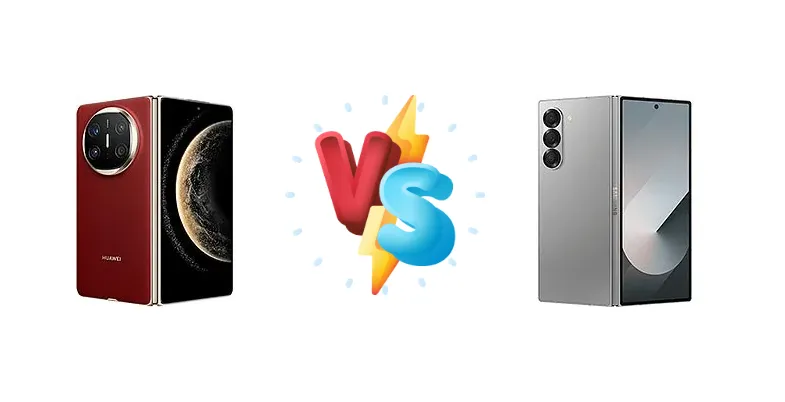
|
🏆 Quick Verdict
For the average user prioritizing longevity and a vibrant display, the Samsung Galaxy Z Fold6 emerges as the winner. Its significantly longer 11:31h active use battery life and 1630 nits peak brightness provide a more reliable and immersive experience. However, the Mate X6’s 66W charging offers a compelling advantage for those who value speed.
| PHONES | ||
|---|---|---|
| Phone Names | Huawei Mate X6 | Samsung Galaxy Z Fold6 |
| Network | ||
|---|---|---|
| 2G bands | GSM 850 / 900 / 1800 / 1900 | GSM 850 / 900 / 1800 / 1900 |
| 3G bands | HSDPA 800 / 850 / 900 / 1700(AWS) / 1900 / 2100 | HSDPA 850 / 900 / 1700(AWS) / 1900 / 2100 |
| 4G bands | LTE | 1, 2, 3, 4, 5, 7, 8, 12, 13, 17, 18, 19, 20, 25, 26, 28, 32, 38, 39, 40, 41, 66 - International |
| 5G bands | SA/NSA | 1, 2, 3, 5, 7, 8, 12, 20, 25, 26, 28, 38, 40, 41, 66, 75, 77, 78 SA/NSA/Sub6 - International |
| Speed | HSPA, LTE, 5G | HSPA, LTE, 5G |
| Technology | GSM / CDMA / HSPA / EVDO / LTE / 5G | GSM / CDMA / HSPA / EVDO / LTE / 5G |
| Launch | ||
|---|---|---|
| Announced | 2024, November 26 | 2024, July 10 |
| Status | Available. Released 2024, November 26 | Available. Released 2024, July 24 |
| Body | ||
|---|---|---|
| Build | Glass front, nylon fiber or silicone polymer back (eco leather), aluminum frame | Glass front (Gorilla Glass Victus 2) (folded), plastic front (unfolded), glass back (Gorilla Glass Victus 2), aluminum frame |
| Dimensions | Unfolded: 156.6 x 144.1 x 4.6 mmFolded: 156.6 x 73.8 x 9.9 mm | Unfolded: 153.5 x 132.6 x 5.6 mmFolded: 153.5 x 68.1 x 12.1 mm |
| SIM | Nano-SIM + Nano-SIM | · Nano-SIM + eSIM· eSIM + eSIM· Nano-SIM + Nano-SIM (SM-F9560) |
| Weight | 239 g (8.43 oz) | 239 g (8.43 oz) |
| Display | ||
|---|---|---|
| Resolution | 2240 x 2440 pixels (~418 ppi density) | 1856 x 2160 pixels (~374 ppi density) |
| Size | 7.93 inches, 202.1 cm2 (~91.5% screen-to-body ratio) | 7.6 inches, 185.2 cm2 (~91.0% screen-to-body ratio) |
| Type | Foldable LTPO OLED, 1B colors, 120Hz, HDR Vivid, 1800 nits (peak) | Foldable Dynamic LTPO AMOLED 2X, 120Hz, HDR10+, 2600 nits (peak) |
| Platform | ||
|---|---|---|
| CPU | Octa-core (1x2.5 GHz & 3x2.15 GHz & 4x1.53GHz) | 8-core (1x3.39GHz Cortex-X4 & 3x3.1GHz Cortex-A720 & 2x2.9GHz Cortex-A720 & 2x2.2GHz Cortex-A520) |
| Chipset | Kirin 9020 (7 nm) | Qualcomm SM8650-AC Snapdragon 8 Gen 3 (4 nm) |
| GPU | Maleoon 920 | Adreno 750 (1 GHz) |
| OS | EMUI 15 (International), HarmonyOS 4.3 (China) | Android 14, up to 7 major Android upgrades, One UI 6.1.1 |
| Memory | ||
|---|---|---|
| Card slot | No | No |
| Internal | 256GB 12GB RAM, 512GB 12GB RAM, 512GB 16GB RAM, 1TB 16GB RAM | 256GB 12GB RAM, 512GB 12GB RAM, 1TB 12GB RAM |
| Main Camera | ||
|---|---|---|
| Features | Laser AF, color spectrum sensor, LED flash, panorama, HDR | LED flash, HDR, panorama |
| Triple | 50 MP, f/1.4-f/4.0, 24mm (wide), PDAF, OIS 48 MP, f/3.0, 90mm (periscope telephoto), PDAF, OIS, 4x optical zoom 40 MP, f/2.2, 13mm, 120˚ (ultrawide), PDAF | 50 MP, f/1.8, 23mm (wide), 1/1.57", 1.0µm, dual pixel PDAF, OIS 10 MP, f/2.4, 66mm (telephoto), 1/3.94", 1.0µm, PDAF, OIS, 3x optical zoom 12 MP, f/2.2, 123˚, 12mm (ultrawide), 1/3.2", 1.12µm |
| Video | 4K, 1080p, HDR, gyro-EIS, OIS, HDR Vivid | 8K@30fps, 4K@60fps, 1080p@60/120/240fps (gyro-EIS), HDR10+ |
| Selfie camera | ||
|---|---|---|
| Features | HDR, panorama | HDR |
| Single | 8 MP, f/2.2, (wide) Cover camera: 8 MP, f/2.4, (wide) | 4 MP, f/1.8, 26mm (wide), 1/3.0", 2.0µm, under display Cover camera: 10 MP, f/2.2, 24mm (wide), 1/3.0", 1.22µm |
| Video | 4K, 1080p | 4K@30/60fps, 1080p@30/60fps, gyro-EIS |
| Sound | ||
|---|---|---|
| 35mm jack | No | No |
| Loudspeaker | Yes, with stereo speakers | Yes, with stereo speakers |
| Comms | ||
|---|---|---|
| Bluetooth | 5.2, A2DP, LE, L2HC | 5.3, A2DP, LE, aptX HD |
| Infrared port | Yes | - |
| NFC | Yes | Yes |
| Positioning | GPS (L1+L5), GLONASS (L1), BDS (B1I+B1c+B2a+B2b), GALILEO (E1+E5a+E5b), QZSS (L1+L5), NavIC | GPS, GALILEO, GLONASS, BDS, QZSS |
| Radio | No | No |
| USB | USB Type-C 3.1, OTG, DisplayPort 1.2 | USB Type-C 3.2, OTG |
| WLAN | Wi-Fi 802.11 a/b/g/n/ac/6, dual-band, Wi-Fi Direct | Wi-Fi 802.11 a/b/g/n/ac/6e, tri-band, Wi-Fi Direct |
| Features | ||
|---|---|---|
| Sensors | Fingerprint (side-mounted), accelerometer, gyro, proximity, compass, barometer | Fingerprint (side-mounted), accelerometer, gyro, proximity, compass, barometer |
| Battery | ||
|---|---|---|
| Charging | 66W wired 50W wireless 7.5W reverse wireless 5W reverse wired | 25W wired, QC2.0, 50% in 30 min 15W wireless 4.5W reverse wireless |
| Type | Si/C Li-Ion 5110 or 5200 mAh | Li-Po 4400 mAh |
| Misc | ||
|---|---|---|
| Colors | Black, White, Gray, Blue, Red | Navy, Silver Shadow, Pink, Black, White |
| Models | ICL-AL10, ICL-LX9 | SM-F956B, SM-F956B/DS, SM-F956U, SM-F956U1, SM-F956N, SM-F956W, SM-F9560 |
| Price | About 2000 EUR | € 670.13 / $ 799.95 / £ 789.99 / ₹ 109,999 |
| SAR EU | - | 1.24 W/kg (head) 1.39 W/kg (body) |
Huawei Mate X6
- Blazing-fast 66W wired charging
- Versatile reverse wireless charging options (50W & 7.5W)
- Potentially more affordable price point (depending on market)
- Shorter battery life (8:56h active use)
- Less efficient 7nm Kirin 9020 chipset
- Software ecosystem may lack the polish of Samsung’s One UI
Samsung Galaxy Z Fold6
- Exceptional battery life (11:31h active use)
- Brighter and more vibrant display (1630 nits)
- Powerful and efficient Snapdragon 8 Gen 3 chipset
- Slower 25W wired charging
- Less powerful reverse wireless charging (4.5W)
- Higher price tag
Display Comparison
The Samsung Galaxy Z Fold6 boasts a significantly brighter display, reaching a measured 1630 nits compared to the Mate X6’s 1173 nits. This translates to superior visibility in direct sunlight. While both utilize foldable OLED technology, the higher brightness of the Z Fold6 provides a more vibrant and engaging viewing experience. Details regarding panel technology (LTPO) and refresh rates are missing, but Samsung’s history suggests a variable refresh rate for power efficiency. The difference in brightness is substantial enough to be noticeable in everyday use.
Camera Comparison
Without detailed camera specifications, a direct comparison is limited. However, given Samsung’s camera prowess, it’s reasonable to assume the Z Fold6 will offer a more refined and versatile camera system. The focus should be on the main sensor size and aperture, as these directly impact low-light performance. The Mate X6’s camera performance will likely rely heavily on Huawei’s computational photography algorithms, but the Snapdragon 8 Gen 3’s ISP in the Z Fold6 provides a powerful foundation for image processing. We can assume both will omit or downplay the usefulness of 2MP macro lenses.
Performance
The Samsung Galaxy Z Fold6’s Qualcomm Snapdragon 8 Gen 3 (4nm) chipset represents a significant leap in performance and efficiency over the Huawei Mate X6’s Kirin 9020 (7nm). The 4nm process node allows for greater transistor density and reduced heat generation, potentially mitigating thermal throttling during demanding tasks. The Z Fold6’s CPU configuration – a 1x3.39GHz Cortex-X4 prime core alongside three 3.1GHz Cortex-A720 cores – offers a clear advantage in multi-core performance. While the Kirin 9020 is a capable chip, it’s likely to struggle against the Snapdragon 8 Gen 3 in sustained workloads like video editing or high-end gaming.
Battery Life
The Samsung Galaxy Z Fold6’s 11:31h active use battery score decisively outperforms the Huawei Mate X6’s 8:56h. This difference is substantial and indicates a significant advantage in battery life. While the Mate X6 compensates with incredibly fast 66W wired charging, allowing for quicker top-ups, the Z Fold6’s superior endurance reduces the need for frequent charging. The Z Fold6 also offers 15W wireless charging, while the Mate X6 provides both 50W wireless and 7.5W/5W reverse wireless options, offering more flexibility in charging methods.
Buying Guide
Buy the Huawei Mate X6 if you prioritize incredibly fast charging and are comfortable with a potentially less optimized software experience. Its 66W wired charging is unmatched in this comparison. Buy the Samsung Galaxy Z Fold6 if you value all-day battery life, a brighter and more color-accurate display, and the proven performance of the Snapdragon 8 Gen 3 platform, alongside Samsung’s robust software ecosystem.