
Huawei Mate X6 vs Oppo Find N3 Flip: A Deep Dive into Foldable Flagships
| Phones Images | |||||
|---|---|---|---|---|---|
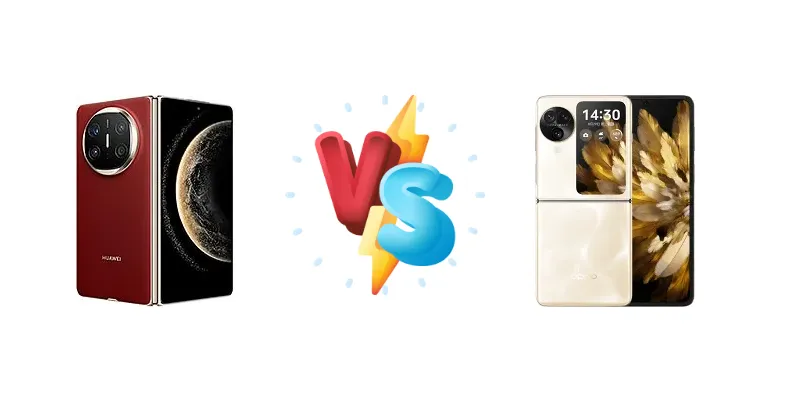
|
🏆 Quick Verdict
For the average user prioritizing all-day battery life and a more efficient chipset, the Oppo Find N3 Flip is the stronger choice. Its 12:58h active use score significantly outperforms the Mate X6’s 8:56h, and the Dimensity 9200 offers a more modern fabrication process.
| PHONES | ||
|---|---|---|
| Phone Names | Huawei Mate X6 | Oppo Find N3 Flip |
| Network | ||
|---|---|---|
| 2G bands | GSM 850 / 900 / 1800 / 1900 | GSM 850 / 900 / 1800 / 1900 |
| 3G bands | HSDPA 800 / 850 / 900 / 1700(AWS) / 1900 / 2100 | HSDPA 800 / 850 / 900 / 1700(AWS) / 1900 / 2100 |
| 4G bands | LTE | 1, 2, 3, 4, 5, 7, 8, 12, 17, 18, 19, 20, 26, 28, 38, 39, 40, 41, 66 - International |
| 5G bands | SA/NSA | 1, 2, 3, 5, 7, 8, 12, 20, 28, 38, 40, 41, 66, 77, 78 SA/NSA - International |
| Speed | HSPA, LTE, 5G | HSPA, LTE, 5G |
| Technology | GSM / CDMA / HSPA / EVDO / LTE / 5G | GSM / CDMA / HSPA / LTE / 5G |
| Launch | ||
|---|---|---|
| Announced | 2024, November 26 | 2023, August 29 |
| Status | Available. Released 2024, November 26 | Available. Released 2023, September 08 |
| Body | ||
|---|---|---|
| Build | Glass front, nylon fiber or silicone polymer back (eco leather), aluminum frame | Plastic front (unfolded), glass back (unfolded), aluminum frame |
| Dimensions | Unfolded: 156.6 x 144.1 x 4.6 mmFolded: 156.6 x 73.8 x 9.9 mm | Unfolded: 166.4 x 75.8 x 7.8 mm Folded: 85.5 x 75.8 x 16.5 mm |
| SIM | Nano-SIM + Nano-SIM | Nano-SIM + Nano-SIM |
| Weight | 239 g (8.43 oz) | 198 g (6.98 oz) |
| Display | ||
|---|---|---|
| Resolution | 2240 x 2440 pixels (~418 ppi density) | 1080 x 2520 pixels, 21:9 ratio (~403 ppi density) |
| Size | 7.93 inches, 202.1 cm2 (~91.5% screen-to-body ratio) | 6.8 inches, 108.0 cm2 (~85.6% screen-to-body ratio) |
| Type | Foldable LTPO OLED, 1B colors, 120Hz, HDR Vivid, 1800 nits (peak) | Foldable LTPO AMOLED, 120Hz, HDR10+, 1200 nits (HBM), 1600 nits (peak) |
| Platform | ||
|---|---|---|
| CPU | Octa-core (1x2.5 GHz & 3x2.15 GHz & 4x1.53GHz) | Octa-core (1x3.05 GHz Cortex-X3 & 3x2.85 GHz Cortex-A715 & 4x1.80 GHz Cortex-A510) |
| Chipset | Kirin 9020 (7 nm) | Mediatek Dimensity 9200 (4 nm) |
| GPU | Maleoon 920 | Immortalis-G715 MC11 |
| OS | EMUI 15 (International), HarmonyOS 4.3 (China) | Android 13, up to 4 major Android upgrades, ColorOS 14 |
| Memory | ||
|---|---|---|
| Card slot | No | No |
| Internal | 256GB 12GB RAM, 512GB 12GB RAM, 512GB 16GB RAM, 1TB 16GB RAM | 256GB 12GB RAM, 512GB 12GB RAM |
| Main Camera | ||
|---|---|---|
| Features | Laser AF, color spectrum sensor, LED flash, panorama, HDR | LED flash, HDR, panorama |
| Triple | 50 MP, f/1.4-f/4.0, 24mm (wide), PDAF, OIS 48 MP, f/3.0, 90mm (periscope telephoto), PDAF, OIS, 4x optical zoom 40 MP, f/2.2, 13mm, 120˚ (ultrawide), PDAF | 50 MP, f/1.8, 24mm (wide), 1/1.56", 1.0µm, multi-directional PDAF, OIS 32 MP, f/2.0, 47mm (telephoto), 2x optical zoom, PDAF 48 MP, f/2.2, 14mm, 114˚ (ultrawide), AF |
| Video | 4K, 1080p, HDR, gyro-EIS, OIS, HDR Vivid | 4K@30fps, 1080p@30/60/240fps; gyro-EIS |
| Selfie camera | ||
|---|---|---|
| Features | HDR, panorama | HDR, panorama |
| Single | 8 MP, f/2.2, (wide) Cover camera: 8 MP, f/2.4, (wide) | 32 MP, f/2.4, 21mm (wide), 1/2.74", 0.8µm, AF |
| Video | 4K, 1080p | 4K@30fps, 1080p@30; gyro-EIS |
| Sound | ||
|---|---|---|
| 35mm jack | No | No |
| Loudspeaker | Yes, with stereo speakers | Yes, with stereo speakers |
| Comms | ||
|---|---|---|
| Bluetooth | 5.2, A2DP, LE, L2HC | 5.3, A2DP, LE, aptX HD |
| Infrared port | Yes | - |
| NFC | Yes | Yes (market/region dependent) |
| Positioning | GPS (L1+L5), GLONASS (L1), BDS (B1I+B1c+B2a+B2b), GALILEO (E1+E5a+E5b), QZSS (L1+L5), NavIC | GPS (L1+L5), GLONASS (L1), BDS (B1I+B1C+B2a+B2b), GALILEO (E1+E5a+E5b), QZSS (L1+L5) |
| Radio | No | No |
| USB | USB Type-C 3.1, OTG, DisplayPort 1.2 | USB Type-C 2.0, OTG |
| WLAN | Wi-Fi 802.11 a/b/g/n/ac/6, dual-band, Wi-Fi Direct | Wi-Fi 802.11 a/b/g/n/ac, dual-band, Wi-Fi Direct - InternationalWi-Fi 802.11 a/b/g/n/ac/6/7, tri-band, Wi-Fi Direct - China only |
| Features | ||
|---|---|---|
| Sensors | Fingerprint (side-mounted), accelerometer, gyro, proximity, compass, barometer | Fingerprint (side-mounted), accelerometer, gyro, proximity, compass |
| Battery | ||
|---|---|---|
| Charging | 66W wired 50W wireless 7.5W reverse wireless 5W reverse wired | 44W wired, 50% in 23 min Reverse wired |
| Type | Si/C Li-Ion 5110 or 5200 mAh | Li-Po 4300 mAh |
| Misc | ||
|---|---|---|
| Colors | Black, White, Gray, Blue, Red | Cream Gold, Misty Pink, Sleek Black |
| Models | ICL-AL10, ICL-LX9 | PHT110, CPH2519 |
| Price | About 2000 EUR | About 1200 EUR |
Huawei Mate X6
- Faster wired and wireless charging speeds.
- Higher peak display brightness for outdoor visibility.
- Potential for deeper Huawei ecosystem integration.
- Significantly shorter battery life in active use.
- Older 7nm chipset architecture.
- Limited camera specification details.
Oppo Find N3 Flip
- Exceptional battery life (12:58h active use).
- More efficient 4nm Dimensity 9200 chipset.
- Faster CPU core (Cortex-X3).
- Lower peak display brightness.
- Slower wired charging speed.
- Camera specifications are currently unknown.
Display Comparison
The Huawei Mate X6 boasts a peak brightness of 1173 nits, exceeding the Oppo Find N3 Flip’s 939 nits. This translates to better visibility under direct sunlight. However, without knowing the panel technology (LTPO or not) for either device, it’s difficult to assess power efficiency. The difference in brightness, while measurable, may not be dramatically noticeable in everyday use, but the Mate X6 has a clear advantage in challenging lighting conditions. We also lack information on color accuracy or refresh rate, making a complete display assessment impossible.
Camera Comparison
Context data is limited regarding camera capabilities beyond the mention of 'Photo / Video' for the Oppo Find N3 Flip. Without sensor size, aperture, or OIS details, a meaningful comparison is impossible. The absence of any specific camera specs for the Mate X6 is equally problematic. We can assume both devices will offer a range of camera modes, but the image quality will heavily depend on the underlying hardware, which remains unknown. Ignoring the likely presence of low-resolution auxiliary cameras (like 2MP macros) is crucial for a realistic assessment.
Performance
The Oppo Find N3 Flip’s Mediatek Dimensity 9200, fabricated on a 4nm process, holds a significant architectural advantage over the Huawei Mate X6’s 7nm Kirin 9020. The Dimensity 9200’s Cortex-X3 prime core, clocked at 3.05 GHz, promises superior single-core performance, crucial for responsive app launches and smooth multitasking. The 4nm node also contributes to improved thermal efficiency, potentially mitigating throttling during sustained workloads. While the Kirin 9020 is a capable chip, the Dimensity 9200 represents a generational leap in performance and efficiency.
Battery Life
The Oppo Find N3 Flip’s 12:58h active use score is a standout feature, dwarfing the Huawei Mate X6’s 8:56h. This substantial difference suggests a more efficient combination of chipset, display, and software optimization. While the Mate X6 offers faster wired charging at 66W compared to the Find N3 Flip’s 44W (reaching 50% in 23 minutes), the superior battery life of the Oppo device reduces the need for frequent top-ups. The Mate X6 also offers 50W wireless and reverse charging options, which the Find N3 Flip matches with 50W wireless and adds reverse wired, providing added versatility.
Buying Guide
Buy the Huawei Mate X6 if you prioritize fast charging speeds (66W wired, 50W wireless) and are deeply embedded in the Huawei ecosystem. Buy the Oppo Find N3 Flip if you value exceptional battery endurance, a more power-efficient processor, and a potentially more streamlined software experience outside of China.