
Huawei Mate X6 vs Honor Magic V3: A Deep Dive into Foldable Flagships
| Phones Images | |||||
|---|---|---|---|---|---|
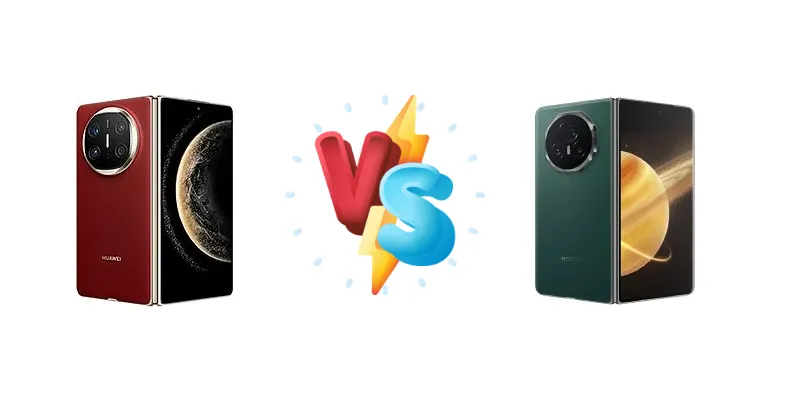
|
🏆 Quick Verdict
For most users, the Honor Magic V3 is the superior choice. Its Snapdragon 8 Gen 3 chipset delivers a substantial performance boost and improved power efficiency, resulting in a significantly longer battery life (10:05h active use) compared to the Mate X6’s 8:56h. While the Mate X6 offers competitive charging, the Magic V3’s overall package is more compelling.
| PHONES | ||
|---|---|---|
| Phone Names | Huawei Mate X6 | Honor Magic V3 |
| Network | ||
|---|---|---|
| 2G bands | GSM 850 / 900 / 1800 / 1900 | GSM 850 / 900 / 1800 / 1900 |
| 3G bands | HSDPA 800 / 850 / 900 / 1700(AWS) / 1900 / 2100 | HSDPA 800 / 850 / 900 / 1700(AWS) / 1900 / 2100 |
| 4G bands | LTE | 1, 2, 3, 4, 5, 7, 8, 12, 17, 18, 19, 20, 26, 28, 34, 38, 39, 40, 41, 66 |
| 5G bands | SA/NSA | 1, 3, 5, 8, 28, 38, 41, 77, 78 SA/NSA |
| Speed | HSPA, LTE, 5G | HSPA, LTE, 5G |
| Technology | GSM / CDMA / HSPA / EVDO / LTE / 5G | GSM / CDMA / HSPA / CDMA2000 / LTE / 5G |
| Launch | ||
|---|---|---|
| Announced | 2024, November 26 | 2024, July 12 |
| Status | Available. Released 2024, November 26 | Available. Released 2024, July 19 |
| Body | ||
|---|---|---|
| Build | Glass front, nylon fiber or silicone polymer back (eco leather), aluminum frame | Glass front, fiber-reinforced plastic back, aluminum frame |
| Dimensions | Unfolded: 156.6 x 144.1 x 4.6 mmFolded: 156.6 x 73.8 x 9.9 mm | Unfolded: 156.6 x 145.3 x 4.35 mm or 4.4 mmFolded: 156.6 x 74.0 x 9.2 mm or 9.3 mm |
| SIM | Nano-SIM + Nano-SIM | · Nano-SIM + eSIM· Nano-SIM + Nano-SIM |
| Weight | 239 g (8.43 oz) | 226 g or 230 g (7.97 oz) |
| Display | ||
|---|---|---|
| Protection | - | King Kong Rhinoceros |
| Resolution | 2240 x 2440 pixels (~418 ppi density) | 2156 x 2344 pixels (~402 ppi density) |
| Size | 7.93 inches, 202.1 cm2 (~91.5% screen-to-body ratio) | 7.92 inches, 201.6 cm2 (~88.6% screen-to-body ratio) |
| Type | Foldable LTPO OLED, 1B colors, 120Hz, HDR Vivid, 1800 nits (peak) | Foldable LTPO AMOLED, 1B colors, HDR10+, Dolby Vision, 120Hz, 1800 nits (peak) |
| Platform | ||
|---|---|---|
| CPU | Octa-core (1x2.5 GHz & 3x2.15 GHz & 4x1.53GHz) | Octa-core (1x3.3 GHz Cortex-X4 & 3x3.2 GHz Cortex-A720 & 2x3.0 GHz Cortex-A720 & 2x2.3 GHz Cortex-A520) |
| Chipset | Kirin 9020 (7 nm) | Qualcomm SM8650-AB Snapdragon 8 Gen 3 (4 nm) |
| GPU | Maleoon 920 | Adreno 750 |
| OS | EMUI 15 (International), HarmonyOS 4.3 (China) | Android 14, upgradable to Android 15, MagicOS 9 |
| Memory | ||
|---|---|---|
| Card slot | No | No |
| Internal | 256GB 12GB RAM, 512GB 12GB RAM, 512GB 16GB RAM, 1TB 16GB RAM | 256GB 12GB RAM, 512GB 12GB RAM, 512GB 16GB RAM, 1TB 16GB RAM |
| Main Camera | ||
|---|---|---|
| Features | Laser AF, color spectrum sensor, LED flash, panorama, HDR | Laser AF, LED flash, HDR, panorama |
| Triple | 50 MP, f/1.4-f/4.0, 24mm (wide), PDAF, OIS 48 MP, f/3.0, 90mm (periscope telephoto), PDAF, OIS, 4x optical zoom 40 MP, f/2.2, 13mm, 120˚ (ultrawide), PDAF | 50 MP, f/1.6, 23mm (wide), 1/1.56", 1.0µm, PDAF, OIS 50 MP, f/3.0, 90mm (periscope telephoto), 1/2.51", 0.7µm, PDAF, OIS, 3.5x optical zoom 40 MP, f/2.2, 16mm, 112˚ (ultrawide), AF |
| Video | 4K, 1080p, HDR, gyro-EIS, OIS, HDR Vivid | 4K@30/60fps (10-bit), 1080p@30/60fps, gyro-EIS, OIS |
| Selfie camera | ||
|---|---|---|
| Features | HDR, panorama | HDR |
| Single | 8 MP, f/2.2, (wide) Cover camera: 8 MP, f/2.4, (wide) | 20 MP, f/2.2, 90˚, 21mm (wide), 0.61µm Cover camera: 20 MP, f/2.2, 90˚, 21mm (wide), 0.61µm |
| Video | 4K, 1080p | 4K@30fps, 1080p@30fps, gyro-EIS |
| Sound | ||
|---|---|---|
| 35mm jack | No | No |
| Loudspeaker | Yes, with stereo speakers | Yes, with stereo speakers |
| Comms | ||
|---|---|---|
| Bluetooth | 5.2, A2DP, LE, L2HC | 5.3, A2DP, LE, aptX HD, LDAC |
| Infrared port | Yes | Yes |
| NFC | Yes | Yes |
| Positioning | GPS (L1+L5), GLONASS (L1), BDS (B1I+B1c+B2a+B2b), GALILEO (E1+E5a+E5b), QZSS (L1+L5), NavIC | GPS (L1+L5), GLONASS (L1), BDS (B1I+B1c+B2a), GALILEO (E1+E5a) |
| Radio | No | No |
| USB | USB Type-C 3.1, OTG, DisplayPort 1.2 | USB Type-C 3.1, OTG, Display Port 1.2 |
| WLAN | Wi-Fi 802.11 a/b/g/n/ac/6, dual-band, Wi-Fi Direct | Wi-Fi 802.11 a/b/g/n/ac/6e/7, dual-band, Wi-Fi Direct |
| Features | ||
|---|---|---|
| Sensors | Fingerprint (side-mounted), accelerometer, gyro, proximity, compass, barometer | Fingerprint (side-mounted), accelerometer, gyro, proximity, compass, barometer |
| Battery | ||
|---|---|---|
| Charging | 66W wired 50W wireless 7.5W reverse wireless 5W reverse wired | 66W wired 50W wireless 5W reverse wired |
| Type | Si/C Li-Ion 5110 or 5200 mAh | Si/C Li-Ion 5150 mAh |
| Misc | ||
|---|---|---|
| Colors | Black, White, Gray, Blue, Red | Velvet Black, Snow, Tundra Green, Red |
| Models | ICL-AL10, ICL-LX9 | FCP-AN10, FCP-N49 |
| Price | About 2000 EUR | € 838.00 / $ 1,229.00 / £ 832.00 |
Huawei Mate X6
- Higher peak display brightness (1173 nits)
- Fast 66W wired charging
- Established Huawei foldable design
- Inferior chipset performance (Kirin 9020)
- Shorter battery life (8:56h active use)
- Less efficient 7nm process
Honor Magic V3
- Superior performance (Snapdragon 8 Gen 3)
- Longer battery life (10:05h active use)
- More efficient 4nm process
- Slightly lower peak display brightness (1076 nits)
- Relatively newer entrant to the foldable market
Display Comparison
Both foldables feature large displays, but differ in brightness and underlying technology. The Huawei Mate X6 boasts a peak brightness of 1173 nits, exceeding the Honor Magic V3’s 1076 nits. This translates to better visibility in direct sunlight for the Mate X6. However, the specifics of panel technology (LTPO, refresh rate) are not provided, making a deeper analysis of display smoothness and power consumption impossible. The difference in peak brightness, while measurable, may not be noticeable in typical usage scenarios.
Camera Comparison
Without detailed camera specifications, a direct comparison is limited. However, the chipset plays a crucial role in image processing. The Snapdragon 8 Gen 3’s advanced ISP (Image Signal Processor) in the Magic V3 will likely result in faster image processing, improved noise reduction, and better dynamic range compared to the Kirin 9020 in the Mate X6. The absence of sensor size or aperture information prevents a more granular analysis, but the Magic V3’s superior processing power gives it an edge.
Performance
The performance gap is the most significant differentiator. The Honor Magic V3’s Qualcomm Snapdragon 8 Gen 3 (4nm) chipset, featuring a Cortex-X4 prime core clocked at 3.3 GHz, represents a substantial leap over the Huawei Mate X6’s Kirin 9020 (7nm). The Snapdragon 8 Gen 3’s newer architecture and smaller process node deliver superior CPU and GPU performance, alongside improved thermal efficiency. The Kirin 9020’s octa-core configuration (2.5 GHz, 2.15 GHz, 1.53 GHz) is simply outmatched by the Snapdragon’s more advanced design. This difference will be most apparent in demanding applications like gaming and video editing, where the Magic V3 will maintain higher frame rates and smoother performance.
Battery Life
The Honor Magic V3’s active use battery score of 10:05h significantly surpasses the Huawei Mate X6’s 8:56h. This difference is primarily attributable to the Snapdragon 8 Gen 3’s superior power efficiency. While both devices offer 66W wired charging and 50W wireless charging, the Magic V3’s larger battery life means users will rely on these charging capabilities less frequently. Both also offer 5W/7.5W reverse wireless charging, a convenient feature for topping up accessories.
Buying Guide
Buy the Huawei Mate X6 if you prioritize fast charging speeds and are deeply embedded within the Huawei ecosystem, potentially benefiting from seamless integration with other Huawei devices. Buy the Honor Magic V3 if you demand top-tier performance for demanding tasks like gaming and video editing, and value longer battery life for all-day use. The Magic V3 is the better choice for users seeking a more future-proof and powerful foldable experience.