
Huawei Mate X3 vs Xiaomi Mix Fold 2: The Ultimate Foldable Face-Off
| Phones Images | |||||
|---|---|---|---|---|---|
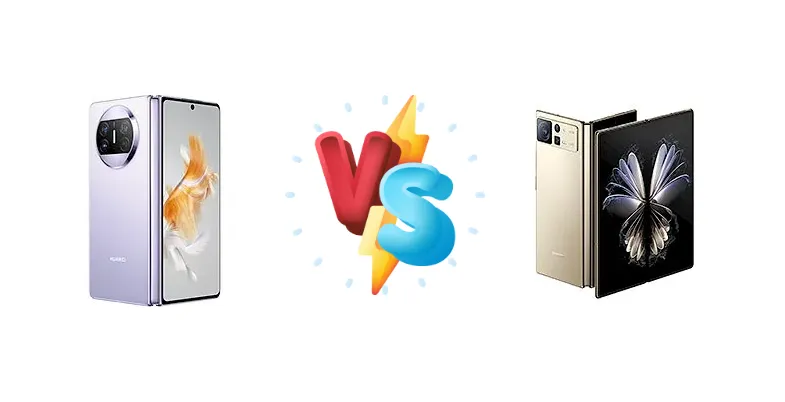
|
🏆 Quick Verdict
The Xiaomi Mix Fold 2 edges out the Mate X3 thanks to its brighter display, slightly faster CPU core speeds, and quicker charging. However, the Mate X3 offers excellent build quality and a refined user experience. Ultimately, the choice depends on your priorities: display brilliance or overall polish.
| PHONES | ||
|---|---|---|
| Phone Names | Huawei Mate X3 | Xiaomi Mix Fold 2 |
| Network | ||
|---|---|---|
| 2G bands | GSM 850 / 900 / 1800 / 1900 | GSM 850 / 900 / 1800 / 1900 |
| 3G bands | HSDPA 800 / 850 / 900 / 1700(AWS) / 1900 / 2100 | HSDPA 850 / 900 / 1700(AWS) / 1900 / 2100 |
| 4G bands | 1, 2, 3, 4, 5, 7, 8, 12, 17, 18, 19, 20, 26, 28, 34, 38, 39, 40, 41 | 1, 2, 3, 4, 5, 7, 8, 12, 17, 18, 19, 20, 26, 28, 34, 38, 39, 40, 41, 42 |
| 5G bands | - | 1, 3, 5, 8, 20, 28, 38, 40, 41, 77, 78, 79 SA/NSA |
| Speed | HSPA, LTE | HSPA, LTE, 5G |
| Technology | GSM / CDMA / HSPA / EVDO / LTE | GSM / CDMA / HSPA / EVDO / LTE / 5G |
| CDMA2000 1xEV-DO | CDMA2000 1xEV-DO | |
| Launch | ||
|---|---|---|
| Announced | 2023, March 23 | 2022, August 11 |
| Status | Available. Released 2023, April 08 | Available. Released 2022, August 26 |
| Body | ||
|---|---|---|
| Build | Glass front, glass back or eco leather back, aluminum frame | - |
| Dimensions | Unfolded: 156.9 x 141.5 x 5.3 mmFolded: 156.9 x 72.4 x 11.1 mm | Unfolded: 161.1 x 144.7 x 5.4 mm Folded: 161.1 x 73.9 x 11.2 mm |
| SIM | Nano-SIM + Nano-SIM | Nano-SIM + Nano-SIM |
| Weight | 239 g or 241 g (8.43 oz) | 262 g (9.24 oz) |
| IPX8 dust/water resistant (up to 1.5m for 30 min) | - | |
| Display | ||
|---|---|---|
| Protection | Kunlun Glass (cover display only) | Schott UTG glass |
| Resolution | 2224 x 2496 pixels (~426 ppi density) | 1914 x 2160 pixels (~360 ppi density) |
| Size | 7.85 inches, 197.5 cm2 (~88.9% screen-to-body ratio) | 8.02 inches, 206.0 cm2 (~88.4% screen-to-body ratio) |
| Type | Foldable OLED, 1B colors, 120Hz | Foldable LTPO2 OLED, 1B colors, 120Hz, HDR10+, Dolby Vision, 1000 nits (HBM), 1300 nits (peak) |
| Cover display: OLED, 120Hz, 6.4 inches, 1080 x 2504 pixels | Cover display: AMOLED, 120Hz, HDR10+, Dolby Vision, 1000 nits (HBM), 1300 nits (peak) 6.56 inches, 1080 x 2520 pixels, 21:9 ratio Corning Gorilla Glass Victus | |
| Platform | ||
|---|---|---|
| CPU | Octa-core (1x3.19 GHz Cortex-X2 & 3x2.75 GHz Cortex-A710 & 4x2.0 GHz Cortex-A510) | Octa-core (1x3.19 GHz Cortex-X2 & 3x2.75 GHz Cortex-A710 & 4x1.80 GHz Cortex-A510) |
| Chipset | Qualcomm SM8475 Snapdragon 8+ Gen 1 4G (4 nm) | Qualcomm SM8475 Snapdragon 8+ Gen 1 (4 nm) |
| GPU | Adreno 730 | Adreno 730 |
| OS | HarmonyOS 3.1 (China), EMUI 13.1 (Europe), no Google Play Services | Android 12, MIUI Fold 13 |
| Memory | ||
|---|---|---|
| Card slot | Nano Memory (uses shared SIM slot) | No |
| Internal | 256GB 12GB RAM, 512GB 12GB RAM, 1TB 12GB RAM | 256GB 12GB RAM, 512GB 12GB RAM, 1TB 12GB RAM |
| UFS | UFS 3.1 | |
| Main Camera | ||
|---|---|---|
| Features | Laser AF, color spectrum sensor, LED flash, panorama, HDR | Color spectrum sensor, Dual-LED flash, HDR, panorama, Leica lenses |
| Triple | 50 MP, f/1.8, 23mm (wide), PDAF, OIS 12 MP, f/3.4, 125mm (periscope telephoto), PDAF, OIS, 5x optical zoom 13 MP, f/2.2, 13mm (ultrawide), AF | 50 MP, f/1.8, (wide), 1/1.56", 1.0µm, PDAF, OIS 8 MP, f/2.6, 45mm (telephoto), dual pixel PDAF, 2x optical zoom 13 MP, f/2.4, 15mm, 123˚ (ultrawide), 1.12µm, AF |
| Video | 4K@30/60fps, 1080p@30/60fps, gyro-EIS | 8K@24fps, 4K@30/60fps, 1080p@30/60/120/240/960fps, gyro-EIS |
| Selfie camera | ||
|---|---|---|
| Features | HDR, panorama | HDR, panorama |
| Single | 8 MP, f/2.4, (wide) Cover camera: 8 MP, f/2.4, (wide) | 20 MP, f/2.4, 23mm (wide) |
| Video | 4K@30fps, 1080p@30fps | 1080p@30/60fps, 720p@120fps |
| Sound | ||
|---|---|---|
| 3.5mm jack | No | No |
| 35mm jack | No | No |
| Loudspeaker | Yes, with stereo speakers | Yes, with stereo speakers |
| - | 24-bit/192kHz audio Tuned by Harman Kardon | |
| Comms | ||
|---|---|---|
| Bluetooth | 5.2, A2DP, LE | 5.2, A2DP, LE, aptX HD, aptX Adaptive |
| Infrared port | Yes | Yes |
| NFC | Yes | Yes |
| Positioning | GPS (L1+L5), GLONASS (B1I+B1c+B2a), BDS (B1I+B1c+B2a), GALILEO (E1+E5a), QZSS (L1+L5), NavIC | GPS (L1+L5), GLONASS (L1), BDS (B1I+B1c+B2a), GALILEO (E1+E5a), QZSS (L1+L5), NavIC (L5) |
| Radio | No | No |
| USB | USB Type-C 3.1, DisplayPort 1.2, OTG | USB Type-C |
| WLAN | Wi-Fi 802.11 a/b/g/n/ac/6, dual-band, Wi-Fi Direct | Wi-Fi 802.11 a/b/g/n/ac/6e, dual-band, Wi-Fi Direct |
| Features | ||
|---|---|---|
| Sensors | Fingerprint (side-mounted), accelerometer, gyro, proximity, compass, barometer, altimeter | Fingerprint (side-mounted), accelerometer, gyro, proximity, compass, barometer |
| BDS Satellite Message | - | |
| Battery | ||
|---|---|---|
| Charging | 66W wired 50W wireless 7.5W reverse wireless | 67W wired, PD3.0, QC4, 100% in 40 min |
| Type | Market-dependent versions:· Li-Po 4800 mAh (Global)· Si/C Li-Ion 5060 mAh (China only) | Li-Po 4500 mAh |
| Misc | ||
|---|---|---|
| Colors | Black, White, Violet, Dark Green, Gold | Black, Gold |
| Models | ALT-AL00, ALT-L29 | 22061218C |
| Price | About 1500 EUR | About 1300 EUR |
| Tests | ||
|---|---|---|
| Battery life | Endurance rating 81h | Endurance rating 82h |
| Camera | Photo / Video | Photo / Video |
| Display | Contrast ratio: Infinite (nominal) | Contrast ratio: Infinite (nominal) |
| Loudspeaker | -26.3 LUFS (Good) | -26.2 LUFS (Good) |
| Performance | AnTuTu: 993592 (v9) GeekBench: 4283 (v5.5), 4512 (v6) GFXBench: 41fps (ES 3.1 onscreen) | AnTuTu: 1050139 (v9) GeekBench: 4368 (v5.1) GFXBench: 52fps (ES 3.1 onscreen) |
Huawei Mate X3
- Premium build quality
- Refined user experience
- Excellent design
- Good camera performance
- Slightly dimmer display
- Slower charging
- Limited software ecosystem (due to Huawei restrictions)
Xiaomi Mix Fold 2
- Brighter display
- Faster charging
- Slightly faster CPU core
- Vibrant color reproduction
- Potentially less polished software
- Design may be less refined than Mate X3
Display Comparison
The Xiaomi Mix Fold 2 takes the display crown with a measured peak brightness of 1054 nits compared to the Mate X3's 926 nits. Both offer excellent contrast ratios (infinite nominal), but the Xiaomi's higher brightness makes it more usable outdoors. Both utilize AMOLED technology for vibrant colors and deep blacks. The folding mechanism on both devices is generally well-engineered, though crease visibility remains a factor.
Camera Comparison
Camera performance is a complex area. Both phones feature high-resolution main sensors, but image processing and overall camera system capabilities differ. The Mate X3 is known for its refined image processing, while the Mix Fold 2 often delivers more vibrant, saturated colors. Detailed camera comparisons require extensive testing, but both are capable of producing excellent photos and videos.
Performance
Both phones are powered by the Snapdragon 8+ Gen 1, ensuring flagship-level performance. However, the Xiaomi Mix Fold 2 has a slightly faster Cortex-A510 core (1.80 GHz vs 2.0 GHz), potentially offering a marginal performance advantage in certain tasks. Day-to-day usage will feel incredibly smooth on both devices, handling demanding games and multitasking with ease.
Battery Life
Both devices offer an endurance rating of 81/82 hours, suggesting comparable battery life. The Xiaomi Mix Fold 2's 67W wired charging is significantly faster than the Mate X3's 66W, allowing for quicker top-ups. The Mix Fold 2 also supports PD3.0, QC4 charging standards.
Buying Guide
The Huawei Mate X3 is ideal for users prioritizing a premium, refined foldable experience with a focus on design and software optimization. The Xiaomi Mix Fold 2 is a better choice for those who demand a brighter, more vibrant display and faster charging speeds, even if it means a slightly less polished overall package.