
Huawei Mate X3 vs vivo X Fold2: The Ultimate Foldable Face-Off
| Phones Images | |||||
|---|---|---|---|---|---|
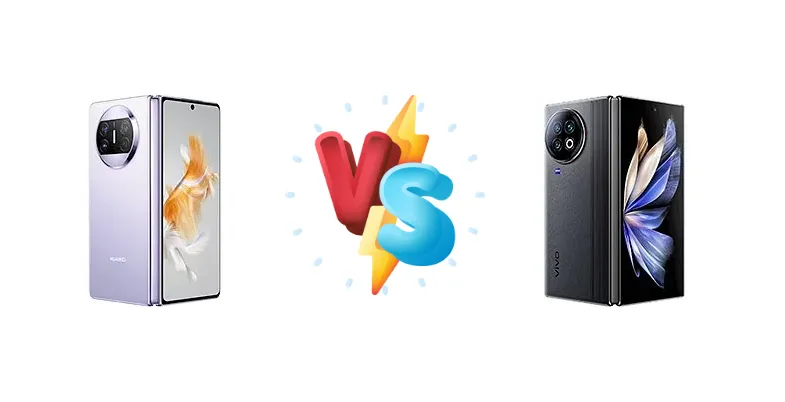
|
🏆 Quick Verdict
The vivo X Fold2 takes the crown with its significantly faster charging, brighter display, and slightly better battery life. While the Mate X3 offers a solid experience, the X Fold2’s advancements in key areas make it the more compelling choice for most users.
| PHONES | ||
|---|---|---|
| Phone Names | Huawei Mate X3 | vivo X Fold2 |
| Network | ||
|---|---|---|
| 2G bands | GSM 850 / 900 / 1800 / 1900 | GSM 850 / 900 / 1800 / 1900 |
| 3G bands | HSDPA 800 / 850 / 900 / 1700(AWS) / 1900 / 2100 | HSDPA 800 / 850 / 900 / 1700(AWS) / 1900 / 2100 |
| 4G bands | 1, 2, 3, 4, 5, 7, 8, 12, 17, 18, 19, 20, 26, 28, 34, 38, 39, 40, 41 | 1, 2, 3, 4, 5, 7, 8, 12, 17, 18, 19, 20, 25, 26, 28, 32, 34, 38, 39, 40, 41, 42, 66 |
| 5G bands | - | 1, 2, 3, 5, 7, 8, 12, 20, 28, 38, 40, 41, 66, 77, 78 SA/NSA |
| Speed | HSPA, LTE | HSPA, LTE, 5G |
| Technology | GSM / CDMA / HSPA / EVDO / LTE | GSM / CDMA / HSPA / CDMA2000 / LTE / 5G |
| CDMA2000 1xEV-DO | CDMA2000 1x | |
| Launch | ||
|---|---|---|
| Announced | 2023, March 23 | 2023, April 20 |
| Status | Available. Released 2023, April 08 | Available. Released 2023, April 28 |
| Body | ||
|---|---|---|
| Build | Glass front, glass back or eco leather back, aluminum frame | - |
| Dimensions | Unfolded: 156.9 x 141.5 x 5.3 mmFolded: 156.9 x 72.4 x 11.1 mm | Unfolded: 161.3 x 143.4 x 6 mmFolded: 161.3 x 73.4 x 12.9 mm |
| SIM | Nano-SIM + Nano-SIM | Nano-SIM + Nano-SIM |
| Weight | 239 g or 241 g (8.43 oz) | 279 g (9.84 oz) |
| IPX8 dust/water resistant (up to 1.5m for 30 min) | - | |
| Display | ||
|---|---|---|
| Protection | Kunlun Glass (cover display only) | - |
| Resolution | 2224 x 2496 pixels (~426 ppi density) | 1916 x 2160 pixels (~360 ppi density) |
| Size | 7.85 inches, 197.5 cm2 (~88.9% screen-to-body ratio) | 8.03 inches, 206.5 cm2 (~89.3% screen-to-body ratio) |
| Type | Foldable OLED, 1B colors, 120Hz | Foldable LTPO4 AMOLED, 120Hz, HDR10+, Dolby Vision, 1800 nits (peak) |
| Cover display: OLED, 120Hz, 6.4 inches, 1080 x 2504 pixels | Cover display: AMOLED, 120Hz, HDR10+, Dolby Vision, 1600 nits (peak) 6.53 inches, 1080 x 2520 pixels, 21:9 ratio | |
| Platform | ||
|---|---|---|
| CPU | Octa-core (1x3.19 GHz Cortex-X2 & 3x2.75 GHz Cortex-A710 & 4x2.0 GHz Cortex-A510) | Octa-core (1x3.2 GHz Cortex-X3 & 2x2.8 GHz Cortex-A715 & 2x2.8 GHz Cortex-A710 & 3x2.0 GHz Cortex-A510) |
| Chipset | Qualcomm SM8475 Snapdragon 8+ Gen 1 4G (4 nm) | Qualcomm SM8550-AB Snapdragon 8 Gen 2 (4 nm) |
| GPU | Adreno 730 | Adreno 740 |
| OS | HarmonyOS 3.1 (China), EMUI 13.1 (Europe), no Google Play Services | Android 13, OriginOS 3 |
| Memory | ||
|---|---|---|
| Card slot | Nano Memory (uses shared SIM slot) | No |
| Internal | 256GB 12GB RAM, 512GB 12GB RAM, 1TB 12GB RAM | 256GB 12GB RAM, 512GB 12GB RAM |
| UFS | UFS 4.0 | |
| Main Camera | ||
|---|---|---|
| Features | Laser AF, color spectrum sensor, LED flash, panorama, HDR | Laser AF, Zeiss optics, Zeiss T* lens coating, Dual-LED flash, panorama |
| Triple | 50 MP, f/1.8, 23mm (wide), PDAF, OIS 12 MP, f/3.4, 125mm (periscope telephoto), PDAF, OIS, 5x optical zoom 13 MP, f/2.2, 13mm (ultrawide), AF | 50 MP, f/1.8, (wide), 1/1.49", 1.0µm, dual pixel PDAF, OIS 12 MP, f/2.0, 47mm (telephoto), 1/2.93", 1.22µm, dual pixel PDAF, 2x optical zoom 12 MP, f/2.0, 16mm, 108˚ (ultrawide), 1/2.93", 1.22µm, dual pixel PDAF |
| Video | 4K@30/60fps, 1080p@30/60fps, gyro-EIS | 8K@30fps, 4K@30/60fps, 1080p@30/60fps, gyro-EIS |
| Selfie camera | ||
|---|---|---|
| Features | HDR, panorama | HDR |
| Single | 8 MP, f/2.4, (wide) Cover camera: 8 MP, f/2.4, (wide) | 16 MP, f/2.5, (wide) Cover camera: 16 MP, f/2.5, (wide) |
| Video | 4K@30fps, 1080p@30fps | 1080p@30fps |
| Sound | ||
|---|---|---|
| 3.5mm jack | No | No |
| 35mm jack | No | No |
| Loudspeaker | Yes, with stereo speakers | Yes, with stereo speakers |
| - | 24-bit/192kHz audio | |
| Comms | ||
|---|---|---|
| Bluetooth | 5.2, A2DP, LE | 5.3, A2DP, LE, aptX HD, aptX Adaptive, aptX Lossless |
| Infrared port | Yes | - |
| NFC | Yes | Yes |
| Positioning | GPS (L1+L5), GLONASS (B1I+B1c+B2a), BDS (B1I+B1c+B2a), GALILEO (E1+E5a), QZSS (L1+L5), NavIC | GPS (L1+L5), GLONASS (G1), BDS (B1I+B1c+B2a+B2b), GALILEO (E1+E5a), QZSS (L1+L5) |
| Radio | No | No |
| USB | USB Type-C 3.1, DisplayPort 1.2, OTG | USB Type-C 2.0, OTG |
| WLAN | Wi-Fi 802.11 a/b/g/n/ac/6, dual-band, Wi-Fi Direct | Wi-Fi 802.11 a/b/g/n/ac/6e/7, tri-band, Wi-Fi Direct |
| Features | ||
|---|---|---|
| Sensors | Fingerprint (side-mounted), accelerometer, gyro, proximity, compass, barometer, altimeter | Dual screen fingerprint (under display, ultrasonic), accelerometer, gyro, proximity, compass, barometer |
| BDS Satellite Message | - | |
| Battery | ||
|---|---|---|
| Charging | 66W wired 50W wireless 7.5W reverse wireless | 120W wired, 100% in 26 min 50W wireless, 100% in 40 min 10W reverse wireless |
| Type | Market-dependent versions:· Li-Po 4800 mAh (Global)· Si/C Li-Ion 5060 mAh (China only) | 4800 mAh |
| Misc | ||
|---|---|---|
| Colors | Black, White, Violet, Dark Green, Gold | Black, Blue, Red |
| Models | ALT-AL00, ALT-L29 | V2266A |
| Price | About 1500 EUR | About 1330 EUR |
| Tests | ||
|---|---|---|
| Battery life | Endurance rating 81h | - |
| Camera | Photo / Video | - |
| Display | Contrast ratio: Infinite (nominal) | - |
| Loudspeaker | -26.3 LUFS (Good) | - |
| Performance | AnTuTu: 993592 (v9) GeekBench: 4283 (v5.5), 4512 (v6) GFXBench: 41fps (ES 3.1 onscreen) | - |
Huawei Mate X3
- Refined design and build quality
- Reliable performance
- Excellent display contrast
- Solid camera system
- Slower charging speeds
- Lower peak brightness compared to X Fold2
- Limited software ecosystem (due to restrictions)
vivo X Fold2
- Blazing-fast 120W charging
- Brighter and more vibrant display
- Slightly better performance
- Improved camera capabilities
- Potentially higher price
- Software experience may vary by region
Display Comparison
The vivo X Fold2 boasts a significantly brighter display at 1308 nits compared to the Mate X3's 926 nits. Both offer excellent contrast ratios (effectively infinite for the Mate X3), but the X Fold2’s increased brightness provides better visibility in direct sunlight. The folding mechanism on both is generally smooth, though hinge durability remains a long-term consideration for any foldable.
Camera Comparison
Camera performance is a complex area. Both offer versatile camera systems, but the X Fold2 generally produces more detailed and vibrant images, especially in challenging lighting conditions. The X Fold2's larger sensor sizes and improved image processing algorithms contribute to its edge. Both record high-quality video, but the X Fold2 may offer slightly better stabilization.
Performance
Both phones are powered by flagship Snapdragon processors – the Mate X3 with the Snapdragon 8+ Gen 1 and the X Fold2 with the Snapdragon 8 Gen 2. The Gen 2 offers a noticeable performance edge, particularly in graphics-intensive tasks and sustained workloads. Expect smoother multitasking and slightly faster app loading times on the X Fold2. Both have ample RAM for seamless operation.
Battery Life
The vivo X Fold2 secures a win in battery life with an endurance rating of 96h compared to the Mate X3's 81h. However, the real difference lies in charging speed. The X Fold2's 120W wired charging is a game-changer, fully charging the phone in just 26 minutes, while the Mate X3's 66W charging takes considerably longer.
Buying Guide
The Huawei Mate X3 is ideal for users deeply embedded in the Huawei ecosystem who prioritize a refined design and reliable performance. The vivo X Fold2 is perfect for those seeking cutting-edge technology, blazing-fast charging, and a brighter, more vibrant display, especially if they value photography.