
Huawei Mate X3 vs. Huawei P60 Pro: A Detailed Showdown
| Phones Images | |||||
|---|---|---|---|---|---|
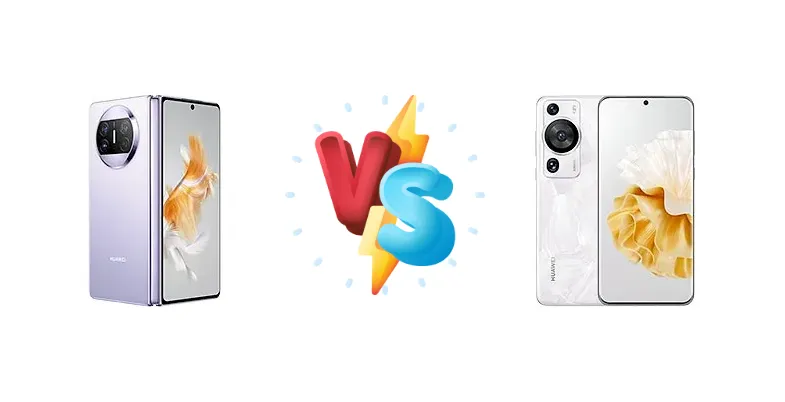
|
🏆 Quick Verdict
The Huawei P60 Pro emerges as the overall winner, boasting superior battery life, a brighter display, and faster charging. While the Mate X3's folding design is innovative, the P60 Pro offers a more polished and practical flagship experience for most users.
| PHONES | ||
|---|---|---|
| Phone Names | Huawei Mate X3 | Huawei P60 Pro |
| Network | ||
|---|---|---|
| 2G bands | GSM 850 / 900 / 1800 / 1900 | GSM 850 / 900 / 1800 / 1900 |
| 3G bands | HSDPA 800 / 850 / 900 / 1700(AWS) / 1900 / 2100 | HSDPA 800 / 850 / 900 / 1700(AWS) / 1900 / 2100 |
| 4G bands | 1, 2, 3, 4, 5, 7, 8, 12, 17, 18, 19, 20, 26, 28, 34, 38, 39, 40, 41 | 1, 2, 3, 4, 5, 7, 8, 12, 13, 17, 18, 19, 20, 26, 28, 32, 34, 38, 39, 40, 41, 66 - International |
| Speed | HSPA, LTE | HSPA, LTE |
| Technology | GSM / CDMA / HSPA / EVDO / LTE | GSM / CDMA / HSPA / CDMA2000 / LTE |
| CDMA2000 1xEV-DO | 1, 2, 3, 4, 5, 7, 8, 12, 17, 18, 19, 20, 26, 28, 34, 38, 39, 40, 41 - China | |
| Launch | ||
|---|---|---|
| Announced | 2023, March 23 | 2023, March 23 |
| Status | Available. Released 2023, April 08 | Available. Released 2023, March 31 |
| Body | ||
|---|---|---|
| Build | Glass front, glass back or eco leather back, aluminum frame | - |
| Dimensions | Unfolded: 156.9 x 141.5 x 5.3 mmFolded: 156.9 x 72.4 x 11.1 mm | 161 x 74.5 x 8.3 mm (6.34 x 2.93 x 0.33 in) |
| SIM | Nano-SIM + Nano-SIM | · Nano-SIM· Nano-SIM + Nano-SIM |
| Weight | 239 g or 241 g (8.43 oz) | 200 g (7.05 oz) |
| IPX8 dust/water resistant (up to 1.5m for 30 min) | IP68 dust/water resistant (up to 1.5m for 30 min) | |
| Display | ||
|---|---|---|
| Protection | Kunlun Glass (cover display only) | Kunlun Glass |
| Resolution | 2224 x 2496 pixels (~426 ppi density) | 1220 x 2700 pixels (~444 ppi density) |
| Size | 7.85 inches, 197.5 cm2 (~88.9% screen-to-body ratio) | 6.67 inches, 107.7 cm2 (~89.8% screen-to-body ratio) |
| Type | Foldable OLED, 1B colors, 120Hz | LTPO OLED, 1B colors, 120Hz |
| Cover display: OLED, 120Hz, 6.4 inches, 1080 x 2504 pixels | - | |
| Platform | ||
|---|---|---|
| CPU | Octa-core (1x3.19 GHz Cortex-X2 & 3x2.75 GHz Cortex-A710 & 4x2.0 GHz Cortex-A510) | Octa-core (1x3.19 GHz Cortex-X2 & 3x2.75 GHz Cortex-A710 & 4x2.0 GHz Cortex-A510) |
| Chipset | Qualcomm SM8475 Snapdragon 8+ Gen 1 4G (4 nm) | Qualcomm SM8475 Snapdragon 8+ Gen 1 4G (4 nm) |
| GPU | Adreno 730 | Adreno 730 |
| OS | HarmonyOS 3.1 (China), EMUI 13.1 (Europe), no Google Play Services | HarmonyOS 3.1 (China), EMUI 13.1 (Europe), no Google Play Services |
| Memory | ||
|---|---|---|
| Card slot | Nano Memory (uses shared SIM slot) | Nano Memory (uses shared SIM slot) |
| Internal | 256GB 12GB RAM, 512GB 12GB RAM, 1TB 12GB RAM | 256GB 8GB RAM, 256GB 12GB RAM, 512GB 12GB RAM |
| UFS | UFS | |
| Main Camera | ||
|---|---|---|
| Features | Laser AF, color spectrum sensor, LED flash, panorama, HDR | Laser AF, color spectrum sensor, LED flash, HDR, panorama |
| Triple | 50 MP, f/1.8, 23mm (wide), PDAF, OIS 12 MP, f/3.4, 125mm (periscope telephoto), PDAF, OIS, 5x optical zoom 13 MP, f/2.2, 13mm (ultrawide), AF | 48 MP, f/1.4-f/4.0, 25mm (wide), PDAF, OIS 48 MP, f/2.1, 90mm (telephoto), PDAF, sensor-shift OIS, 3.5x optical zoom 13 MP, f/2.2, 13mm (ultrawide), AF |
| Video | 4K@30/60fps, 1080p@30/60fps, gyro-EIS | 4K@30/60fps, 1080p@30/60fps, 1080p@960fps; gyro-EIS, HDR Vivid |
| Selfie camera | ||
|---|---|---|
| Features | HDR, panorama | Panorama, HDR |
| Single | 8 MP, f/2.4, (wide) Cover camera: 8 MP, f/2.4, (wide) | 13 MP, f/2.4, (ultrawide) |
| Video | 4K@30fps, 1080p@30fps | 4K@30/60fps, 1080p@30fps, HDR Vivid |
| Sound | ||
|---|---|---|
| 3.5mm jack | No | No |
| 35mm jack | No | No |
| Loudspeaker | Yes, with stereo speakers | Yes, with stereo speakers |
| Comms | ||
|---|---|---|
| Bluetooth | 5.2, A2DP, LE | 5.2, A2DP, LE |
| Infrared port | Yes | Yes |
| NFC | Yes | Yes |
| Positioning | GPS (L1+L5), GLONASS (B1I+B1c+B2a), BDS (B1I+B1c+B2a), GALILEO (E1+E5a), QZSS (L1+L5), NavIC | GPS (L1+L5), GLONASS (B1I+B1c+B2a), BDS (B1I+B1c+B2a), GALILEO (E1+E5a), QZSS (L1+L5), NavIC |
| Radio | No | No |
| USB | USB Type-C 3.1, DisplayPort 1.2, OTG | USB Type-C 3.1, OTG |
| WLAN | Wi-Fi 802.11 a/b/g/n/ac/6, dual-band, Wi-Fi Direct | Wi-Fi 802.11 a/b/g/n/ac/6, dual-band, Wi-Fi Direct |
| Features | ||
|---|---|---|
| Sensors | Fingerprint (side-mounted), accelerometer, gyro, proximity, compass, barometer, altimeter | Fingerprint (under display, optical), accelerometer, gyro, proximity, compass |
| BDS Satellite Message | BDS Satellite Message | |
| Battery | ||
|---|---|---|
| Charging | 66W wired 50W wireless 7.5W reverse wireless | 88W wired 50W wireless Reverse wireless |
| Type | Market-dependent versions:· Li-Po 4800 mAh (Global)· Si/C Li-Ion 5060 mAh (China only) | Li-Po 4815 mAh |
| Misc | ||
|---|---|---|
| Colors | Black, White, Violet, Dark Green, Gold | Black, Green, Violet, Rococo Pearl |
| Models | ALT-AL00, ALT-L29 | MNA-AL00, MNA-LX9 |
| Price | About 1500 EUR | € 738.50 |
| Tests | ||
|---|---|---|
| Battery life | Endurance rating 81h | Endurance rating 96h |
| Camera | Photo / Video | Photo / Video |
| Display | Contrast ratio: Infinite (nominal) | Contrast ratio: Infinite (nominal) |
| Loudspeaker | -26.3 LUFS (Good) | -27.3 LUFS (Good) |
| Performance | AnTuTu: 993592 (v9) GeekBench: 4283 (v5.5), 4512 (v6) GFXBench: 41fps (ES 3.1 onscreen) | AnTuTu: 1030473 (v9) GeekBench: 4422 (v6) GFXBench: 65fps (ES 3.1 onscreen) |
Huawei Mate X3
- Innovative folding design
- Bright display
- Powerful processor
- Shorter battery life
- Potentially less durable folding mechanism
- Higher price point
Huawei P60 Pro
- Excellent battery life
- Brighter display
- Superior camera system
- Faster charging
- Less unique design
- No folding screen
- Potentially limited software support outside of China
Display Comparison
The P60 Pro takes the display crown with a measured peak brightness of 1135 nits compared to the Mate X3's 926 nits. Both offer excellent contrast ratios (infinite nominal), but the P60 Pro's higher brightness provides better visibility in direct sunlight. Both utilize OLED technology for vibrant colors and deep blacks.
Camera Comparison
While both offer excellent camera capabilities, the P60 Pro is generally considered to have a more advanced camera system. It's expected to have better low-light performance and more versatile zoom capabilities, leveraging Huawei's renowned camera technology. Specific camera specs and sample images would be needed for a definitive comparison.
Performance
Both devices share the same Qualcomm Snapdragon 8+ Gen 1 4G chipset and CPU configuration, ensuring comparable performance in everyday tasks and demanding games. Real-world performance differences will likely be minimal, depending on software optimization.
Battery Life
The P60 Pro significantly outperforms the Mate X3 in battery life, boasting an endurance rating of 96 hours compared to the Mate X3's 81 hours. This translates to noticeably longer usage times on a single charge, a crucial factor for many users.
Buying Guide
The Huawei Mate X3 is ideal for tech enthusiasts and early adopters who desire a foldable phone and are willing to accept potential compromises in battery life and overall practicality. The Huawei P60 Pro is perfect for users seeking a top-tier flagship camera, excellent battery life, and a premium, reliable smartphone experience.