
Huawei Mate X3 vs. Mate X2: The Ultimate Foldable Face-Off
| Phones Images | |||||
|---|---|---|---|---|---|
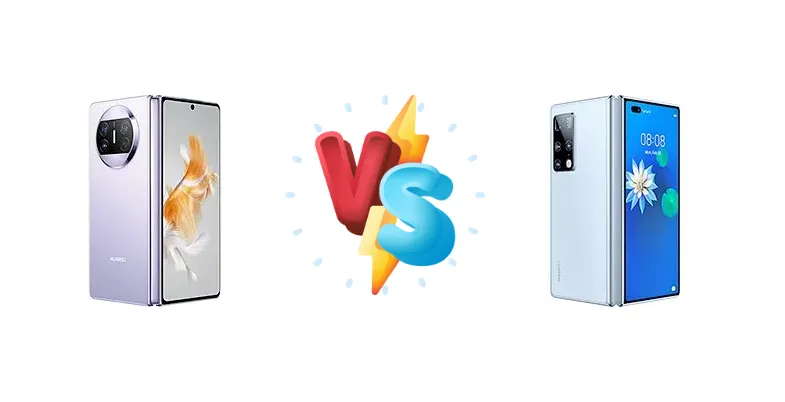
|
🏆 Quick Verdict
The Huawei Mate X3 emerges as the clear winner, boasting a brighter display, a more powerful Snapdragon 8+ Gen 1 chipset, and slightly improved battery life. While the Mate X2 remains a capable device, the X3’s upgrades make it the superior choice for those seeking the latest foldable technology.
| PHONES | ||
|---|---|---|
| Phone Names | Huawei Mate X3 | Huawei Mate X2 |
| Network | ||
|---|---|---|
| 2G bands | GSM 850 / 900 / 1800 / 1900 | GSM 850 / 900 / 1800 / 1900 |
| 3G bands | HSDPA 800 / 850 / 900 / 1700(AWS) / 1900 / 2100 | HSDPA 800 / 850 / 900 / 1700(AWS) / 1900 / 2100 |
| 4G bands | 1, 2, 3, 4, 5, 7, 8, 12, 17, 18, 19, 20, 26, 28, 34, 38, 39, 40, 41 | 1, 2, 3, 4, 5, 6, 7, 8, 9, 12, 17, 18, 19, 20, 26, 34, 38, 39, 40, 41 |
| 5G bands | - | 1, 3, 28, 38, 40, 41, 77, 78, 79, 80, 84 SA/NSA |
| Speed | HSPA, LTE | HSPA, LTE, 5G |
| Technology | GSM / CDMA / HSPA / EVDO / LTE | GSM / CDMA / HSPA / EVDO / LTE / 5G |
| CDMA2000 1xEV-DO | CDMA2000 1xEV-DO | |
| Launch | ||
|---|---|---|
| Announced | 2023, March 23 | 2021, February 22 |
| Status | Available. Released 2023, April 08 | Available. Released 2021, February 25 |
| Body | ||
|---|---|---|
| Build | Glass front, glass back or eco leather back, aluminum frame | Glass front, glass back, aluminum frame |
| Dimensions | Unfolded: 156.9 x 141.5 x 5.3 mmFolded: 156.9 x 72.4 x 11.1 mm | Unfolded: 161.8 x 145.8 x 8.2 mmFolded: 161.8 x 74.6 x 14.7 mm |
| SIM | Nano-SIM + Nano-SIM | Nano-SIM + Nano-SIM |
| Weight | 239 g or 241 g (8.43 oz) | 295 g (10.41 oz) |
| IPX8 dust/water resistant (up to 1.5m for 30 min) | - | |
| Display | ||
|---|---|---|
| Protection | Kunlun Glass (cover display only) | - |
| Resolution | 2224 x 2496 pixels (~426 ppi density) | 2200 x 2480 pixels (~413 ppi density) |
| Size | 7.85 inches, 197.5 cm2 (~88.9% screen-to-body ratio) | 8.0 inches, 206.0 cm2 (~87.3% screen-to-body ratio) |
| Type | Foldable OLED, 1B colors, 120Hz | Foldable OLED, 90Hz |
| Cover display: OLED, 120Hz, 6.4 inches, 1080 x 2504 pixels | Cover display: OLED, 90Hz, 6.45 inches, 1160 x 2700 pixels | |
| Platform | ||
|---|---|---|
| CPU | Octa-core (1x3.19 GHz Cortex-X2 & 3x2.75 GHz Cortex-A710 & 4x2.0 GHz Cortex-A510) | Octa-core (1x3.13 GHz Cortex-A77 & 3x2.54 GHz Cortex-A77 & 4x2.05 GHz Cortex-A55) |
| Chipset | Qualcomm SM8475 Snapdragon 8+ Gen 1 4G (4 nm) | Kirin 9000 5G (5 nm) |
| GPU | Adreno 730 | Mali-G78 MP24 |
| OS | HarmonyOS 3.1 (China), EMUI 13.1 (Europe), no Google Play Services | Android 10, EMUI 11, no Google Play Services |
| Memory | ||
|---|---|---|
| Card slot | Nano Memory (uses shared SIM slot) | Nano Memory (uses shared SIM slot) |
| Internal | 256GB 12GB RAM, 512GB 12GB RAM, 1TB 12GB RAM | 256GB 8GB RAM, 512GB 8GB RAM, 512GB 12GB RAM |
| UFS | UFS 3.X | |
| Main Camera | ||
|---|---|---|
| Features | Laser AF, color spectrum sensor, LED flash, panorama, HDR | Laser AF, color spectrum sensor, Leica optics, LED flash, panorama, HDR |
| Quad | - | 50 MP, f/1.9, 23mm (wide), 1/1.28", 1.22µm, multi-directional PDAF, OIS 12 MP, f/2.4, 70mm (telephoto), PDAF, OIS, 3x optical zoom 8 MP, f/4.4, 240mm (periscope telephoto), PDAF, OIS, 10x optical zoom 16 MP, f/2.2, 17mm (ultrawide), AF |
| Triple | 50 MP, f/1.8, 23mm (wide), PDAF, OIS 12 MP, f/3.4, 125mm (periscope telephoto), PDAF, OIS, 5x optical zoom 13 MP, f/2.2, 13mm (ultrawide), AF | - |
| Video | 4K@30/60fps, 1080p@30/60fps, gyro-EIS | 4K@30/60fps, 1080p@30/60fps, gyro-EIS |
| Selfie camera | ||
|---|---|---|
| Features | HDR, panorama | HDR, panorama |
| Single | 8 MP, f/2.4, (wide) Cover camera: 8 MP, f/2.4, (wide) | 16 MP, f/2.2, (wide) |
| Video | 4K@30fps, 1080p@30fps | 1080p@30fps |
| Sound | ||
|---|---|---|
| 3.5mm jack | No | No |
| 35mm jack | No | No |
| Loudspeaker | Yes, with stereo speakers | Yes, with stereo speakers |
| Comms | ||
|---|---|---|
| Bluetooth | 5.2, A2DP, LE | 5.2, A2DP, LE |
| Infrared port | Yes | Yes |
| NFC | Yes | Yes |
| Positioning | GPS (L1+L5), GLONASS (B1I+B1c+B2a), BDS (B1I+B1c+B2a), GALILEO (E1+E5a), QZSS (L1+L5), NavIC | GPS (L1+L5), GLONASS (L1), BDS (B1I+B1c+B2a+B2b), GALILEO (E1+E5a+E5b), QZSS (L1+L5), NavIC |
| Radio | No | No |
| USB | USB Type-C 3.1, DisplayPort 1.2, OTG | USB Type-C 3.1, OTG |
| WLAN | Wi-Fi 802.11 a/b/g/n/ac/6, dual-band, Wi-Fi Direct | Wi-Fi 802.11 a/b/g/n/ac/6, dual-band, Wi-Fi Direct |
| Features | ||
|---|---|---|
| Sensors | Fingerprint (side-mounted), accelerometer, gyro, proximity, compass, barometer, altimeter | Fingerprint (side-mounted), accelerometer, gyro, proximity, compass, barometer |
| BDS Satellite Message | - | |
| Battery | ||
|---|---|---|
| Charging | 66W wired 50W wireless 7.5W reverse wireless | 55W wired |
| Type | Market-dependent versions:· Li-Po 4800 mAh (Global)· Si/C Li-Ion 5060 mAh (China only) | Li-Po 4500 mAh |
| Misc | ||
|---|---|---|
| Colors | Black, White, Violet, Dark Green, Gold | Black, White, Light Blue, Rose Gold, Collector’s Edition Black/White/Red |
| Models | ALT-AL00, ALT-L29 | TET-AN00 |
| Price | About 1500 EUR | About 2300 EUR |
| Tests | ||
|---|---|---|
| Battery life | Endurance rating 81h | Endurance rating 74h |
| Camera | Photo / Video | Photo / Video |
| Display | Contrast ratio: Infinite (nominal) | Contrast ratio: Infinite (nominal) |
| Loudspeaker | -26.3 LUFS (Good) | -26.8 LUFS (Good) |
| Performance | AnTuTu: 993592 (v9) GeekBench: 4283 (v5.5), 4512 (v6) GFXBench: 41fps (ES 3.1 onscreen) | AnTuTu: 632818 (v8) GeekBench: 14393 (v4.4), 3389 (v5.1) GFXBench: 29fps (ES 3.1 onscreen) |
Huawei Mate X3
- Brighter Display
- More Powerful Processor (Snapdragon 8+ Gen 1)
- Slightly Better Battery Life
- Faster Charging (Wired & Wireless)
- Improved Build Quality (Generally)
- Higher Price
- Limited Software Support (due to US sanctions)
Huawei Mate X2
- Lower Price
- Capable Performance
- Good Camera System
- Still a Functional Foldable
- Dimmer Display
- Older Processor (Kirin 9000)
- Slightly Shorter Battery Life
- Less Refined Design (Compared to X3)
Display Comparison
The Mate X3’s display shines with a measured peak brightness of 926 nits, significantly outperforming the Mate X2’s 542 nits. Both offer excellent contrast ratios (infinite nominal), but the X3’s brightness provides better visibility in outdoor conditions. The foldable nature of both screens remains a key feature, offering a tablet-like experience when unfolded.
Camera Comparison
While both phones feature capable camera systems, detailed camera comparisons require more in-depth testing. However, the Snapdragon 8+ Gen 1 in the X3 often includes improved image signal processing (ISP) capabilities, potentially leading to better image quality and video recording. Both offer versatile camera setups for various shooting scenarios.
Performance
The Mate X3’s Qualcomm Snapdragon 8+ Gen 1 chipset provides a noticeable performance boost over the Mate X2’s Kirin 9000. The Snapdragon offers improved efficiency and raw processing power, resulting in smoother multitasking and faster app loading times. Both devices handle demanding games well, but the X3 has a slight edge.
Battery Life
The Mate X3 secures a slight advantage in battery life, boasting an endurance rating of 81 hours compared to the Mate X2’s 74 hours. Both offer fast charging capabilities, with the X3 supporting 66W wired charging and 50W wireless charging, while the X2 offers 55W wired. Reverse wireless charging is also available on the X3.
Buying Guide
The Huawei Mate X3 is ideal for users who prioritize performance, a vibrant display, and the latest hardware. It's a premium choice for those willing to invest in cutting-edge foldable technology. The Mate X2 is a good option for budget-conscious buyers who still want a foldable experience, but are less concerned with having the absolute best specs.