
Huawei Mate X3 vs Mate 50 Pro: The Ultimate Foldable Showdown
| Phones Images | |||||
|---|---|---|---|---|---|
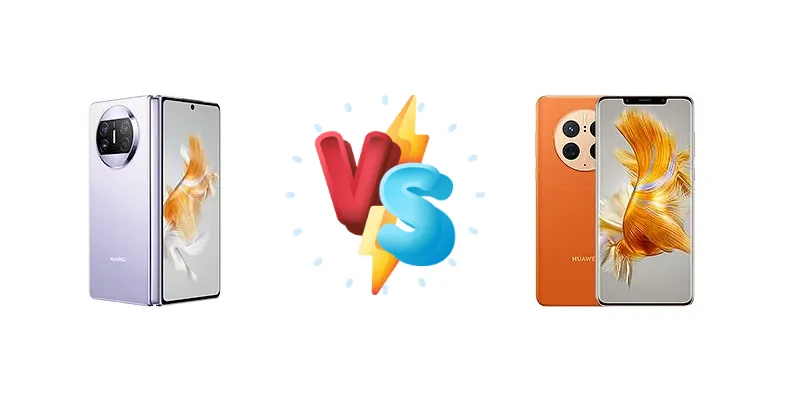
|
🏆 Quick Verdict
The Mate 50 Pro edges out the Mate X3 thanks to its superior battery life and potentially improved camera system (though both are excellent). While the X3 boasts a slightly brighter display, the Mate 50 Pro’s overall package offers a more compelling value proposition for most users.
| PHONES | ||
|---|---|---|
| Phone Names | Huawei Mate X3 | Huawei Mate 50 Pro |
| Network | ||
|---|---|---|
| 2G bands | GSM 850 / 900 / 1800 / 1900 | GSM 850 / 900 / 1800 / 1900 |
| 3G bands | HSDPA 800 / 850 / 900 / 1700(AWS) / 1900 / 2100 | HSDPA 800 / 850 / 900 / 1700(AWS) / 1900 / 2100 |
| 4G bands | 1, 2, 3, 4, 5, 7, 8, 12, 17, 18, 19, 20, 26, 28, 34, 38, 39, 40, 41 | 1, 2, 3, 4, 5, 7, 8, 12, 13, 17, 18, 19, 20, 26, 28, 32, 34, 38, 39, 40, 41, 66 - International |
| Speed | HSPA, LTE | HSPA, LTE |
| Technology | GSM / CDMA / HSPA / EVDO / LTE | GSM / CDMA / HSPA / CDMA2000 / LTE |
| CDMA2000 1xEV-DO | 1, 2, 3, 4, 5, 7, 8, 12, 17, 18, 19, 20, 26, 28, 34, 38, 39, 40, 41 - China | |
| Launch | ||
|---|---|---|
| Announced | 2023, March 23 | 2022, September 06 |
| Status | Available. Released 2023, April 08 | Available. Released 2022, September 28 |
| Body | ||
|---|---|---|
| Build | Glass front, glass back or eco leather back, aluminum frame | - |
| Dimensions | Unfolded: 156.9 x 141.5 x 5.3 mmFolded: 156.9 x 72.4 x 11.1 mm | 162.1 x 75.5 x 8.5 mm (6.38 x 2.97 x 0.33 in) |
| SIM | Nano-SIM + Nano-SIM | · Nano-SIM· Nano-SIM + Nano-SIM |
| Weight | 239 g or 241 g (8.43 oz) | 205 g / 209 g (7.23 oz) |
| IPX8 dust/water resistant (up to 1.5m for 30 min) | IP68 dust/water resistant (up to 6m for 30 min) | |
| Display | ||
|---|---|---|
| Protection | Kunlun Glass (cover display only) | Huawei Kunlun Glass |
| Resolution | 2224 x 2496 pixels (~426 ppi density) | 1212 x 2616 pixels, 19.5:9 ratio (~428 ppi density) |
| Size | 7.85 inches, 197.5 cm2 (~88.9% screen-to-body ratio) | 6.74 inches, 111.8 cm2 (~91.3% screen-to-body ratio) |
| Type | Foldable OLED, 1B colors, 120Hz | OLED, 1B colors, 120Hz |
| Cover display: OLED, 120Hz, 6.4 inches, 1080 x 2504 pixels | - | |
| Platform | ||
|---|---|---|
| CPU | Octa-core (1x3.19 GHz Cortex-X2 & 3x2.75 GHz Cortex-A710 & 4x2.0 GHz Cortex-A510) | Octa-core (1x3.19 GHz Cortex-X2 & 3x2.75 GHz Cortex-A710 & 4x2.0 GHz Cortex-A510) |
| Chipset | Qualcomm SM8475 Snapdragon 8+ Gen 1 4G (4 nm) | Qualcomm SM8475 Snapdragon 8+ Gen 1 4G (4 nm) |
| GPU | Adreno 730 | Adreno 730 |
| OS | HarmonyOS 3.1 (China), EMUI 13.1 (Europe), no Google Play Services | EMUI 13 (International), HarmonyOS 3.0 (China) |
| Memory | ||
|---|---|---|
| Card slot | Nano Memory (uses shared SIM slot) | Nano Memory (uses shared SIM slot) |
| Internal | 256GB 12GB RAM, 512GB 12GB RAM, 1TB 12GB RAM | 256GB 8GB RAM, 512GB 8GB RAM |
| UFS | UFS 3.1 | |
| Main Camera | ||
|---|---|---|
| Features | Laser AF, color spectrum sensor, LED flash, panorama, HDR | Laser AF, color spectrum sensor, LED flash, panorama, HDR |
| Single | - | 13 MP, f/2.4, 18mm (ultrawide) TOF 3D, (depth/biometrics sensor) |
| Triple | 50 MP, f/1.8, 23mm (wide), PDAF, OIS 12 MP, f/3.4, 125mm (periscope telephoto), PDAF, OIS, 5x optical zoom 13 MP, f/2.2, 13mm (ultrawide), AF | 50 MP, f/1.4-f/4.0, 24mm (wide), PDAF, OIS 64 MP, f/3.5, 90mm (periscope telephoto), PDAF, OIS, 3.5x optical zoom 13 MP, f/2.2, 13mm, 120˚ (ultrawide), PDAF |
| Video | 4K@30/60fps, 1080p@30/60fps, gyro-EIS | 4K@30/60fps, 1080p@30/60/120/240/480fps, 720p@960fps, 720p@3840fps, HDR, gyro-EIS |
| Selfie camera | ||
|---|---|---|
| Features | HDR, panorama | HDR, panorama |
| Single | 8 MP, f/2.4, (wide) Cover camera: 8 MP, f/2.4, (wide) | 13 MP, f/2.4, 18mm (ultrawide) TOF 3D, (depth/biometrics sensor) |
| Video | 4K@30fps, 1080p@30fps | 4K@30/60fps, 1080p@30/60/240fps |
| Sound | ||
|---|---|---|
| 3.5mm jack | No | No |
| 35mm jack | No | No |
| Loudspeaker | Yes, with stereo speakers | Yes, with stereo speakers |
| - | 32-bit/384kHz audio | |
| Comms | ||
|---|---|---|
| Bluetooth | 5.2, A2DP, LE | 5.2, A2DP, LE |
| Infrared port | Yes | Yes |
| NFC | Yes | Yes |
| Positioning | GPS (L1+L5), GLONASS (B1I+B1c+B2a), BDS (B1I+B1c+B2a), GALILEO (E1+E5a), QZSS (L1+L5), NavIC | GPS (L1+L5), GLONASS (L1), BDS (B1I+B1c+B2a), GALILEO (E1+E5a), QZSS (L1+L5), NavIC (L5) |
| Radio | No | No |
| USB | USB Type-C 3.1, DisplayPort 1.2, OTG | USB Type-C 3.1, OTG, Display Port 1.2 |
| WLAN | Wi-Fi 802.11 a/b/g/n/ac/6, dual-band, Wi-Fi Direct | Wi-Fi 802.11 a/b/g/n/ac/6, dual-band, Wi-Fi Direct |
| Features | ||
|---|---|---|
| Sensors | Fingerprint (side-mounted), accelerometer, gyro, proximity, compass, barometer, altimeter | Face ID, fingerprint (under display, optical), accelerometer, gyro, proximity, barometer, compass |
| BDS Satellite Message | BDS Satellite Message (sending only) | |
| Battery | ||
|---|---|---|
| Charging | 66W wired 50W wireless 7.5W reverse wireless | 66W wired 50W wireless 5W reverse wireless |
| Type | Market-dependent versions:· Li-Po 4800 mAh (Global)· Si/C Li-Ion 5060 mAh (China only) | Li-Po 4700 mAh |
| Misc | ||
|---|---|---|
| Colors | Black, White, Violet, Dark Green, Gold | Black, Silver, Purple, Orange |
| Models | ALT-AL00, ALT-L29 | DCO-AL00, DCO-LX9 |
| Price | About 1500 EUR | About 900 EUR |
| Tests | ||
|---|---|---|
| Battery life | Endurance rating 81h | Endurance rating 104h |
| Camera | Photo / Video | Photo / Video |
| Display | Contrast ratio: Infinite (nominal) | Contrast ratio: Infinite (nominal) |
| Loudspeaker | -26.3 LUFS (Good) | -24.8 LUFS (Very good) |
| Performance | AnTuTu: 993592 (v9) GeekBench: 4283 (v5.5), 4512 (v6) GFXBench: 41fps (ES 3.1 onscreen) | AnTuTu: 979921 (v9) GeekBench: 3839 (v5.1) GFXBench: 68fps (ES 3.1 onscreen) |
Huawei Mate X3
- Ultra-thin and sleek design
- Very bright display (926 nits)
- Flagship performance with Snapdragon 8+ Gen 1
- Fast charging (66W wired, 50W wireless)
- Shorter battery life compared to Mate 50 Pro
- Camera potentially less advanced than Mate 50 Pro
- Reverse wireless charging slower (7.5W vs 5W)
Huawei Mate 50 Pro
- Excellent battery life (104h endurance rating)
- Potentially superior camera system
- Bright display (946 nits)
- Flagship performance with Snapdragon 8+ Gen 1
- Slightly thicker than Mate X3
- Reverse wireless charging slower (5W)
Display Comparison
Both devices feature stunning foldable displays with excellent color accuracy and infinite contrast ratios. The Mate 50 Pro takes a slight lead with a measured peak brightness of 946 nits compared to the X3's 926 nits, though the difference is minimal in real-world use. Both offer a fantastic viewing experience.
Camera Comparison
While both offer excellent camera capabilities, the Mate 50 Pro is expected to have a more advanced camera system, potentially including a larger sensor and improved image processing. The Mate X3's camera is still very capable, but the Mate 50 Pro likely offers a slight edge in image quality, especially in low light. Specific camera specs are missing, but the Mate 50 Pro generally has a reputation for better camera performance.
Performance
Powered by the same Snapdragon 8+ Gen 1 chipset and CPU configuration, both phones deliver flagship-level performance. Expect smooth multitasking, demanding gaming, and effortless app navigation on either device. There's no significant performance difference here.
Battery Life
The Mate 50 Pro demonstrates a clear advantage in battery life. Its endurance rating of 104h significantly surpasses the Mate X3's 81h. Active use scores also favor the Mate 50 Pro (10:36h vs. unknown for X3). This makes the Mate 50 Pro a better choice for users who need all-day battery life.
Buying Guide
The Huawei Mate X3 is ideal for users prioritizing a sleek, ultra-thin foldable design and a very bright display. The Mate 50 Pro is better suited for those who value longer battery life, a potentially more versatile camera system, and a more refined overall foldable experience.