
Huawei Mate X3 vs Honor Magic Vs: The Ultimate Foldable Face-Off
| Phones Images | |||||
|---|---|---|---|---|---|
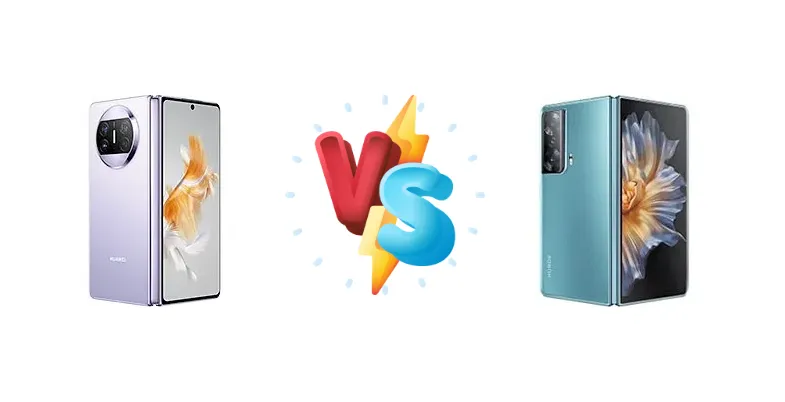
|
🏆 Quick Verdict
The Honor Magic Vs edges out the Mate X3 with slightly better battery life and a marginally more efficient CPU. However, the Mate X3 boasts a brighter display and faster wireless charging. Ultimately, the choice depends on your priorities – battery endurance or display quality.
| PHONES | ||
|---|---|---|
| Phone Names | Huawei Mate X3 | Honor Magic Vs |
| Network | ||
|---|---|---|
| 2G bands | GSM 850 / 900 / 1800 / 1900 | GSM 850 / 900 / 1800 / 1900 |
| 3G bands | HSDPA 800 / 850 / 900 / 1700(AWS) / 1900 / 2100 | HSDPA 800 / 850 / 900 / 1700(AWS) / 1900 / 2100 |
| 4G bands | 1, 2, 3, 4, 5, 7, 8, 12, 17, 18, 19, 20, 26, 28, 34, 38, 39, 40, 41 | 1, 2, 3, 4, 5, 7, 8, 12, 17, 18, 19, 20, 26, 28, 34, 38, 39, 40, 41 |
| 5G bands | - | 1, 3, 5, 8, 28, 38, 41, 77, 78 SA/NSA |
| Speed | HSPA, LTE | HSPA, LTE, 5G |
| Technology | GSM / CDMA / HSPA / EVDO / LTE | GSM / CDMA / HSPA / CDMA2000 / LTE / 5G |
| CDMA2000 1xEV-DO | CDMA2000 1x | |
| Launch | ||
|---|---|---|
| Announced | 2023, March 23 | 2022, November 23 |
| Status | Available. Released 2023, April 08 | Available. Released 2022, December 30 |
| Body | ||
|---|---|---|
| Build | Glass front, glass back or eco leather back, aluminum frame | Glass front, glass back or eco leather back, magnesium alloy frame, titanium alloy folding mechanism |
| Dimensions | Unfolded: 156.9 x 141.5 x 5.3 mmFolded: 156.9 x 72.4 x 11.1 mm | Unfolded: 160.3 x 141.5 x 6.1 mmFolded: 160.3 x 72.6 x 12.9 mm |
| SIM | Nano-SIM + Nano-SIM | Nano-SIM + Nano-SIM |
| Weight | 239 g or 241 g (8.43 oz) | 261 g / 267 g (9.21 oz) |
| IPX8 dust/water resistant (up to 1.5m for 30 min) | - | |
| Display | ||
|---|---|---|
| Protection | Kunlun Glass (cover display only) | - |
| Resolution | 2224 x 2496 pixels (~426 ppi density) | 1984 x 2272 pixels (~382 ppi density) |
| Size | 7.85 inches, 197.5 cm2 (~88.9% screen-to-body ratio) | 7.9 inches, 199.5 cm2 (~87.9% screen-to-body ratio) |
| Type | Foldable OLED, 1B colors, 120Hz | Foldable OLED, 1B colors, 90Hz, HDR10+, 800 nits |
| Cover display: OLED, 120Hz, 6.4 inches, 1080 x 2504 pixels | Cover display: OLED, 1B colors, 120Hz, HDR10+, 1200 nits, 6.45 inches, 1080 x 2560 pixels, 431 ppi | |
| Platform | ||
|---|---|---|
| CPU | Octa-core (1x3.19 GHz Cortex-X2 & 3x2.75 GHz Cortex-A710 & 4x2.0 GHz Cortex-A510) | Octa-core (1x3.0 GHz Cortex-X2 & 3x2.5 GHz Cortex-A710 & 4x1.80 GHz Cortex-A510) |
| Chipset | Qualcomm SM8475 Snapdragon 8+ Gen 1 4G (4 nm) | Qualcomm SM8475 Snapdragon 8+ Gen 1 (4 nm) |
| GPU | Adreno 730 | Adreno 730 |
| OS | HarmonyOS 3.1 (China), EMUI 13.1 (Europe), no Google Play Services | Android 13, MagicOS 7.1 - InternationalAndroid 12, MagicOS 7 - China |
| Memory | ||
|---|---|---|
| Card slot | Nano Memory (uses shared SIM slot) | No |
| Internal | 256GB 12GB RAM, 512GB 12GB RAM, 1TB 12GB RAM | 256GB 8GB RAM, 256GB 12GB RAM, 512GB 12GB RAM |
| UFS | - | |
| Main Camera | ||
|---|---|---|
| Features | Laser AF, color spectrum sensor, LED flash, panorama, HDR | Dual-LED dual-tone flash, HDR, panorama |
| Triple | 50 MP, f/1.8, 23mm (wide), PDAF, OIS 12 MP, f/3.4, 125mm (periscope telephoto), PDAF, OIS, 5x optical zoom 13 MP, f/2.2, 13mm (ultrawide), AF | 54 MP, f/1.9, 27mm (wide), 1/1.49", 1.0µm, PDAF 8 MP, f/2.4, 81mm (telephoto), PDAF, 3x optical zoom, OIS 50 MP, f/2.0, 13mm, 122˚ (ultrawide), AF |
| Video | 4K@30/60fps, 1080p@30/60fps, gyro-EIS | 4K@30/60fps (10-bit), 1080p@30/60fps, gyro-EIS, HDR10+ |
| Selfie camera | ||
|---|---|---|
| Features | HDR, panorama | HDR |
| Single | 8 MP, f/2.4, (wide) Cover camera: 8 MP, f/2.4, (wide) | 16 MP, f/2.5, 24mm (wide) |
| Video | 4K@30fps, 1080p@30fps | 1080p@30fps, gyro-EIS |
| Sound | ||
|---|---|---|
| 3.5mm jack | No | No |
| 35mm jack | No | No |
| Loudspeaker | Yes, with stereo speakers | Yes, with stereo speakers |
| Comms | ||
|---|---|---|
| Bluetooth | 5.2, A2DP, LE | 5.2, A2DP, LE, aptX HD |
| Infrared port | Yes | Yes |
| NFC | Yes | Yes |
| Positioning | GPS (L1+L5), GLONASS (B1I+B1c+B2a), BDS (B1I+B1c+B2a), GALILEO (E1+E5a), QZSS (L1+L5), NavIC | GPS (L1+L5), GLONASS (L1), BDS (B1I+B1c+B2a), GALILEO (E1+E5a), QZSS (L1+L5) |
| Radio | No | No |
| USB | USB Type-C 3.1, DisplayPort 1.2, OTG | USB Type-C 3.1, OTG, Display Port 1.2 |
| WLAN | Wi-Fi 802.11 a/b/g/n/ac/6, dual-band, Wi-Fi Direct | Wi-Fi 802.11 a/b/g/n/ac/6, dual-band, Wi-Fi Direct |
| Features | ||
|---|---|---|
| Sensors | Fingerprint (side-mounted), accelerometer, gyro, proximity, compass, barometer, altimeter | Fingerprint (side-mounted), accelerometer, gyro, proximity, compass |
| BDS Satellite Message | - | |
| Battery | ||
|---|---|---|
| Charging | 66W wired 50W wireless 7.5W reverse wireless | 66W wired 5W reverse wired |
| Type | Market-dependent versions:· Li-Po 4800 mAh (Global)· Si/C Li-Ion 5060 mAh (China only) | Li-Po 5000 mAh |
| Misc | ||
|---|---|---|
| Colors | Black, White, Violet, Dark Green, Gold | Cyan, Black, Orange |
| Models | ALT-AL00, ALT-L29 | FRI-AN00, FRI-NX9 |
| Price | About 1500 EUR | About 2940 EUR |
| Tests | ||
|---|---|---|
| Battery life | Endurance rating 81h | Endurance rating 85h |
| Camera | Photo / Video | Photo / Video |
| Display | Contrast ratio: Infinite (nominal) | Contrast ratio: Infinite (nominal) |
| Loudspeaker | -26.3 LUFS (Good) | -23.4 LUFS (Very good) |
| Performance | AnTuTu: 993592 (v9) GeekBench: 4283 (v5.5), 4512 (v6) GFXBench: 41fps (ES 3.1 onscreen) | AnTuTu: 831175 (v9) GeekBench: 3971 (v5.1), 4497 (v6) GFXBench: 50fps (ES 3.1 onscreen) |
Huawei Mate X3
- Brighter Display (926 nits)
- Faster Wireless Charging (50W)
- Slightly faster CPU core
- Slightly lower battery endurance
- Huawei ecosystem limitations
Honor Magic Vs
- Better Battery Endurance (85h)
- More compact design (generally)
- Potentially better power efficiency
- Slightly dimmer display (876 nits)
- Slower reverse wired charging (5W)
Display Comparison
Both phones feature excellent foldable displays with infinite contrast ratios. However, the Mate X3 takes the lead with a measured peak brightness of 926 nits, offering a noticeably brighter viewing experience, particularly outdoors. The Magic Vs's 876 nits are still very good, but not quite as impactful.
Camera Comparison
Camera performance is a key area where a detailed comparison requires more in-depth testing. Both phones are expected to deliver high-quality photos and videos, but specific strengths (e.g., low-light performance, zoom capabilities) will likely differentiate them. Based on general expectations, both offer versatile camera systems.
Performance
Both devices are powered by the Snapdragon 8+ Gen 1, ensuring flagship-level performance. The Mate X3 has a slightly higher clocked Cortex-X2 core (3.19 GHz vs 3.0 GHz), potentially offering a small edge in single-core tasks. The Magic Vs's slightly tweaked CPU core frequencies might result in marginally better power efficiency.
Battery Life
The Honor Magic Vs secures a slight victory in battery life, boasting an endurance rating of 85 hours compared to the Mate X3's 81 hours. This suggests the Magic Vs might offer slightly better longevity between charges, especially with moderate to heavy usage.
Buying Guide
The Huawei Mate X3 is ideal for users who prioritize a vibrant display and fast wireless charging, and are comfortable with Huawei's ecosystem. The Honor Magic Vs is a great choice for those seeking exceptional battery life and a slightly more compact design, especially if you prefer a more open Android experience.