
Huawei Mate X3 vs Google Pixel Fold: The Ultimate Foldable Face-Off
| Phones Images | |||||
|---|---|---|---|---|---|
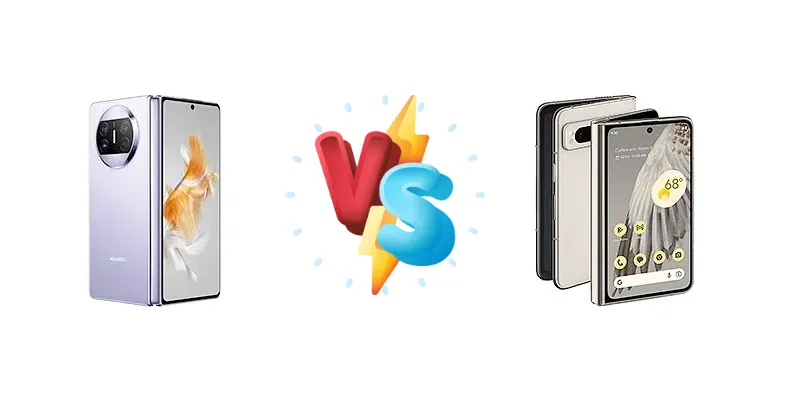
|
🏆 Quick Verdict
The Mate X3 boasts impressive battery life and a brighter display, while the Pixel Fold leverages Google's software expertise and Tensor G2 chip. The Mate X3 is a hardware powerhouse, while the Pixel Fold excels in software integration and camera capabilities. It depends on your priorities.
| PHONES | ||
|---|---|---|
| Phone Names | Huawei Mate X3 | Google Pixel Fold |
| Network | ||
|---|---|---|
| 2G bands | GSM 850 / 900 / 1800 / 1900 | GSM 850 / 900 / 1800 / 1900 |
| 3G bands | HSDPA 800 / 850 / 900 / 1700(AWS) / 1900 / 2100 | HSDPA 800 / 850 / 900 / 1700(AWS) / 1900 / 2100 |
| 4G bands | 1, 2, 3, 4, 5, 7, 8, 12, 17, 18, 19, 20, 26, 28, 34, 38, 39, 40, 41 | 1, 2, 3, 4, 5, 7, 8, 12, 13, 14, 17, 18, 19, 20, 21, 25, 26, 28, 29, 30, 32, 38, 39, 40, 41, 42, 46, 48, 66, 71 |
| 5G bands | - | 1, 2, 3, 5, 7, 8, 12, 14, 20, 25, 28, 30, 38, 40, 41, 48, 66, 71, 75, 76, 77, 78, 79, 257, 258, 260, 261 SA/NSA/Sub6/mmWave |
| Speed | HSPA, LTE | HSPA, LTE, 5G |
| Technology | GSM / CDMA / HSPA / EVDO / LTE | GSM / CDMA / HSPA / EVDO / LTE / 5G |
| CDMA2000 1xEV-DO | CDMA2000 1xEV-DO | |
| Launch | ||
|---|---|---|
| Announced | 2023, March 23 | 2023, May 10 |
| Status | Available. Released 2023, April 08 | Available. Released 2023, June 27 |
| Body | ||
|---|---|---|
| Build | Glass front, glass back or eco leather back, aluminum frame | Glass front (Gorilla Glass Victus) (folded), plastic front (unfolded), glass back (Gorilla Glass Victus), aluminum frame |
| Dimensions | Unfolded: 156.9 x 141.5 x 5.3 mmFolded: 156.9 x 72.4 x 11.1 mm | Unfolded: 139.7 x 158.7 x 5.8 mmFolded: 139.7 x 79.5 x 12.1 mm |
| SIM | Nano-SIM + Nano-SIM | Nano-SIM + eSIM |
| Weight | 239 g or 241 g (8.43 oz) | 283 g (9.98 oz) |
| IPX8 dust/water resistant (up to 1.5m for 30 min) | IPX8 water resistant | |
| Display | ||
|---|---|---|
| Protection | Kunlun Glass (cover display only) | - |
| Resolution | 2224 x 2496 pixels (~426 ppi density) | 1840 x 2208 pixels (~378 ppi density) |
| Size | 7.85 inches, 197.5 cm2 (~88.9% screen-to-body ratio) | 7.6 inches, 183.3 cm2 (~82.7% screen-to-body ratio) |
| Type | Foldable OLED, 1B colors, 120Hz | Foldable OLED, 120Hz, HDR10+, 1000 nits (HBM), 1450 nits (peak) |
| Cover display: OLED, 120Hz, 6.4 inches, 1080 x 2504 pixels | Cover display: OLED, 120Hz, HDR, Corning Gorilla Glass Victus 5.8 inches, 1080 x 2092 pixels, 17.4:9 ratio, 408 ppi 1200 nits (HBM), 1550 nits (peak) | |
| Platform | ||
|---|---|---|
| CPU | Octa-core (1x3.19 GHz Cortex-X2 & 3x2.75 GHz Cortex-A710 & 4x2.0 GHz Cortex-A510) | Octa-core (2x2.85 GHz Cortex-X1 & 2x2.35 GHz Cortex-A78 & 4x1.80 GHz Cortex-A55) |
| Chipset | Qualcomm SM8475 Snapdragon 8+ Gen 1 4G (4 nm) | Google Tensor G2 (5 nm) |
| GPU | Adreno 730 | Mali-G710 MP7 |
| OS | HarmonyOS 3.1 (China), EMUI 13.1 (Europe), no Google Play Services | Android 13, upgradable to Android 15, up to 5 major Android upgrades |
| Memory | ||
|---|---|---|
| Card slot | Nano Memory (uses shared SIM slot) | No |
| Internal | 256GB 12GB RAM, 512GB 12GB RAM, 1TB 12GB RAM | 256GB 12GB RAM, 512GB 12GB RAM |
| UFS | UFS 3.1 | |
| Main Camera | ||
|---|---|---|
| Features | Laser AF, color spectrum sensor, LED flash, panorama, HDR | Laser AF, Dual-LED flash, HDR, panorama |
| Triple | 50 MP, f/1.8, 23mm (wide), PDAF, OIS 12 MP, f/3.4, 125mm (periscope telephoto), PDAF, OIS, 5x optical zoom 13 MP, f/2.2, 13mm (ultrawide), AF | 48 MP, f/1.7, 25mm (wide), 1/2.0", 0.8µm, dual pixel PDAF, OIS 10.8 MP, f/3.1, 112mm (telephoto), 1/3.1", 1.22µm, dual pixel PDAF, OIS, 5x optical zoom 10.8 MP, f/2.2, 121˚, (ultrawide), 1/3.0", 1.25µm |
| Video | 4K@30/60fps, 1080p@30/60fps, gyro-EIS | 4K@30/60fps, 1080p@30/60/120/240fps, 10-bit HDR |
| Selfie camera | ||
|---|---|---|
| Features | HDR, panorama | HDR, panorama |
| Single | 8 MP, f/2.4, (wide) Cover camera: 8 MP, f/2.4, (wide) | 8 MP, f/2.0, 24mm (wide), 1/4.0", 1.12µm Cover camera: 9.5 MP, f/2.2, 24mm (wide), 1.22µm, dual pixel PDAF |
| Video | 4K@30fps, 1080p@30fps | 4K@30/60fps, 1080p@30/60fps |
| Sound | ||
|---|---|---|
| 3.5mm jack | No | No |
| 35mm jack | No | No |
| Loudspeaker | Yes, with stereo speakers | Yes, with stereo speakers |
| Comms | ||
|---|---|---|
| Bluetooth | 5.2, A2DP, LE | 5.2, A2DP, LE, aptX HD |
| Infrared port | Yes | - |
| NFC | Yes | Yes |
| Positioning | GPS (L1+L5), GLONASS (B1I+B1c+B2a), BDS (B1I+B1c+B2a), GALILEO (E1+E5a), QZSS (L1+L5), NavIC | GPS, GLONASS, GALILEO, BDS |
| Radio | No | No |
| USB | USB Type-C 3.1, DisplayPort 1.2, OTG | USB Type-C 3.2, OTG |
| WLAN | Wi-Fi 802.11 a/b/g/n/ac/6, dual-band, Wi-Fi Direct | Wi-Fi 802.11 a/b/g/n/ac/6e, tri-band, Wi-Fi Direct |
| Features | ||
|---|---|---|
| Sensors | Fingerprint (side-mounted), accelerometer, gyro, proximity, compass, barometer, altimeter | Fingerprint (side-mounted), accelerometer, gyro, proximity, compass, barometer |
| BDS Satellite Message | Ultra Wideband (UWB) support | |
| Battery | ||
|---|---|---|
| Charging | 66W wired 50W wireless 7.5W reverse wireless | Wired, PD3.0 Wireless |
| Type | Market-dependent versions:· Li-Po 4800 mAh (Global)· Si/C Li-Ion 5060 mAh (China only) | Li-Po 4821 mAh |
| Misc | ||
|---|---|---|
| Colors | Black, White, Violet, Dark Green, Gold | Porcelain, Obsidian |
| Models | ALT-AL00, ALT-L29 | G9FPL |
| Price | About 1500 EUR | € 670.87 / $ 389.26 / £ 899.99 |
| Tests | ||
|---|---|---|
| Battery life | Endurance rating 81h | - |
| Camera | Photo / Video | - |
| Display | Contrast ratio: Infinite (nominal) | - |
| Loudspeaker | -26.3 LUFS (Good) | - |
| Performance | AnTuTu: 993592 (v9) GeekBench: 4283 (v5.5), 4512 (v6) GFXBench: 41fps (ES 3.1 onscreen) | - |
Huawei Mate X3
- Exceptional battery life (81h endurance)
- Bright and vibrant display (926 nits)
- Powerful Snapdragon 8+ Gen 1 chipset
- Reverse wireless charging
- Limited software support (due to Huawei's situation)
- Availability may be restricted
- Potential lack of Google services
Google Pixel Fold
- Seamless Google integration
- Excellent camera with Google's computational photography
- Smooth and responsive Tensor G2 chip
- Refined software experience
- Battery life potentially less impressive than Mate X3
- Tensor G2 may not match Snapdragon 8+ Gen 1 in raw power
- Price point likely to be premium
Display Comparison
The Mate X3's display shines with a measured 926 nits of peak brightness, offering excellent outdoor visibility. While the Pixel Fold's display details are less readily available, it's expected to be a high-quality OLED panel. Contrast ratio on the Mate X3 is reported as 'Infinite' (nominal), suggesting exceptional blacks. The Pixel Fold likely offers a more color-accurate experience.
Camera Comparison
Both phones feature advanced camera systems. The Mate X3 is expected to have a versatile setup, likely including a main, ultrawide, and telephoto lens. The Pixel Fold leverages Google's renowned computational photography, promising exceptional image quality, especially in challenging lighting conditions. Pixel's software processing is a key advantage.
Performance
The Snapdragon 8+ Gen 1 in the Mate X3 is a formidable performer, known for its speed and efficiency. The Pixel Fold's Tensor G2 prioritizes AI and machine learning tasks, offering a smooth experience for everyday use and Google-specific features. Gaming performance is likely to be slightly better on the Mate X3.
Battery Life
The Mate X3 takes a clear lead in battery life, boasting an impressive endurance rating of 81 hours. The Pixel Fold's battery performance is expected to be good, but likely not as exceptional as the Mate X3. Both support wireless charging, with the Mate X3 also offering reverse wireless charging.
Buying Guide
The Huawei Mate X3 is ideal for users prioritizing battery life, a vibrant display, and raw processing power. The Google Pixel Fold is best suited for those deeply embedded in the Google ecosystem, valuing software optimization, and seeking a refined camera experience.