
Huawei Mate X2 vs Xiaomi Mix Fold 3: A Deep Dive into Foldable Flagships
| Phones Images | |||||
|---|---|---|---|---|---|
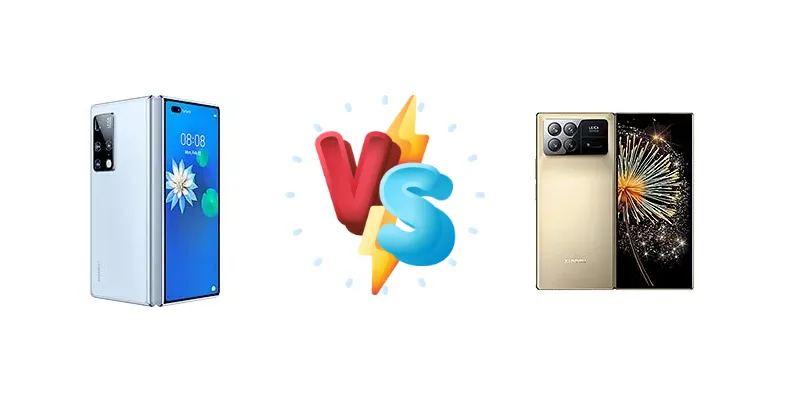
|
🏆 Quick Verdict
For most users, the Xiaomi Mix Fold 3 emerges as the superior choice. Its Snapdragon 8 Gen 2 chipset delivers substantially better performance and efficiency, while the 67W charging and 117-hour endurance rating address key foldable pain points. The Mate X2 remains a compelling option for those prioritizing a more established in-folding design.
| PHONES | ||
|---|---|---|
| Phone Names | Huawei Mate X2 | Xiaomi Mix Fold 3 |
| Network | ||
|---|---|---|
| 2G bands | GSM 850 / 900 / 1800 / 1900 | GSM 850 / 900 / 1800 / 1900 |
| 3G bands | HSDPA 800 / 850 / 900 / 1700(AWS) / 1900 / 2100 | HSDPA 800 / 850 / 900 / 1700(AWS) / 1900 / 2100 |
| 4G bands | 1, 2, 3, 4, 5, 6, 7, 8, 9, 12, 17, 18, 19, 20, 26, 34, 38, 39, 40, 41 | 1, 2, 3, 4, 5, 7, 8, 12, 17, 18, 19, 26, 34, 38, 39, 40, 41, 42 |
| 5G bands | 1, 3, 28, 38, 40, 41, 77, 78, 79, 80, 84 SA/NSA | 1, 3, 5, 8, 28, 38, 40, 41, 77, 78, 79 SA/NSA |
| Speed | HSPA, LTE, 5G | HSPA, LTE, 5G |
| Technology | GSM / CDMA / HSPA / EVDO / LTE / 5G | GSM / CDMA / HSPA / EVDO / LTE / 5G |
| CDMA2000 1xEV-DO | - | |
| Launch | ||
|---|---|---|
| Announced | 2021, February 22 | 2023, August 14 |
| Status | Available. Released 2021, February 25 | Available. Released 2023, August 14 |
| Body | ||
|---|---|---|
| Build | Glass front, glass back, aluminum frame | Glass front (folded), plastic front (unfolded), glass back or aramid fiber back, aluminum frame |
| Dimensions | Unfolded: 161.8 x 145.8 x 8.2 mmFolded: 161.8 x 74.6 x 14.7 mm | Unfolded: 161.2 x 143.3 x 5.3 mm Folded: 161.2 x 73.5 x 10.9 mm |
| SIM | Nano-SIM + Nano-SIM | Nano-SIM + Nano-SIM |
| Weight | 295 g (10.41 oz) | 255 g or 259 g (8.99 oz) |
| Display | ||
|---|---|---|
| Resolution | 2200 x 2480 pixels (~413 ppi density) | 1916 x 2160 pixels (~360 ppi density) |
| Size | 8.0 inches, 206.0 cm2 (~87.3% screen-to-body ratio) | 8.03 inches, 206.5 cm2 (~89.4% screen-to-body ratio) |
| Type | Foldable OLED, 90Hz | Foldable LTPO OLED+, 1B colors, 120Hz, HDR10+, Dolby Vision, 1300 nits (peak) |
| Cover display: OLED, 90Hz, 6.45 inches, 1160 x 2700 pixels | - | |
| Platform | ||
|---|---|---|
| CPU | Octa-core (1x3.13 GHz Cortex-A77 & 3x2.54 GHz Cortex-A77 & 4x2.05 GHz Cortex-A55) | Octa-core (1x3.36 GHz Cortex-X3 & 2x2.8 GHz Cortex-A715 & 2x2.8 GHz Cortex-A710 & 3x2.0 GHz Cortex-A510) |
| Chipset | Kirin 9000 5G (5 nm) | Qualcomm SM8550-AC Snapdragon 8 Gen 2 (4 nm) |
| GPU | Mali-G78 MP24 | Adreno 740 |
| OS | Android 10, EMUI 11, no Google Play Services | Android 13, upgradable to Android 14, HyperOS |
| Memory | ||
|---|---|---|
| Card slot | Nano Memory (uses shared SIM slot) | No |
| Internal | 256GB 8GB RAM, 512GB 8GB RAM, 512GB 12GB RAM | 256GB 12GB RAM, 512GB 16GB RAM, 1TB 16GB RAM |
| UFS 3.X | - | |
| Main Camera | ||
|---|---|---|
| Features | Laser AF, color spectrum sensor, Leica optics, LED flash, panorama, HDR | Color spectrum sensor, LED flash, HDR, panorama, Leica lenses |
| Quad | 50 MP, f/1.9, 23mm (wide), 1/1.28", 1.22µm, multi-directional PDAF, OIS 12 MP, f/2.4, 70mm (telephoto), PDAF, OIS, 3x optical zoom 8 MP, f/4.4, 240mm (periscope telephoto), PDAF, OIS, 10x optical zoom 16 MP, f/2.2, 17mm (ultrawide), AF | 50 MP, f/1.8, 23mm (wide), 1/1.49", 1.0µm, PDAF, OIS 10 MP, f/2.0, 75mm (telephoto), 1/3.94", 1.0µm, PDAF, OIS, 3.2x optical zoom 10 MP, f/2.9, 115mm (telephoto), 1/3.94", 1.0µm, PDAF, OIS, 5x optical zoom 12 MP, f/2.2, 15mm, 120˚ (ultrawide), 1/3.1", 1.12µm |
| Video | 4K@30/60fps, 1080p@30/60fps, gyro-EIS | 8K@24fps, 4K@24/30/60fps, 1080p@30/60/120/240/960/1920fps, Dolby Vision HDR |
| Selfie camera | ||
|---|---|---|
| Features | HDR, panorama | HDR, panorama |
| Single | 16 MP, f/2.2, (wide) | 20 MP, f/2.3, 23mm (wide), 1/4.0", 0.8µm Cover camera: 20 MP, f/2.3, 23mm (wide), 1/4.0", 0.8µm |
| Video | 1080p@30fps | 1080p@30/60fps |
| Sound | ||
|---|---|---|
| 3.5mm jack | No | - |
| 35mm jack | No | No |
| Loudspeaker | Yes, with stereo speakers | Yes, with stereo speakers |
| Comms | ||
|---|---|---|
| Bluetooth | 5.2, A2DP, LE | 5.3, A2DP, LE |
| Infrared port | Yes | Yes |
| NFC | Yes | Yes |
| Positioning | GPS (L1+L5), GLONASS (L1), BDS (B1I+B1c+B2a+B2b), GALILEO (E1+E5a+E5b), QZSS (L1+L5), NavIC | GPS (L1+L5), GLONASS (G1), BDS (B1I+B1c+B2a), GALILEO (E1+E5a), QZSS (L1+L5), NavIC (L5) |
| Radio | No | No |
| USB | USB Type-C 3.1, OTG | USB Type-C 3.2, OTG |
| WLAN | Wi-Fi 802.11 a/b/g/n/ac/6, dual-band, Wi-Fi Direct | Wi-Fi 802.11 a/b/g/n/ac/6e/7, dual-band (tri-band after future SW update) |
| Features | ||
|---|---|---|
| Sensors | Fingerprint (side-mounted), accelerometer, gyro, proximity, compass, barometer | Fingerprint (side-mounted), accelerometer, gyro, proximity, compass, barometer |
| Battery | ||
|---|---|---|
| Charging | 55W wired | 67W wired, PD3.0, QC4, 100% in 40 min 50W wireless, 100% in 55 min |
| Type | Li-Po 4500 mAh | Li-Po 4800 mAh |
| Misc | ||
|---|---|---|
| Colors | Black, White, Light Blue, Rose Gold, Collector’s Edition Black/White/Red | Black, Gold |
| Models | TET-AN00 | 2308CPXD0C |
| Price | About 2300 EUR | About 1150 EUR |
| Tests | ||
|---|---|---|
| Battery life | Endurance rating 74h | - |
| Camera | Photo / Video | - |
| Display | Contrast ratio: Infinite (nominal) | - |
| Loudspeaker | -26.8 LUFS (Good) | - |
| Performance | AnTuTu: 632818 (v8) GeekBench: 14393 (v4.4), 3389 (v5.1) GFXBench: 29fps (ES 3.1 onscreen) | - |
Huawei Mate X2
- Refined in-folding design
- Mature software experience
- Respectable 74-hour battery endurance
- Older Kirin 9000 chipset
- Significantly lower display brightness
- Slower charging speed (55W)
Xiaomi Mix Fold 3
- Powerful Snapdragon 8 Gen 2 chipset
- Much brighter display (1277 nits)
- Faster charging (67W wired, 50W wireless)
- Superior battery life (117 hours)
- Potentially less refined software (depending on MIUI version)
- Larger form factor may be less pocketable
Display Comparison
The Xiaomi Mix Fold 3 boasts a significantly brighter display, reaching a measured 1277 nits compared to the Mate X2’s 542 nits. This translates to vastly improved outdoor visibility. While both utilize foldable OLED panels with an infinite contrast ratio, the brightness difference is substantial. The Mix Fold 3 likely employs LTPO technology for variable refresh rates, enhancing power efficiency, a feature not explicitly stated for the Mate X2. The larger brightness gap benefits content consumption and usability in bright environments for the Mix Fold 3.
Camera Comparison
Both devices feature capable photo and video cameras, but detailed sensor information is lacking. However, the Mix Fold 3’s superior processing power from the Snapdragon 8 Gen 2 likely translates to faster image processing and potentially better low-light performance. Without specific sensor details, it’s difficult to definitively declare a winner, but the Mix Fold 3’s chipset advantage gives it an edge in computational photography. The absence of details on OIS or lens apertures prevents a deeper analysis.
Performance
The core difference lies in the chipsets. The Xiaomi Mix Fold 3’s Snapdragon 8 Gen 2 (4nm) is a generation ahead of the Huawei Mate X2’s Kirin 9000 (5nm). The Snapdragon 8 Gen 2’s Cortex-X3 prime core, clocked at 3.36 GHz, offers a noticeable performance uplift over the Mate X2’s Cortex-A77. Furthermore, the 4nm process node of the Snapdragon 8 Gen 2 provides superior thermal efficiency, reducing throttling during sustained workloads like gaming. The Mix Fold 3’s CPU architecture (Cortex-A715/A710/A510) is also more modern and efficient than the Mate X2’s (Cortex-A77/A55).
Battery Life
The Xiaomi Mix Fold 3 dominates in battery endurance, achieving a measured 117 hours compared to the Mate X2’s 74 hours. This is a significant advantage for users who rely heavily on their phones throughout the day. The Mix Fold 3 also offers significantly faster charging: 67W wired (0-100% in 40 minutes), 50W wireless (0-100% in 55 minutes), compared to the Mate X2’s 55W wired only. The combination of longer endurance and faster charging makes the Mix Fold 3 far more convenient for power users.
Buying Guide
Buy the Huawei Mate X2 if you prioritize a refined, well-established in-folding experience and are comfortable with a slightly older chipset. Its 74-hour endurance is respectable, but it won't match the Mix Fold 3's stamina. Buy the Xiaomi Mix Fold 3 if you demand top-tier performance, faster charging (67W wired, 50W wireless), and longer battery life (117-hour endurance). The Snapdragon 8 Gen 2 provides a significant leap in processing power and efficiency.