
Huawei Mate X2 vs Xiaomi Mix Fold 2: A Deep Dive into Foldable Flagships
| Phones Images | |||||
|---|---|---|---|---|---|
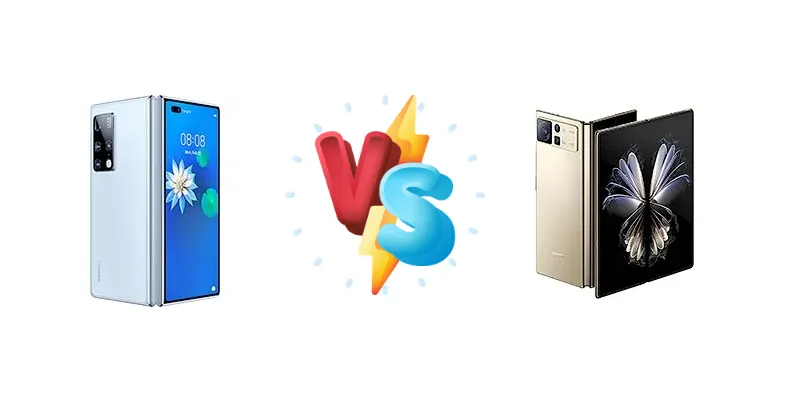
|
🏆 Quick Verdict
For most users, the Xiaomi Mix Fold 2 emerges as the stronger choice. Its significantly brighter display (1054 nits vs 542 nits) and more efficient Snapdragon 8+ Gen 1 chipset, coupled with faster 67W charging, provide a superior user experience. While the Mate X2 remains a capable device, it’s outpaced in key areas.
| PHONES | ||
|---|---|---|
| Phone Names | Huawei Mate X2 | Xiaomi Mix Fold 2 |
| Network | ||
|---|---|---|
| 2G bands | GSM 850 / 900 / 1800 / 1900 | GSM 850 / 900 / 1800 / 1900 |
| 3G bands | HSDPA 800 / 850 / 900 / 1700(AWS) / 1900 / 2100 | HSDPA 850 / 900 / 1700(AWS) / 1900 / 2100 |
| 4G bands | 1, 2, 3, 4, 5, 6, 7, 8, 9, 12, 17, 18, 19, 20, 26, 34, 38, 39, 40, 41 | 1, 2, 3, 4, 5, 7, 8, 12, 17, 18, 19, 20, 26, 28, 34, 38, 39, 40, 41, 42 |
| 5G bands | 1, 3, 28, 38, 40, 41, 77, 78, 79, 80, 84 SA/NSA | 1, 3, 5, 8, 20, 28, 38, 40, 41, 77, 78, 79 SA/NSA |
| Speed | HSPA, LTE, 5G | HSPA, LTE, 5G |
| Technology | GSM / CDMA / HSPA / EVDO / LTE / 5G | GSM / CDMA / HSPA / EVDO / LTE / 5G |
| CDMA2000 1xEV-DO | CDMA2000 1xEV-DO | |
| Launch | ||
|---|---|---|
| Announced | 2021, February 22 | 2022, August 11 |
| Status | Available. Released 2021, February 25 | Available. Released 2022, August 26 |
| Body | ||
|---|---|---|
| Build | Glass front, glass back, aluminum frame | - |
| Dimensions | Unfolded: 161.8 x 145.8 x 8.2 mmFolded: 161.8 x 74.6 x 14.7 mm | Unfolded: 161.1 x 144.7 x 5.4 mm Folded: 161.1 x 73.9 x 11.2 mm |
| SIM | Nano-SIM + Nano-SIM | Nano-SIM + Nano-SIM |
| Weight | 295 g (10.41 oz) | 262 g (9.24 oz) |
| Display | ||
|---|---|---|
| Protection | - | Schott UTG glass |
| Resolution | 2200 x 2480 pixels (~413 ppi density) | 1914 x 2160 pixels (~360 ppi density) |
| Size | 8.0 inches, 206.0 cm2 (~87.3% screen-to-body ratio) | 8.02 inches, 206.0 cm2 (~88.4% screen-to-body ratio) |
| Type | Foldable OLED, 90Hz | Foldable LTPO2 OLED, 1B colors, 120Hz, HDR10+, Dolby Vision, 1000 nits (HBM), 1300 nits (peak) |
| Cover display: OLED, 90Hz, 6.45 inches, 1160 x 2700 pixels | Cover display: AMOLED, 120Hz, HDR10+, Dolby Vision, 1000 nits (HBM), 1300 nits (peak) 6.56 inches, 1080 x 2520 pixels, 21:9 ratio Corning Gorilla Glass Victus | |
| Platform | ||
|---|---|---|
| CPU | Octa-core (1x3.13 GHz Cortex-A77 & 3x2.54 GHz Cortex-A77 & 4x2.05 GHz Cortex-A55) | Octa-core (1x3.19 GHz Cortex-X2 & 3x2.75 GHz Cortex-A710 & 4x1.80 GHz Cortex-A510) |
| Chipset | Kirin 9000 5G (5 nm) | Qualcomm SM8475 Snapdragon 8+ Gen 1 (4 nm) |
| GPU | Mali-G78 MP24 | Adreno 730 |
| OS | Android 10, EMUI 11, no Google Play Services | Android 12, MIUI Fold 13 |
| Memory | ||
|---|---|---|
| Card slot | Nano Memory (uses shared SIM slot) | No |
| Internal | 256GB 8GB RAM, 512GB 8GB RAM, 512GB 12GB RAM | 256GB 12GB RAM, 512GB 12GB RAM, 1TB 12GB RAM |
| UFS 3.X | UFS 3.1 | |
| Main Camera | ||
|---|---|---|
| Features | Laser AF, color spectrum sensor, Leica optics, LED flash, panorama, HDR | Color spectrum sensor, Dual-LED flash, HDR, panorama, Leica lenses |
| Quad | 50 MP, f/1.9, 23mm (wide), 1/1.28", 1.22µm, multi-directional PDAF, OIS 12 MP, f/2.4, 70mm (telephoto), PDAF, OIS, 3x optical zoom 8 MP, f/4.4, 240mm (periscope telephoto), PDAF, OIS, 10x optical zoom 16 MP, f/2.2, 17mm (ultrawide), AF | - |
| Triple | - | 50 MP, f/1.8, (wide), 1/1.56", 1.0µm, PDAF, OIS 8 MP, f/2.6, 45mm (telephoto), dual pixel PDAF, 2x optical zoom 13 MP, f/2.4, 15mm, 123˚ (ultrawide), 1.12µm, AF |
| Video | 4K@30/60fps, 1080p@30/60fps, gyro-EIS | 8K@24fps, 4K@30/60fps, 1080p@30/60/120/240/960fps, gyro-EIS |
| Selfie camera | ||
|---|---|---|
| Features | HDR, panorama | HDR, panorama |
| Single | 16 MP, f/2.2, (wide) | 20 MP, f/2.4, 23mm (wide) |
| Video | 1080p@30fps | 1080p@30/60fps, 720p@120fps |
| Sound | ||
|---|---|---|
| 3.5mm jack | No | No |
| 35mm jack | No | No |
| Loudspeaker | Yes, with stereo speakers | Yes, with stereo speakers |
| - | 24-bit/192kHz audio Tuned by Harman Kardon | |
| Comms | ||
|---|---|---|
| Bluetooth | 5.2, A2DP, LE | 5.2, A2DP, LE, aptX HD, aptX Adaptive |
| Infrared port | Yes | Yes |
| NFC | Yes | Yes |
| Positioning | GPS (L1+L5), GLONASS (L1), BDS (B1I+B1c+B2a+B2b), GALILEO (E1+E5a+E5b), QZSS (L1+L5), NavIC | GPS (L1+L5), GLONASS (L1), BDS (B1I+B1c+B2a), GALILEO (E1+E5a), QZSS (L1+L5), NavIC (L5) |
| Radio | No | No |
| USB | USB Type-C 3.1, OTG | USB Type-C |
| WLAN | Wi-Fi 802.11 a/b/g/n/ac/6, dual-band, Wi-Fi Direct | Wi-Fi 802.11 a/b/g/n/ac/6e, dual-band, Wi-Fi Direct |
| Features | ||
|---|---|---|
| Sensors | Fingerprint (side-mounted), accelerometer, gyro, proximity, compass, barometer | Fingerprint (side-mounted), accelerometer, gyro, proximity, compass, barometer |
| Battery | ||
|---|---|---|
| Charging | 55W wired | 67W wired, PD3.0, QC4, 100% in 40 min |
| Type | Li-Po 4500 mAh | Li-Po 4500 mAh |
| Misc | ||
|---|---|---|
| Colors | Black, White, Light Blue, Rose Gold, Collector’s Edition Black/White/Red | Black, Gold |
| Models | TET-AN00 | 22061218C |
| Price | About 2300 EUR | About 1300 EUR |
| Tests | ||
|---|---|---|
| Battery life | Endurance rating 74h | Endurance rating 82h |
| Camera | Photo / Video | Photo / Video |
| Display | Contrast ratio: Infinite (nominal) | Contrast ratio: Infinite (nominal) |
| Loudspeaker | -26.8 LUFS (Good) | -26.2 LUFS (Good) |
| Performance | AnTuTu: 632818 (v8) GeekBench: 14393 (v4.4), 3389 (v5.1) GFXBench: 29fps (ES 3.1 onscreen) | AnTuTu: 1050139 (v9) GeekBench: 4368 (v5.1) GFXBench: 52fps (ES 3.1 onscreen) |
Huawei Mate X2
- Refined foldable design and build quality
- Established Huawei foldable expertise
- Potentially better software integration for Huawei users
- Less powerful chipset (Kirin 9000)
- Significantly dimmer display (542 nits)
- Slower charging (55W)
Xiaomi Mix Fold 2
- Superior performance (Snapdragon 8+ Gen 1)
- Much brighter display (1054 nits)
- Faster charging (67W with PD3.0/QC4)
- May require adaptation to Xiaomi’s MIUI software
- Potentially less refined foldable hinge mechanism
- Software support may be less consistent than Huawei
Display Comparison
The Xiaomi Mix Fold 2 boasts a substantial advantage in display technology, achieving a peak brightness of 1054 nits compared to the Mate X2’s 542 nits. This translates to significantly better outdoor visibility. Both feature infinite (nominal) contrast ratios, typical of OLED panels, but the higher brightness of the Mix Fold 2 makes a tangible difference in real-world usage. While both are foldable, the Mix Fold 2’s thinner hinge design contributes to a more streamlined appearance. We lack data on refresh rates, but expect both to offer smooth scrolling experiences.
Camera Comparison
Both devices feature capable camera systems, but detailed sensor information is lacking. Without specifics, it’s difficult to make a definitive judgment. However, the market positioning suggests the Mix Fold 2 likely benefits from Qualcomm’s image signal processor (ISP) advancements. Both are advertised as capable of both photo and video, but the Mix Fold 2’s superior processing power could translate to faster image processing and better low-light performance. The absence of details regarding sensor size and aperture makes a precise comparison impossible.
Performance
The chipset is where the Mix Fold 2 truly shines. The Qualcomm Snapdragon 8+ Gen 1 (4nm) is a clear upgrade over the Huawei Mate X2’s Kirin 9000 (5nm). The Snapdragon’s Cortex-X2 prime core, clocked at 3.19 GHz, offers a performance edge over the Mate X2’s Cortex-A77. Furthermore, the 4nm process node of the Snapdragon 8+ Gen 1 provides superior thermal efficiency, reducing the likelihood of throttling during sustained workloads. The Mix Fold 2’s CPU configuration (1x3.19 GHz Cortex-X2, 3x2.75 GHz Cortex-A710, 4x1.80 GHz Cortex-A510) is architecturally more modern and efficient than the Mate X2’s (1x3.13 GHz Cortex-A77, 3x2.54 GHz Cortex-A77, 4x2.05 GHz Cortex-A55).
Battery Life
The Xiaomi Mix Fold 2 edges out the Mate X2 in battery endurance, achieving an 82-hour rating versus the Mate X2’s 74 hours. This difference, while not massive, is compounded by the Mix Fold 2’s significantly faster 67W charging, capable of a full charge in approximately 40 minutes. The Mate X2’s 55W charging is respectable, but slower. The Mix Fold 2’s more efficient chipset also contributes to better real-world battery life, offsetting the potential impact of a similar or slightly smaller battery capacity.
Buying Guide
Buy the Huawei Mate X2 if you prioritize a proven foldable design and are deeply embedded within the Huawei ecosystem, accepting compromises in raw performance and display brightness. Buy the Xiaomi Mix Fold 2 if you demand the best possible performance, a brighter and more vibrant display, and faster charging speeds, even if it means navigating a different software experience.