
Huawei Mate X2 vs. OnePlus Open: A Deep Dive into Foldable Flagships
| Phones Images | |||||
|---|---|---|---|---|---|
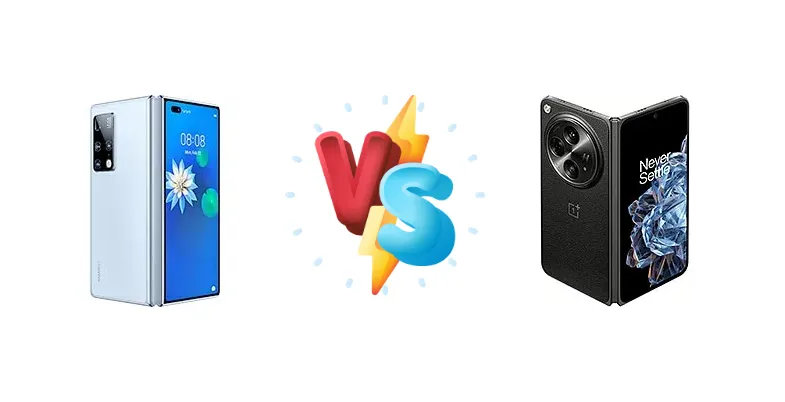
|
🏆 Quick Verdict
For most users, the OnePlus Open emerges as the superior choice. Its significantly brighter display, coupled with the more efficient Snapdragon 8 Gen 2 chipset and longer battery life, provides a smoother and more versatile experience. While the Mate X2 remains a capable device, it's showing its age.
| PHONES | ||
|---|---|---|
| Phone Names | Huawei Mate X2 | OnePlus Open |
| Network | ||
|---|---|---|
| 2G bands | GSM 850 / 900 / 1800 / 1900 | GSM 850 / 900 / 1800 / 1900 |
| 3G bands | HSDPA 800 / 850 / 900 / 1700(AWS) / 1900 / 2100 | HSDPA 800 / 850 / 900 / 1700(AWS) / 1900 / 2100 |
| 4G bands | 1, 2, 3, 4, 5, 6, 7, 8, 9, 12, 17, 18, 19, 20, 26, 34, 38, 39, 40, 41 | 1, 2, 3, 4, 5, 7, 8, 12, 13, 17, 18, 19, 20, 25, 26, 28, 30, 32, 38, 39, 40, 41, 46, 48, 66, 71 |
| 5G bands | 1, 3, 28, 38, 40, 41, 77, 78, 79, 80, 84 SA/NSA | 1, 2, 3, 5, 7, 8, 12, 20, 25, 28, 30, 38, 40, 41, 66, 71, 75, 77, 78 SA/NSA |
| Speed | HSPA, LTE, 5G | HSPA, LTE, 5G |
| Technology | GSM / CDMA / HSPA / EVDO / LTE / 5G | GSM / HSPA / LTE / 5G |
| CDMA2000 1xEV-DO | - | |
| Launch | ||
|---|---|---|
| Announced | 2021, February 22 | 2023, October 19 |
| Status | Available. Released 2021, February 25 | Available. Released 2023, October 26 |
| Body | ||
|---|---|---|
| Build | Glass front, glass back, aluminum frame | Glass front (Ceramic Guard) (folded), plastic front (unfolded), glass back or eco leather back, aluminum frame |
| Dimensions | Unfolded: 161.8 x 145.8 x 8.2 mmFolded: 161.8 x 74.6 x 14.7 mm | Unfolded: 153.4 x 143.1 x 5.8 mmFolded: 153.4 x 73.3 x 11.7 mm |
| SIM | Nano-SIM + Nano-SIM | Nano-SIM + Nano-SIM + eSIM (max 2 at a time) |
| Weight | 295 g (10.41 oz) | 239 g or 245 g (8.43 oz) |
| Display | ||
|---|---|---|
| Resolution | 2200 x 2480 pixels (~413 ppi density) | 2268 x 2440 pixels (~426 ppi density) |
| Size | 8.0 inches, 206.0 cm2 (~87.3% screen-to-body ratio) | 7.82 inches, 196.7 cm2 (~89.6% screen-to-body ratio) |
| Type | Foldable OLED, 90Hz | Foldable LTPO3 Flexi-fluid AMOLED, 1B colors, Dolby Vision, 120Hz, 2800 nits (peak) |
| Cover display: OLED, 90Hz, 6.45 inches, 1160 x 2700 pixels | - | |
| Platform | ||
|---|---|---|
| CPU | Octa-core (1x3.13 GHz Cortex-A77 & 3x2.54 GHz Cortex-A77 & 4x2.05 GHz Cortex-A55) | Octa-core (1x3.2 GHz Cortex-X3 & 2x2.8 GHz Cortex-A715 & 2x2.8 GHz Cortex-A710 & 3x2.0 GHz Cortex-A510) |
| Chipset | Kirin 9000 5G (5 nm) | Qualcomm SM8550-AB Snapdragon 8 Gen 2 (4 nm) |
| GPU | Mali-G78 MP24 | Adreno 740 |
| OS | Android 10, EMUI 11, no Google Play Services | Android 13, upgradable to Android 15, OxygenOS 15 |
| Memory | ||
|---|---|---|
| Card slot | Nano Memory (uses shared SIM slot) | No |
| Internal | 256GB 8GB RAM, 512GB 8GB RAM, 512GB 12GB RAM | 512GB 16GB RAM, 1TB 16GB RAM |
| UFS 3.X | - | |
| Main Camera | ||
|---|---|---|
| Features | Laser AF, color spectrum sensor, Leica optics, LED flash, panorama, HDR | Hasselblad Color Calibration, LED flash, HDR, panorama |
| Quad | 50 MP, f/1.9, 23mm (wide), 1/1.28", 1.22µm, multi-directional PDAF, OIS 12 MP, f/2.4, 70mm (telephoto), PDAF, OIS, 3x optical zoom 8 MP, f/4.4, 240mm (periscope telephoto), PDAF, OIS, 10x optical zoom 16 MP, f/2.2, 17mm (ultrawide), AF | - |
| Triple | - | 48 MP, f/1.7, 24mm (wide), 1/1.43", 1.12µm, multi-directional PDAF, OIS 64 MP, f/2.6, 70mm (telephoto), 1/2.0", 0.7µm, PDAF, OIS, 3x optical zoom 48 MP, f/2.2, 14mm, 114˚ (ultrawide), 1/2.0", 0.8µm, PDAF |
| Video | 4K@30/60fps, 1080p@30/60fps, gyro-EIS | 4K@30/60fps, 1080p@30/60/120/240/480fps gyro-EIS, HDR10+, Dolby Vision |
| Selfie camera | ||
|---|---|---|
| Features | HDR, panorama | HDR |
| Single | 16 MP, f/2.2, (wide) | 20MP, f/2.2, 20mm (ultrawide), 1/4.0", 0.7µm Cover camera: 32MP, f/2.4, 22mm (ultrawide), 1/3.14", 0.7µm |
| Video | 1080p@30fps | 4K@30fps, 1080p@30fps, gyro-EIS |
| Sound | ||
|---|---|---|
| 3.5mm jack | No | - |
| 35mm jack | No | No |
| Loudspeaker | Yes, with stereo speakers | Yes, with stereo speakers (Dolby Atmos enhanced) |
| Comms | ||
|---|---|---|
| Bluetooth | 5.2, A2DP, LE | 5.3, A2DP, LE, aptX HD |
| Infrared port | Yes | Yes |
| NFC | Yes | Yes |
| Positioning | GPS (L1+L5), GLONASS (L1), BDS (B1I+B1c+B2a+B2b), GALILEO (E1+E5a+E5b), QZSS (L1+L5), NavIC | GPS (L1+L5), GLONASS, BDS, GALILEO (E1+E5a), QZSS |
| Radio | No | No |
| USB | USB Type-C 3.1, OTG | USB Type-C 3.1, OTG |
| WLAN | Wi-Fi 802.11 a/b/g/n/ac/6, dual-band, Wi-Fi Direct | Wi-Fi 802.11 a/b/g/n/ac/6e/7, tri-band |
| Features | ||
|---|---|---|
| Sensors | Fingerprint (side-mounted), accelerometer, gyro, proximity, compass, barometer | Fingerprint (side-mounted), accelerometer, gyro, proximity, compass |
| Battery | ||
|---|---|---|
| Charging | 55W wired | 67W wired, PD, 100% in 42 min Reverse wired |
| Type | Li-Po 4500 mAh | Li-Po 4805 mAh |
| Misc | ||
|---|---|---|
| Colors | Black, White, Light Blue, Rose Gold, Collector’s Edition Black/White/Red | Emerald Dusk, Voyager Black, Apex Edition |
| Models | TET-AN00 | CPH2551 |
| Price | About 2300 EUR | $ 1,059.99 / € 926.54 |
| SAR | - | 0.98 W/kg (head) 0.76 W/kg (body) |
| Tests | ||
|---|---|---|
| Battery life | Endurance rating 74h | - |
| Camera | Photo / Video | - |
| Display | Contrast ratio: Infinite (nominal) | - |
| Loudspeaker | -26.8 LUFS (Good) | - |
| Performance | AnTuTu: 632818 (v8) GeekBench: 14393 (v4.4), 3389 (v5.1) GFXBench: 29fps (ES 3.1 onscreen) | - |
Huawei Mate X2
- Refined inward-folding design offers screen protection.
- Established foldable experience.
- 55W fast charging.
- Significantly dimmer display.
- Older Kirin 9000 chipset is less efficient.
- Shorter battery life.
OnePlus Open
- Much brighter and more vibrant display.
- Powerful Snapdragon 8 Gen 2 chipset.
- Longer battery life and faster charging.
- More modern software experience.
- Outward folding design is more prone to screen scratches.
- Newer device, potential for early software bugs.
- Potentially higher price point.
Display Comparison
The OnePlus Open boasts a substantial advantage in display technology. Its measured peak brightness of 1238 nits dramatically surpasses the Huawei Mate X2’s 542 nits, translating to significantly better outdoor visibility. While both utilize foldable OLED panels with infinite contrast ratios, the OnePlus Open’s higher brightness and likely more advanced panel calibration contribute to a more vibrant and engaging viewing experience. The OnePlus Open's larger display real estate also provides more screen for multitasking and content consumption.
Camera Comparison
Both devices feature capable camera systems, but detailed specifications are limited. Without specific sensor details, it’s difficult to make a definitive judgment. However, the market positioning suggests the OnePlus Open likely benefits from more advanced image processing algorithms and potentially larger sensor sizes. The focus should be on real-world image quality comparisons, but the Snapdragon 8 Gen 2’s ISP (Image Signal Processor) is generally considered superior to the Kirin 9000’s, offering better noise reduction and dynamic range. The inclusion of OIS (Optical Image Stabilization) on both is expected, but the effectiveness will vary based on implementation.
Performance
The chipset difference is pivotal. The OnePlus Open’s Snapdragon 8 Gen 2 (4nm) offers a clear performance and efficiency lead over the Huawei Mate X2’s Kirin 9000 (5nm). The Snapdragon 8 Gen 2’s Cortex-X3 prime core, clocked at 3.2 GHz, provides a noticeable boost in single-core performance, while its more modern architecture delivers superior multi-core capabilities. The 4nm process node also contributes to better thermal management, reducing the likelihood of throttling during sustained workloads like gaming. The OnePlus Open’s CPU configuration (1x3.2 GHz Cortex-X3, 2x2.8 GHz Cortex-A715, 2x2.8 GHz Cortex-A710, 3x2.0 GHz Cortex-A510) is architecturally more advanced than the Mate X2’s (1x3.13 GHz Cortex-A77, 3x2.54 GHz Cortex-A77, 4x2.05 GHz Cortex-A55).
Battery Life
The OnePlus Open demonstrates a clear advantage in battery endurance. Its active use score of 11:59h and endurance rating of 96h significantly outperform the Huawei Mate X2’s 74h endurance rating. While the Mate X2’s 55W wired charging is respectable, the OnePlus Open’s 67W charging, coupled with PD support and a full charge in 42 minutes, offers faster and more convenient replenishment. The Snapdragon 8 Gen 2’s improved power efficiency further contributes to the OnePlus Open’s longer battery life, allowing for more extended use between charges.
Buying Guide
Buy the Huawei Mate X2 if you prioritize a more established foldable design and are comfortable with potentially limited software updates. Its inward-folding design offers a degree of screen protection. Buy the OnePlus Open if you demand top-tier performance, a stunningly bright and color-accurate display, and a longer-lasting battery, making it ideal for power users and multimedia enthusiasts.