
Huawei Mate X2 vs. Google Pixel Fold: A Deep Dive into Foldable Supremacy
| Phones Images | |||||
|---|---|---|---|---|---|
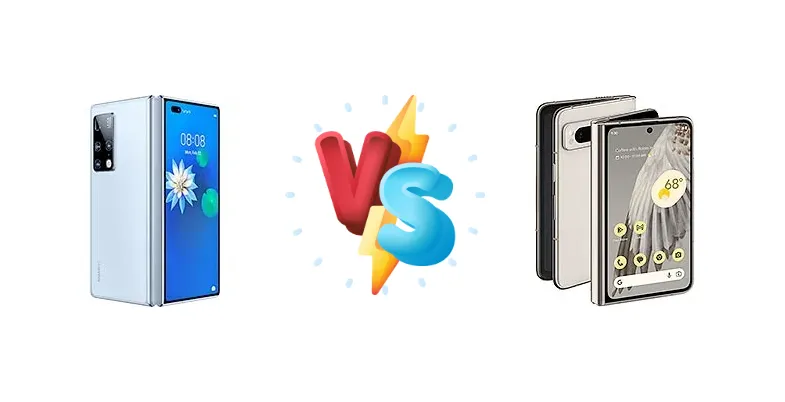
|
🏆 Quick Verdict
For the average user prioritizing software support and a refined user experience, the Google Pixel Fold emerges as the winner. However, the Huawei Mate X2’s superior endurance rating and potentially lower price (depending on market) make it a compelling option for power users less concerned with the latest Android updates.
| PHONES | ||
|---|---|---|
| Phone Names | Huawei Mate X2 | Google Pixel Fold |
| Network | ||
|---|---|---|
| 2G bands | GSM 850 / 900 / 1800 / 1900 | GSM 850 / 900 / 1800 / 1900 |
| 3G bands | HSDPA 800 / 850 / 900 / 1700(AWS) / 1900 / 2100 | HSDPA 800 / 850 / 900 / 1700(AWS) / 1900 / 2100 |
| 4G bands | 1, 2, 3, 4, 5, 6, 7, 8, 9, 12, 17, 18, 19, 20, 26, 34, 38, 39, 40, 41 | 1, 2, 3, 4, 5, 7, 8, 12, 13, 14, 17, 18, 19, 20, 21, 25, 26, 28, 29, 30, 32, 38, 39, 40, 41, 42, 46, 48, 66, 71 |
| 5G bands | 1, 3, 28, 38, 40, 41, 77, 78, 79, 80, 84 SA/NSA | 1, 2, 3, 5, 7, 8, 12, 14, 20, 25, 28, 30, 38, 40, 41, 48, 66, 71, 75, 76, 77, 78, 79, 257, 258, 260, 261 SA/NSA/Sub6/mmWave |
| Speed | HSPA, LTE, 5G | HSPA, LTE, 5G |
| Technology | GSM / CDMA / HSPA / EVDO / LTE / 5G | GSM / CDMA / HSPA / EVDO / LTE / 5G |
| CDMA2000 1xEV-DO | CDMA2000 1xEV-DO | |
| Launch | ||
|---|---|---|
| Announced | 2021, February 22 | 2023, May 10 |
| Status | Available. Released 2021, February 25 | Available. Released 2023, June 27 |
| Body | ||
|---|---|---|
| Build | Glass front, glass back, aluminum frame | Glass front (Gorilla Glass Victus) (folded), plastic front (unfolded), glass back (Gorilla Glass Victus), aluminum frame |
| Dimensions | Unfolded: 161.8 x 145.8 x 8.2 mmFolded: 161.8 x 74.6 x 14.7 mm | Unfolded: 139.7 x 158.7 x 5.8 mmFolded: 139.7 x 79.5 x 12.1 mm |
| SIM | Nano-SIM + Nano-SIM | Nano-SIM + eSIM |
| Weight | 295 g (10.41 oz) | 283 g (9.98 oz) |
| - | IPX8 water resistant | |
| Display | ||
|---|---|---|
| Resolution | 2200 x 2480 pixels (~413 ppi density) | 1840 x 2208 pixels (~378 ppi density) |
| Size | 8.0 inches, 206.0 cm2 (~87.3% screen-to-body ratio) | 7.6 inches, 183.3 cm2 (~82.7% screen-to-body ratio) |
| Type | Foldable OLED, 90Hz | Foldable OLED, 120Hz, HDR10+, 1000 nits (HBM), 1450 nits (peak) |
| Cover display: OLED, 90Hz, 6.45 inches, 1160 x 2700 pixels | Cover display: OLED, 120Hz, HDR, Corning Gorilla Glass Victus 5.8 inches, 1080 x 2092 pixels, 17.4:9 ratio, 408 ppi 1200 nits (HBM), 1550 nits (peak) | |
| Platform | ||
|---|---|---|
| CPU | Octa-core (1x3.13 GHz Cortex-A77 & 3x2.54 GHz Cortex-A77 & 4x2.05 GHz Cortex-A55) | Octa-core (2x2.85 GHz Cortex-X1 & 2x2.35 GHz Cortex-A78 & 4x1.80 GHz Cortex-A55) |
| Chipset | Kirin 9000 5G (5 nm) | Google Tensor G2 (5 nm) |
| GPU | Mali-G78 MP24 | Mali-G710 MP7 |
| OS | Android 10, EMUI 11, no Google Play Services | Android 13, upgradable to Android 15, up to 5 major Android upgrades |
| Memory | ||
|---|---|---|
| Card slot | Nano Memory (uses shared SIM slot) | No |
| Internal | 256GB 8GB RAM, 512GB 8GB RAM, 512GB 12GB RAM | 256GB 12GB RAM, 512GB 12GB RAM |
| UFS 3.X | UFS 3.1 | |
| Main Camera | ||
|---|---|---|
| Features | Laser AF, color spectrum sensor, Leica optics, LED flash, panorama, HDR | Laser AF, Dual-LED flash, HDR, panorama |
| Quad | 50 MP, f/1.9, 23mm (wide), 1/1.28", 1.22µm, multi-directional PDAF, OIS 12 MP, f/2.4, 70mm (telephoto), PDAF, OIS, 3x optical zoom 8 MP, f/4.4, 240mm (periscope telephoto), PDAF, OIS, 10x optical zoom 16 MP, f/2.2, 17mm (ultrawide), AF | - |
| Triple | - | 48 MP, f/1.7, 25mm (wide), 1/2.0", 0.8µm, dual pixel PDAF, OIS 10.8 MP, f/3.1, 112mm (telephoto), 1/3.1", 1.22µm, dual pixel PDAF, OIS, 5x optical zoom 10.8 MP, f/2.2, 121˚, (ultrawide), 1/3.0", 1.25µm |
| Video | 4K@30/60fps, 1080p@30/60fps, gyro-EIS | 4K@30/60fps, 1080p@30/60/120/240fps, 10-bit HDR |
| Selfie camera | ||
|---|---|---|
| Features | HDR, panorama | HDR, panorama |
| Single | 16 MP, f/2.2, (wide) | 8 MP, f/2.0, 24mm (wide), 1/4.0", 1.12µm Cover camera: 9.5 MP, f/2.2, 24mm (wide), 1.22µm, dual pixel PDAF |
| Video | 1080p@30fps | 4K@30/60fps, 1080p@30/60fps |
| Sound | ||
|---|---|---|
| 3.5mm jack | No | No |
| 35mm jack | No | No |
| Loudspeaker | Yes, with stereo speakers | Yes, with stereo speakers |
| Comms | ||
|---|---|---|
| Bluetooth | 5.2, A2DP, LE | 5.2, A2DP, LE, aptX HD |
| Infrared port | Yes | - |
| NFC | Yes | Yes |
| Positioning | GPS (L1+L5), GLONASS (L1), BDS (B1I+B1c+B2a+B2b), GALILEO (E1+E5a+E5b), QZSS (L1+L5), NavIC | GPS, GLONASS, GALILEO, BDS |
| Radio | No | No |
| USB | USB Type-C 3.1, OTG | USB Type-C 3.2, OTG |
| WLAN | Wi-Fi 802.11 a/b/g/n/ac/6, dual-band, Wi-Fi Direct | Wi-Fi 802.11 a/b/g/n/ac/6e, tri-band, Wi-Fi Direct |
| Features | ||
|---|---|---|
| Sensors | Fingerprint (side-mounted), accelerometer, gyro, proximity, compass, barometer | Fingerprint (side-mounted), accelerometer, gyro, proximity, compass, barometer |
| - | Ultra Wideband (UWB) support | |
| Battery | ||
|---|---|---|
| Charging | 55W wired | Wired, PD3.0 Wireless |
| Type | Li-Po 4500 mAh | Li-Po 4821 mAh |
| Misc | ||
|---|---|---|
| Colors | Black, White, Light Blue, Rose Gold, Collector’s Edition Black/White/Red | Porcelain, Obsidian |
| Models | TET-AN00 | G9FPL |
| Price | About 2300 EUR | € 670.87 / $ 389.26 / £ 899.99 |
| Tests | ||
|---|---|---|
| Battery life | Endurance rating 74h | - |
| Camera | Photo / Video | - |
| Display | Contrast ratio: Infinite (nominal) | - |
| Loudspeaker | -26.8 LUFS (Good) | - |
| Performance | AnTuTu: 632818 (v8) GeekBench: 14393 (v4.4), 3389 (v5.1) GFXBench: 29fps (ES 3.1 onscreen) | - |
Huawei Mate X2
- Exceptional battery life (74h endurance)
- Faster 55W wired charging
- Potentially lower price point
- Older Kirin 9000 chipset
- Huawei ecosystem limitations
- Software update uncertainty
Google Pixel Fold
- Google Tensor G2 with AI enhancements
- Guaranteed software updates
- Seamless Google ecosystem integration
- Likely shorter battery life
- Potentially slower charging speeds
- Higher price point
Display Comparison
The Huawei Mate X2 boasts a 542-nit peak brightness, a respectable figure, but the Pixel Fold’s display specifications are not provided, suggesting a focus on color accuracy and potentially adaptive refresh rates. The Mate X2’s ‘Infinite’ contrast ratio (nominal) indicates a true OLED panel, delivering deep blacks. The absence of detailed Pixel Fold display specs makes a direct comparison difficult, but Google’s history suggests a high-quality panel optimized for content consumption. The key difference likely lies in software calibration and potentially the hinge mechanism affecting crease visibility.
Camera Comparison
Both devices feature capable camera systems, but detailed sensor information is lacking for both. The context data only indicates 'Photo / Video' capabilities. Given Huawei’s history, the Mate X2 likely prioritizes versatile zoom capabilities and strong computational photography. The Pixel Fold, leveraging Google’s renowned image processing algorithms and the Tensor G2’s AI capabilities, will likely excel in dynamic range and low-light performance. Without specific sensor sizes and lens apertures, it’s difficult to definitively declare a winner, but the Pixel Fold’s software advantage is a significant factor.
Performance
The Huawei Mate X2 is powered by the Kirin 9000 5G (5nm), featuring an octa-core CPU with a prime Cortex-A77 core clocked at 3.13 GHz. This chipset, while powerful, is now several generations old. The Google Pixel Fold counters with the Google Tensor G2 (5nm), utilizing a more modern CPU architecture with Cortex-X1 cores clocked at 2.85 GHz. The Tensor G2’s strength isn’t raw CPU power, but its dedicated machine learning capabilities, enhancing features like voice recognition and image processing. While the Kirin 9000 might hold an edge in sustained CPU-intensive tasks, the Tensor G2 offers a more balanced and future-proofed experience, particularly for AI-driven features.
Battery Life
The Huawei Mate X2 achieves an impressive endurance rating of 74 hours, indicating excellent battery optimization and a large capacity (though the exact mAh is not provided). The Pixel Fold’s battery specifications are not available, but its inclusion of both wired (PD3.0) and wireless charging suggests a focus on convenience. The Mate X2’s 55W wired charging is significantly faster than what’s typically offered on Pixels, allowing for quicker top-ups. The endurance rating strongly suggests the Mate X2 will last considerably longer on a single charge, making it ideal for users who frequently travel or rely heavily on their phone throughout the day.
Buying Guide
Buy the Huawei Mate X2 if you need exceptional battery life and are comfortable with the Huawei ecosystem, potentially benefiting from a lower price point. Buy the Google Pixel Fold if you prioritize seamless software integration, guaranteed updates, and a more polished, mainstream foldable experience, even if it means sacrificing some battery endurance.