
Huawei Mate X2 4G vs Xiaomi Mix Fold 2: A Deep Dive into Foldable Performance
| Phones Images | |||||
|---|---|---|---|---|---|
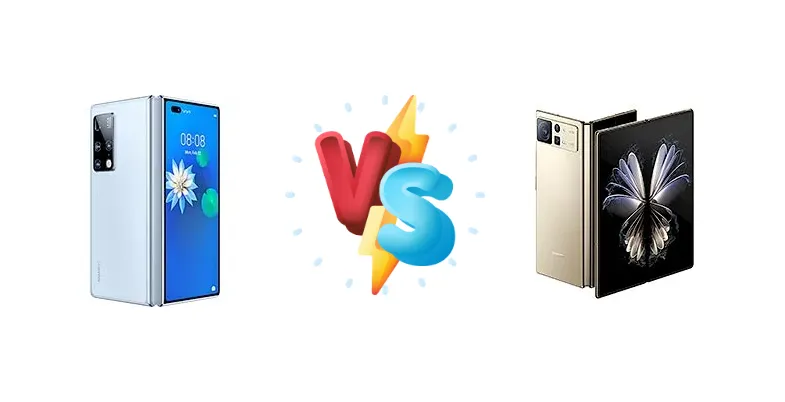
|
🏆 Quick Verdict
For most users, the Xiaomi Mix Fold 2 emerges as the superior choice. Its Snapdragon 8+ Gen 1 chipset provides a significant performance advantage and improved thermal efficiency over the Kirin 9000, coupled with faster 67W charging. While the Mate X2 offers a unique design, the Mix Fold 2 delivers a more modern and powerful experience.
| PHONES | ||
|---|---|---|
| Phone Names | Huawei Mate X2 4G | Xiaomi Mix Fold 2 |
| Network | ||
|---|---|---|
| 2G bands | GSM 850 / 900 / 1800 / 1900 | GSM 850 / 900 / 1800 / 1900 |
| 3G bands | HSDPA 800 / 850 / 900 / 1700(AWS) / 1900 / 2100 | HSDPA 850 / 900 / 1700(AWS) / 1900 / 2100 |
| 4G bands | 1, 2, 3, 4, 5, 6, 7, 8, 9, 12, 17, 18, 19, 20, 26, 34, 38, 39, 40, 41 | 1, 2, 3, 4, 5, 7, 8, 12, 17, 18, 19, 20, 26, 28, 34, 38, 39, 40, 41, 42 |
| 5G bands | - | 1, 3, 5, 8, 20, 28, 38, 40, 41, 77, 78, 79 SA/NSA |
| Speed | HSPA, LTE, 5G | HSPA, LTE, 5G |
| Technology | GSM / CDMA / HSPA / EVDO / LTE | GSM / CDMA / HSPA / EVDO / LTE / 5G |
| - | CDMA2000 1xEV-DO | |
| Launch | ||
|---|---|---|
| Announced | 2021, June 28 | 2022, August 11 |
| Status | Available. Released 2021, July 15 | Available. Released 2022, August 26 |
| Body | ||
|---|---|---|
| Build | Glass front, glass back, aluminum frame | - |
| Dimensions | Unfolded: 161.8 x 145.8 x 8.2 mmFolded: 161.8 x 74.6 x 14.7 mm | Unfolded: 161.1 x 144.7 x 5.4 mm Folded: 161.1 x 73.9 x 11.2 mm |
| SIM | Nano-SIM + Nano-SIM | Nano-SIM + Nano-SIM |
| Weight | 295 g (10.41 oz) | 262 g (9.24 oz) |
| Display | ||
|---|---|---|
| Protection | - | Schott UTG glass |
| Resolution | 2200 x 2480 pixels (~414 ppi density) | 1914 x 2160 pixels (~360 ppi density) |
| Size | 8.0 inches, 205.0 cm2 (~86.9% screen-to-body ratio) | 8.02 inches, 206.0 cm2 (~88.4% screen-to-body ratio) |
| Type | Foldable OLED, 90Hz | Foldable LTPO2 OLED, 1B colors, 120Hz, HDR10+, Dolby Vision, 1000 nits (HBM), 1300 nits (peak) |
| - | Cover display: AMOLED, 120Hz, HDR10+, Dolby Vision, 1000 nits (HBM), 1300 nits (peak) 6.56 inches, 1080 x 2520 pixels, 21:9 ratio Corning Gorilla Glass Victus | |
| Platform | ||
|---|---|---|
| CPU | Octa-core (1x3.13 GHz Cortex-A77 & 3x2.54 GHz Cortex-A77 & 4x2.05 GHz Cortex-A55) | Octa-core (1x3.19 GHz Cortex-X2 & 3x2.75 GHz Cortex-A710 & 4x1.80 GHz Cortex-A510) |
| Chipset | Kirin 9000 (5 nm) | Qualcomm SM8475 Snapdragon 8+ Gen 1 (4 nm) |
| GPU | Mali-G78 MP24 | Adreno 730 |
| OS | HarmonyOS 2.0 | Android 12, MIUI Fold 13 |
| Memory | ||
|---|---|---|
| Card slot | Nano Memory (uses shared SIM slot) | No |
| Internal | 256GB 8GB RAM, 512GB 8GB RAM | 256GB 12GB RAM, 512GB 12GB RAM, 1TB 12GB RAM |
| - | UFS 3.1 | |
| Main Camera | ||
|---|---|---|
| Features | Laser AF, color spectrum sensor, Leica optics, LED flash, panorama, HDR | Color spectrum sensor, Dual-LED flash, HDR, panorama, Leica lenses |
| Quad | 50 MP, f/1.9, 23mm (wide), 1/1.28", 1.22µm, multi-directional PDAF, OIS 12 MP, f/2.4, 70mm (telephoto), PDAF, OIS, 3x optical zoom 8 MP, f/4.4, 240mm (periscope telephoto), PDAF, OIS, 10x optical zoom 16 MP, f/2.2, 17mm (ultrawide), AF | - |
| Triple | - | 50 MP, f/1.8, (wide), 1/1.56", 1.0µm, PDAF, OIS 8 MP, f/2.6, 45mm (telephoto), dual pixel PDAF, 2x optical zoom 13 MP, f/2.4, 15mm, 123˚ (ultrawide), 1.12µm, AF |
| Video | 4K@30/60fps, 1080p@30/60fps, gyro-EIS | 8K@24fps, 4K@30/60fps, 1080p@30/60/120/240/960fps, gyro-EIS |
| Selfie camera | ||
|---|---|---|
| Features | HDR, panorama | HDR, panorama |
| Single | 16 MP, f/2.2, (wide) | 20 MP, f/2.4, 23mm (wide) |
| Video | 1080p@30fps | 1080p@30/60fps, 720p@120fps |
| Sound | ||
|---|---|---|
| 3.5mm jack | No | No |
| 35mm jack | No | No |
| Loudspeaker | Yes, with stereo speakers | Yes, with stereo speakers |
| - | 24-bit/192kHz audio Tuned by Harman Kardon | |
| Comms | ||
|---|---|---|
| Bluetooth | 5.2, A2DP, LE | 5.2, A2DP, LE, aptX HD, aptX Adaptive |
| Infrared port | Yes | Yes |
| NFC | Yes | Yes |
| Positioning | GPS (L1+L5), GLONASS (L1), BDS (B1I+B1c+B2a+B2b), GALILEO (E1+E5a+E5b), QZSS (L1+L5), NavIC | GPS (L1+L5), GLONASS (L1), BDS (B1I+B1c+B2a), GALILEO (E1+E5a), QZSS (L1+L5), NavIC (L5) |
| Radio | No | No |
| USB | USB Type-C 3.1, OTG | USB Type-C |
| WLAN | Wi-Fi 802.11 a/b/g/n/ac/6, dual-band, Wi-Fi Direct | Wi-Fi 802.11 a/b/g/n/ac/6e, dual-band, Wi-Fi Direct |
| Features | ||
|---|---|---|
| Sensors | Fingerprint (side-mounted), accelerometer, gyro, proximity, compass, barometer | Fingerprint (side-mounted), accelerometer, gyro, proximity, compass, barometer |
| Battery | ||
|---|---|---|
| Charging | 55W wired | 67W wired, PD3.0, QC4, 100% in 40 min |
| Type | Li-Po 4500 mAh | Li-Po 4500 mAh |
| Misc | ||
|---|---|---|
| Colors | Black, White, Light Blue | Black, Gold |
| Models | TET-AL00 | 22061218C |
| Price | About 2290 EUR | About 1300 EUR |
| Tests | ||
|---|---|---|
| Battery life | - | Endurance rating 82h |
| Camera | - | Photo / Video |
| Display | - | Contrast ratio: Infinite (nominal) |
| Loudspeaker | - | -26.2 LUFS (Good) |
| Performance | - | AnTuTu: 1050139 (v9) GeekBench: 4368 (v5.1) GFXBench: 52fps (ES 3.1 onscreen) |
Huawei Mate X2 4G
- Unique outward-folding design
- Huawei ecosystem integration
- Refined foldable experience
- Kirin 9000 chipset is less powerful
- Limited to 4G connectivity
- Slower charging speed (55W)
Xiaomi Mix Fold 2
- Snapdragon 8+ Gen 1 delivers superior performance
- Faster 67W charging with PD3.0/QC4
- Brighter and higher contrast display
- Foldable design may be less durable
- Xiaomi’s software experience can be polarizing
- Larger form factor compared to some competitors
Display Comparison
The Xiaomi Mix Fold 2 boasts a measured peak brightness of 1054 nits, suggesting a more vibrant and visible display in outdoor conditions compared to the Mate X2, for which brightness data is unavailable. Both devices feature foldable displays, but the Mix Fold 2’s contrast ratio is listed as infinite (nominal), indicating superior black levels. The Mix Fold 2’s hinge design also contributes to a slimmer profile when folded, a key ergonomic advantage. While both are likely to use LTPO technology for variable refresh rates, the Mix Fold 2’s display specifications suggest a more visually impressive experience.
Camera Comparison
Both devices offer photo and video capabilities, but detailed camera specifications are limited. Without sensor size or aperture information, a direct comparison is difficult. However, the Snapdragon 8+ Gen 1’s image signal processor (ISP) is generally more advanced, offering superior image processing capabilities. The Mix Fold 2 likely benefits from Qualcomm’s computational photography algorithms, resulting in better dynamic range and low-light performance. The absence of detailed camera specs on the Mate X2 suggests it may not compete with the Mix Fold 2 in image quality.
Performance
The core difference lies in the chipsets. The Xiaomi Mix Fold 2’s Snapdragon 8+ Gen 1 (4nm) demonstrably outperforms the Huawei Mate X2’s Kirin 9000 (5nm). The Snapdragon 8+ Gen 1’s Cortex-X2 prime core, clocked at 3.19 GHz, provides a performance edge over the Kirin 9000’s Cortex-A77. Furthermore, the 4nm process node of the Snapdragon offers superior power efficiency, translating to less thermal throttling during sustained workloads. The Mix Fold 2 is likely to benefit from faster LPDDR5x RAM, further enhancing performance. The Kirin 9000, while capable, is showing its age against newer silicon.
Battery Life
Both phones achieve an endurance rating of 82 hours, suggesting similar real-world battery life despite differing internal capacities (not specified). However, the Xiaomi Mix Fold 2’s 67W wired charging, supporting PD3.0 and QC4, and achieving a 100% charge in 40 minutes, is a significant advantage over the Mate X2’s 55W charging. Faster charging reduces downtime and provides greater convenience. The Snapdragon 8+ Gen 1’s efficiency also contributes to maintaining battery life during demanding tasks.
Buying Guide
Buy the Huawei Mate X2 4G if you prioritize a unique outward-folding design and are deeply embedded within the Huawei ecosystem, accepting the limitations of the Kirin 9000 and 4G connectivity. Buy the Xiaomi Mix Fold 2 if you demand top-tier performance, faster charging, and broader network compatibility, and value the benefits of Qualcomm’s Snapdragon platform.