
Huawei Mate X2 4G vs. Motorola Razr 2022: A Folding Phone Showdown
| Phones Images | |||||
|---|---|---|---|---|---|
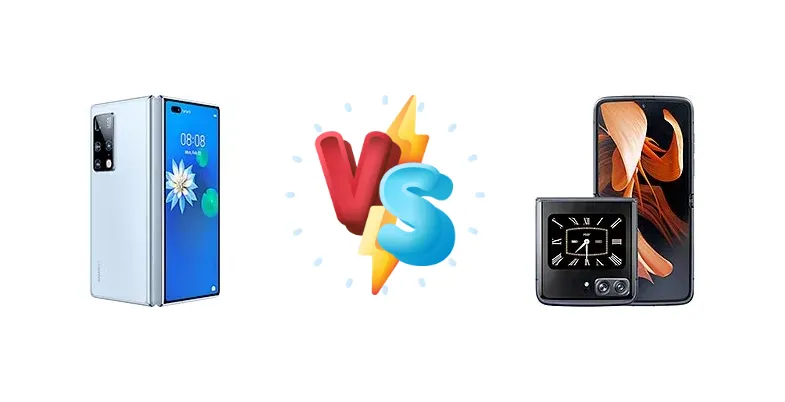
|
🏆 Quick Verdict
For most users, the Motorola Razr 2022 is the better choice. Its Snapdragon 8+ Gen 1 chipset delivers significantly superior performance and efficiency compared to the Kirin 9000, while the 64-hour endurance rating suggests comparable battery life despite a potentially smaller capacity. The Razr’s more compact form factor also appeals to a wider audience.
| PHONES | ||
|---|---|---|
| Phone Names | Huawei Mate X2 4G | Motorola Razr 2022 |
| Network | ||
|---|---|---|
| 2G bands | GSM 850 / 900 / 1800 / 1900 | GSM 900 / 1800 / 1900 |
| 3G bands | HSDPA 800 / 850 / 900 / 1700(AWS) / 1900 / 2100 | HSDPA 850 / 900 / 1700(AWS) / 1900 / 2100 |
| 4G bands | 1, 2, 3, 4, 5, 6, 7, 8, 9, 12, 17, 18, 19, 20, 26, 34, 38, 39, 40, 41 | 1, 2, 3, 4, 5, 7, 8, 12, 13, 14, 17, 18, 19, 20, 25, 26, 28, 34, 38, 39, 40, 41, 42, 43, 48, 66 |
| 5G bands | - | 1, 2, 3, 5, 7, 8, 12, 20, 25, 26, 28, 38, 40, 41, 66, 77, 78, 79 SA/NSA/Sub6 |
| Speed | HSPA, LTE, 5G | HSPA, LTE, 5G |
| Technology | GSM / CDMA / HSPA / EVDO / LTE | GSM / CDMA / HSPA / EVDO / LTE / 5G |
| - | CDMA2000 1xEV-DO | |
| Launch | ||
|---|---|---|
| Announced | 2021, June 28 | 2022, August 11 |
| Status | Available. Released 2021, July 15 | Available. Released 2022, August 18 |
| Body | ||
|---|---|---|
| Build | Glass front, glass back, aluminum frame | Plastic front (unfolded), glass front (folded, Gorilla Glass 5), glass back (Gorilla Glass 5), aluminum frame (7000 series), hinge (stainless steel) |
| Dimensions | Unfolded: 161.8 x 145.8 x 8.2 mmFolded: 161.8 x 74.6 x 14.7 mm | Unfolded: 167.0 x 79.8 x 7.6 mm Folded: 86.5 x 79.8 x 17 mm |
| SIM | Nano-SIM + Nano-SIM | Nano-SIM + eSIM |
| Weight | 295 g (10.41 oz) | 200 g (7.05 oz) |
| - | Water-repellent coating | |
| Display | ||
|---|---|---|
| Resolution | 2200 x 2480 pixels (~414 ppi density) | 1080 x 2400 pixels, 20:9 ratio (~393 ppi density) |
| Size | 8.0 inches, 205.0 cm2 (~86.9% screen-to-body ratio) | 6.7 inches, 108.4 cm2 (~81.3% screen-to-body ratio) |
| Type | Foldable OLED, 90Hz | Foldable AMOLED, 1B colors, 144Hz, HDR10+ |
| - | Second external AMOLED display, 2.7 inches, 573 x 800 pixels | |
| Platform | ||
|---|---|---|
| CPU | Octa-core (1x3.13 GHz Cortex-A77 & 3x2.54 GHz Cortex-A77 & 4x2.05 GHz Cortex-A55) | Octa-core (1x3.19 GHz Cortex-X2 & 3x2.75 GHz Cortex-A710 & 4x1.80 GHz Cortex-A510) |
| Chipset | Kirin 9000 (5 nm) | Qualcomm SM8475 Snapdragon 8+ Gen 1 (4 nm) |
| GPU | Mali-G78 MP24 | Adreno 730 |
| OS | HarmonyOS 2.0 | Android 13, upgradable to Android 14 |
| Memory | ||
|---|---|---|
| Card slot | Nano Memory (uses shared SIM slot) | No |
| Internal | 256GB 8GB RAM, 512GB 8GB RAM | 128GB 8GB RAM, 256GB 8GB RAM, 512GB 12GB RAM |
| - | UFS 3.1 | |
| Main Camera | ||
|---|---|---|
| Dual | - | 50 MP, f/1.8, (wide), 1/1.55", 1.0µm, PDAF, OIS 13 MP, f/2.2, 120˚ (ultrawide), 1/3.0", 1.12µm, AF |
| Features | Laser AF, color spectrum sensor, Leica optics, LED flash, panorama, HDR | LED flash, panorama, auto HDR |
| Quad | 50 MP, f/1.9, 23mm (wide), 1/1.28", 1.22µm, multi-directional PDAF, OIS 12 MP, f/2.4, 70mm (telephoto), PDAF, OIS, 3x optical zoom 8 MP, f/4.4, 240mm (periscope telephoto), PDAF, OIS, 10x optical zoom 16 MP, f/2.2, 17mm (ultrawide), AF | - |
| Video | 4K@30/60fps, 1080p@30/60fps, gyro-EIS | 8K@30fps, 4K@30/60fps, 1080p@30/60/120fps, gyro-EIS |
| Selfie camera | ||
|---|---|---|
| Features | HDR, panorama | Auto HDR |
| Single | 16 MP, f/2.2, (wide) | 32 MP, f/2.4, 25mm (wide), 1/3.2", 0.7µm |
| Video | 1080p@30fps | 1080p@30/60fps |
| Sound | ||
|---|---|---|
| 3.5mm jack | No | No |
| 35mm jack | No | No |
| Loudspeaker | Yes, with stereo speakers | Yes, with stereo speakers |
| Comms | ||
|---|---|---|
| Bluetooth | 5.2, A2DP, LE | 5.2, A2DP, LE, aptX HD, aptX Adaptive |
| Infrared port | Yes | - |
| NFC | Yes | Yes |
| Positioning | GPS (L1+L5), GLONASS (L1), BDS (B1I+B1c+B2a+B2b), GALILEO (E1+E5a+E5b), QZSS (L1+L5), NavIC | GPS (L1+L5), GLONASS (L1), BDS (B1I+B1c+B2a), GALILEO (E1+E5a), QZSS (L1+L5) |
| Radio | No | No |
| USB | USB Type-C 3.1, OTG | USB Type-C 3.1 |
| WLAN | Wi-Fi 802.11 a/b/g/n/ac/6, dual-band, Wi-Fi Direct | Wi-Fi 802.11 a/b/g/n/ac/6e, dual-band, Wi-Fi Direct |
| Features | ||
|---|---|---|
| Sensors | Fingerprint (side-mounted), accelerometer, gyro, proximity, compass, barometer | Fingerprint (side-mounted), accelerometer, gyro, proximity, compass |
| Battery | ||
|---|---|---|
| Charging | 55W wired | 30W wired |
| Type | Li-Po 4500 mAh | Li-Po 3500 mAh |
| Misc | ||
|---|---|---|
| Colors | Black, White, Light Blue | Satin Black |
| Models | TET-AL00 | XT2251-1 |
| Price | About 2290 EUR | About 670 EUR |
| Tests | ||
|---|---|---|
| Battery life | - | Endurance rating 64h |
| Camera | - | Photo / Video |
| Display | - | Contrast ratio: Infinite (nominal) |
| Loudspeaker | - | -25.4 LUFS (Very good) |
| Performance | - | AnTuTu: 965260 (v9) GeekBench: 3944 (v5.1) GFXBench: 76fps (ES 3.1 onscreen) |
Huawei Mate X2 4G
- Larger, more tablet-like unfolded display
- Inward-folding design minimizes screen crease visibility
- Faster 55W wired charging
- Older Kirin 9000 chipset offers lower performance
- Less efficient 5nm process leads to potential throttling
- Limited camera details hinder comparison
Motorola Razr 2022
- Flagship Snapdragon 8+ Gen 1 delivers superior performance
- Excellent 64-hour battery endurance rating
- Compact clamshell design for portability
- Smaller unfolded display compared to Mate X2
- 30W charging is slower than Mate X2
- Cover screen size may limit functionality
Display Comparison
The Motorola Razr 2022 boasts a measured peak brightness of 1033 nits, suggesting excellent outdoor visibility, a metric the Mate X2 4G’s display specifications lack. While both offer 'infinite' contrast ratios (typical for OLED), the Razr’s smaller cover screen and overall form factor impact the unfolded display size. The Mate X2’s inward-folding design aims to minimize creases, a common issue with foldable displays, but long-term durability remains a concern. The absence of LTPO technology in either device means refresh rate scaling isn't optimized for battery efficiency.
Camera Comparison
Both devices feature photo and video capabilities, but detailed sensor information is limited. The absence of specific details on the Mate X2’s camera system makes a direct comparison difficult. The Razr 2022 likely benefits from Qualcomm’s image signal processor (ISP) enhancements within the Snapdragon 8+ Gen 1, potentially leading to better image processing and low-light performance. The inclusion of Optical Image Stabilization (OIS) in the Razr would be a significant advantage, but this is unconfirmed. We can assume both phones offer a range of shooting modes, but the Razr’s newer chipset likely provides more advanced computational photography features.
Performance
The Qualcomm Snapdragon 8+ Gen 1 (4nm) in the Motorola Razr 2022 represents a significant leap over the Huawei Mate X2 4G’s Kirin 9000 (5nm). The Snapdragon’s Cortex-X2 prime core, clocked at 3.19 GHz, provides a performance advantage over the Mate X2’s Cortex-A77 cores. The 4nm process node of the Snapdragon also translates to improved thermal efficiency, reducing the likelihood of throttling during sustained workloads. While both phones likely utilize LPDDR5 RAM, the Snapdragon’s Adreno 730 GPU offers superior graphics performance, benefiting gamers and demanding users.
Battery Life
The Motorola Razr 2022 achieves a remarkable 64-hour endurance rating, despite potentially having a smaller battery capacity than the Mate X2. This is largely attributable to the Snapdragon 8+ Gen 1’s superior power efficiency. The Mate X2 4G supports 55W wired charging, potentially offering faster charging speeds than the Razr’s 30W charging. However, the Razr’s overall efficiency means it may not require as frequent charging, mitigating the charging speed difference. The 64-hour endurance rating suggests the Razr can comfortably last a full day of moderate to heavy use.
Buying Guide
Buy the Huawei Mate X2 4G if you prioritize a larger, uninterrupted foldable display resembling a tablet and are willing to accept slightly older processing power. This phone is ideal for multitasking, content creation, and those who value a near-seamless visual experience. Buy the Motorola Razr 2022 if you prefer a pocketable, retro-inspired design with flagship-level performance and a more modern chipset. It’s the better option for users who want a powerful, yet compact, foldable phone for everyday use.