
Huawei Mate Xs 2 vs. Mate X2: Which Foldable Reigns Supreme?
| Phones Images | |||||
|---|---|---|---|---|---|
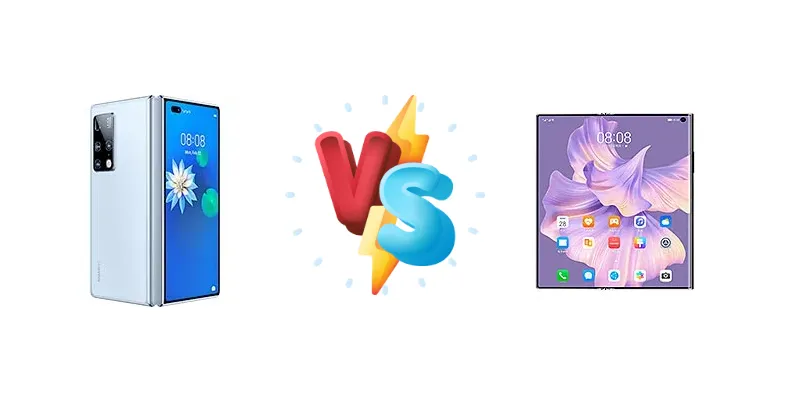
|
🏆 Quick Verdict
For most users, the Huawei Mate Xs 2 offers a more compelling package. The Snapdragon 888, despite being a generation older, provides a balanced experience with 66W charging and comparable battery endurance, making it a more practical daily driver than the Kirin 9000-powered Mate X2.
| PHONES | ||
|---|---|---|
| Phone Names | Huawei Mate X2 4G | Huawei Mate Xs 2 |
| Network | ||
|---|---|---|
| 2G bands | GSM 850 / 900 / 1800 / 1900 | GSM 850 / 900 / 1800 / 1900 |
| 3G bands | HSDPA 800 / 850 / 900 / 1700(AWS) / 1900 / 2100 | HSDPA 800 / 850 / 900 / 1700(AWS) / 1900 / 2100 |
| 4G bands | 1, 2, 3, 4, 5, 6, 7, 8, 9, 12, 17, 18, 19, 20, 26, 34, 38, 39, 40, 41 | 1, 2, 3, 4, 5, 7, 8, 12, 17, 18, 19, 20, 26, 28, 34, 38, 39, 40, 41 |
| Speed | HSPA, LTE, 5G | HSPA, LTE |
| Technology | GSM / CDMA / HSPA / EVDO / LTE | GSM / CDMA / HSPA / EVDO / LTE |
| - | CDMA2000 1xEV-DO | |
| Launch | ||
|---|---|---|
| Announced | 2021, June 28 | 2022, April 28 |
| Status | Available. Released 2021, July 15 | Available. Released 2022, May 07 |
| Body | ||
|---|---|---|
| Build | Glass front, glass back, aluminum frame | - |
| Dimensions | Unfolded: 161.8 x 145.8 x 8.2 mmFolded: 161.8 x 74.6 x 14.7 mm | Unfolded: 156.5 x 139.3 x 5.4 mmFolded: 156.5 x 75.5 x 11.1 mm |
| SIM | Nano-SIM + Nano-SIM | Nano-SIM + Nano-SIM |
| Weight | 295 g (10.41 oz) | 255 g / 257 g (8.99 oz) |
| Display | ||
|---|---|---|
| Resolution | 2200 x 2480 pixels (~414 ppi density) | 2200 x 2480 pixels (~424 ppi density) |
| Size | 8.0 inches, 205.0 cm2 (~86.9% screen-to-body ratio) | 7.8 inches, 195.8 cm2 (~89.8% screen-to-body ratio) |
| Type | Foldable OLED, 90Hz | Foldable OLED, 1B colors, 120Hz |
| - | Folded cover display: OLED, 6.5 inches, 1176 x 2480 pixels | |
| Platform | ||
|---|---|---|
| CPU | Octa-core (1x3.13 GHz Cortex-A77 & 3x2.54 GHz Cortex-A77 & 4x2.05 GHz Cortex-A55) | Octa-core (1x2.84 GHz Cortex-X1 & 3x2.42 GHz Cortex-A78 & 4x1.80 GHz Cortex-A55) |
| Chipset | Kirin 9000 (5 nm) | Qualcomm SM8350 Snapdragon 888 4G (5 nm) |
| GPU | Mali-G78 MP24 | Adreno 660 |
| OS | HarmonyOS 2.0 | EMUI 12, no Google Play Services (International); HarmonyOS 2.0 (China) |
| Memory | ||
|---|---|---|
| Card slot | Nano Memory (uses shared SIM slot) | Nano Memory (uses shared SIM slot) |
| Internal | 256GB 8GB RAM, 512GB 8GB RAM | 256GB 8GB RAM, 512GB 8GB RAM, 512GB 12GB RAM |
| - | UFS | |
| Main Camera | ||
|---|---|---|
| Features | Laser AF, color spectrum sensor, Leica optics, LED flash, panorama, HDR | Laser AF, color spectrum sensor, Dual-LED dual-tone flash, panorama, HDR |
| Quad | 50 MP, f/1.9, 23mm (wide), 1/1.28", 1.22µm, multi-directional PDAF, OIS 12 MP, f/2.4, 70mm (telephoto), PDAF, OIS, 3x optical zoom 8 MP, f/4.4, 240mm (periscope telephoto), PDAF, OIS, 10x optical zoom 16 MP, f/2.2, 17mm (ultrawide), AF | - |
| Single | - | 10.7 MP, f/2.2 |
| Triple | - | 50 MP, f/1.8, (wide), PDAF 8 MP, f/2.4, 81mm (telephoto), PDAF, OIS, 3x optical zoom 13 MP, f/2.2, 120˚ (ultrawide) |
| Video | 4K@30/60fps, 1080p@30/60fps, gyro-EIS | 4K@30/60fps, 1080p@30/240fps |
| Selfie camera | ||
|---|---|---|
| Features | HDR, panorama | HDR |
| Single | 16 MP, f/2.2, (wide) | 10.7 MP, f/2.2 |
| Video | 1080p@30fps | 4K@30fps, 1080p@30/240fps |
| Sound | ||
|---|---|---|
| 3.5mm jack | No | No |
| 35mm jack | No | No |
| Loudspeaker | Yes, with stereo speakers | Yes, with stereo speakers |
| Comms | ||
|---|---|---|
| Bluetooth | 5.2, A2DP, LE | 5.2, A2DP, LE |
| Infrared port | Yes | Yes |
| NFC | Yes | Yes |
| Positioning | GPS (L1+L5), GLONASS (L1), BDS (B1I+B1c+B2a+B2b), GALILEO (E1+E5a+E5b), QZSS (L1+L5), NavIC | GPS (L1+L5), GLONASS (L1), BDS (B1I+B1c+B2a), GALILEO (E1+E5a), QZSS (L1+L5), NavIC (L5) |
| Radio | No | No |
| USB | USB Type-C 3.1, OTG | USB Type-C 3.1, OTG |
| WLAN | Wi-Fi 802.11 a/b/g/n/ac/6, dual-band, Wi-Fi Direct | Wi-Fi 802.11 a/b/g/n/ac/6, dual-band, Wi-Fi Direct |
| Features | ||
|---|---|---|
| Sensors | Fingerprint (side-mounted), accelerometer, gyro, proximity, compass, barometer | Fingerprint (side-mounted), accelerometer, gyro, proximity, compass, barometer |
| Battery | ||
|---|---|---|
| Charging | 55W wired | 66W wired 5W reverse wired |
| Type | Li-Po 4500 mAh | Market-dependent versions:· Li-Po 4600 mAh (w/ 8GB RAM)· Li-Po 4880 mAh (w/ 12GB RAM) |
| Misc | ||
|---|---|---|
| Colors | Black, White, Light Blue | Black, White, Purple |
| Models | TET-AL00 | PAL-AL00, PAL-LX9 |
| Price | About 2290 EUR | About 2000 EUR |
| Tests | ||
|---|---|---|
| Battery life | - | Endurance rating 49h |
| Camera | - | Photo / Video |
| Display | - | Contrast ratio: Infinite (nominal) |
| Loudspeaker | - | -25.8 LUFS (Very good) |
| Performance | - | AnTuTu: 641608 (v9) GeekBench: 3131 (v5.1) GFXBench: 28fps (ES 3.1 onscreen) |
Huawei Mate X2 4G
- Potentially smoother software experience with Kirin chipset.
- Slightly more Cortex-A77 cores for multi-threaded tasks.
- Refined hinge design (based on brand reputation).
- Slower 55W charging.
- Likely lower peak display brightness.
- Limited 4G connectivity.
Huawei Mate Xs 2
- Faster 66W charging with 5W reverse charging.
- Brighter 725 nit display for outdoor visibility.
- Snapdragon 888’s superior GPU performance.
- Snapdragon 888 may exhibit more thermal throttling under sustained load.
- Software experience may vary compared to Kirin-based devices.
- Limited 4G connectivity.
Display Comparison
The Mate Xs 2 boasts a brighter display, reaching a measured 725 nits, a significant advantage over the Mate X2, which lacks published brightness data but is expected to be lower. Both feature foldable OLED panels, but the Xs 2’s higher peak brightness translates to better readability under direct sunlight. The infinite contrast ratio (nominal) on the Xs 2 is standard for OLED technology, promising deep blacks and vibrant colors. The hinge mechanism on the Xs 2 is also refined, aiming for improved durability, a crucial factor for foldable longevity.
Camera Comparison
Both devices offer a 'Photo / Video' experience, but detailed camera specifications are absent. Given Huawei’s history, both likely feature capable camera systems with strong computational photography. Without sensor size or aperture data, it’s difficult to definitively declare a winner. However, the Snapdragon 888’s image signal processor (ISP) is known for its advanced features and efficient processing, potentially giving the Mate Xs 2 an edge in image quality and video stabilization. The absence of details on secondary cameras (ultrawide, telephoto) makes a comprehensive comparison impossible.
Performance
The core difference lies in the chipsets. The Mate X2 utilizes Huawei’s Kirin 9000 (5nm), while the Mate Xs 2 features the Qualcomm Snapdragon 888 4G (5nm). While both are 5nm chips, the Snapdragon 888’s Cortex-X1 prime core (2.84 GHz) offers a slight architectural advantage over the Kirin 9000’s Cortex-A77 (3.13 GHz) in single-core performance. The Kirin 9000’s octa-core configuration includes more Cortex-A77 cores, potentially benefiting multi-threaded tasks, but the Snapdragon 888’s Adreno 660 GPU is generally considered superior for gaming. Both devices are limited to 4G connectivity, negating any potential 5G advantages of newer chipsets.
Battery Life
Both the Mate X2 and Mate Xs 2 achieve an endurance rating of 49 hours, suggesting similar real-world battery performance despite potential differences in battery capacity (not specified). However, the Mate Xs 2 significantly improves charging speed with 66W wired charging, compared to the Mate X2’s 55W. This translates to faster top-ups, reducing downtime. The addition of 5W reverse wired charging on the Xs 2 is a convenient feature for topping up accessories.
Buying Guide
Buy the Huawei Mate X2 4G if you prioritize the potentially smoother software experience historically associated with Kirin chipsets and are willing to accept slightly slower charging speeds. Buy the Huawei Mate Xs 2 if you value the wider availability of the Snapdragon platform, faster 66W charging, and a brighter display for outdoor visibility, all while maintaining comparable performance and battery life.