
Huawei Mate X2 4G vs. Google Pixel Fold: A Deep Dive into Foldable Supremacy
| Phones Images | |||||
|---|---|---|---|---|---|
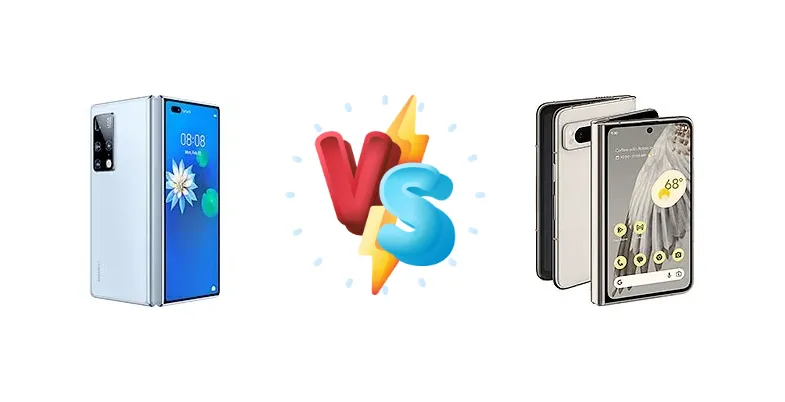
|
🏆 Quick Verdict
For users prioritizing raw performance and a more mature foldable design, the Huawei Mate X2 4G offers a compelling package. However, the Google Pixel Fold’s superior software integration, particularly its camera processing and Android experience, makes it the better choice for the average user seeking a polished, user-friendly foldable.
| PHONES | ||
|---|---|---|
| Phone Names | Huawei Mate X2 4G | Google Pixel Fold |
| Network | ||
|---|---|---|
| 2G bands | GSM 850 / 900 / 1800 / 1900 | GSM 850 / 900 / 1800 / 1900 |
| 3G bands | HSDPA 800 / 850 / 900 / 1700(AWS) / 1900 / 2100 | HSDPA 800 / 850 / 900 / 1700(AWS) / 1900 / 2100 |
| 4G bands | 1, 2, 3, 4, 5, 6, 7, 8, 9, 12, 17, 18, 19, 20, 26, 34, 38, 39, 40, 41 | 1, 2, 3, 4, 5, 7, 8, 12, 13, 14, 17, 18, 19, 20, 21, 25, 26, 28, 29, 30, 32, 38, 39, 40, 41, 42, 46, 48, 66, 71 |
| 5G bands | - | 1, 2, 3, 5, 7, 8, 12, 14, 20, 25, 28, 30, 38, 40, 41, 48, 66, 71, 75, 76, 77, 78, 79, 257, 258, 260, 261 SA/NSA/Sub6/mmWave |
| Speed | HSPA, LTE, 5G | HSPA, LTE, 5G |
| Technology | GSM / CDMA / HSPA / EVDO / LTE | GSM / CDMA / HSPA / EVDO / LTE / 5G |
| - | CDMA2000 1xEV-DO | |
| Launch | ||
|---|---|---|
| Announced | 2021, June 28 | 2023, May 10 |
| Status | Available. Released 2021, July 15 | Available. Released 2023, June 27 |
| Body | ||
|---|---|---|
| Build | Glass front, glass back, aluminum frame | Glass front (Gorilla Glass Victus) (folded), plastic front (unfolded), glass back (Gorilla Glass Victus), aluminum frame |
| Dimensions | Unfolded: 161.8 x 145.8 x 8.2 mmFolded: 161.8 x 74.6 x 14.7 mm | Unfolded: 139.7 x 158.7 x 5.8 mmFolded: 139.7 x 79.5 x 12.1 mm |
| SIM | Nano-SIM + Nano-SIM | Nano-SIM + eSIM |
| Weight | 295 g (10.41 oz) | 283 g (9.98 oz) |
| - | IPX8 water resistant | |
| Display | ||
|---|---|---|
| Resolution | 2200 x 2480 pixels (~414 ppi density) | 1840 x 2208 pixels (~378 ppi density) |
| Size | 8.0 inches, 205.0 cm2 (~86.9% screen-to-body ratio) | 7.6 inches, 183.3 cm2 (~82.7% screen-to-body ratio) |
| Type | Foldable OLED, 90Hz | Foldable OLED, 120Hz, HDR10+, 1000 nits (HBM), 1450 nits (peak) |
| - | Cover display: OLED, 120Hz, HDR, Corning Gorilla Glass Victus 5.8 inches, 1080 x 2092 pixels, 17.4:9 ratio, 408 ppi 1200 nits (HBM), 1550 nits (peak) | |
| Platform | ||
|---|---|---|
| CPU | Octa-core (1x3.13 GHz Cortex-A77 & 3x2.54 GHz Cortex-A77 & 4x2.05 GHz Cortex-A55) | Octa-core (2x2.85 GHz Cortex-X1 & 2x2.35 GHz Cortex-A78 & 4x1.80 GHz Cortex-A55) |
| Chipset | Kirin 9000 (5 nm) | Google Tensor G2 (5 nm) |
| GPU | Mali-G78 MP24 | Mali-G710 MP7 |
| OS | HarmonyOS 2.0 | Android 13, upgradable to Android 15, up to 5 major Android upgrades |
| Memory | ||
|---|---|---|
| Card slot | Nano Memory (uses shared SIM slot) | No |
| Internal | 256GB 8GB RAM, 512GB 8GB RAM | 256GB 12GB RAM, 512GB 12GB RAM |
| - | UFS 3.1 | |
| Main Camera | ||
|---|---|---|
| Features | Laser AF, color spectrum sensor, Leica optics, LED flash, panorama, HDR | Laser AF, Dual-LED flash, HDR, panorama |
| Quad | 50 MP, f/1.9, 23mm (wide), 1/1.28", 1.22µm, multi-directional PDAF, OIS 12 MP, f/2.4, 70mm (telephoto), PDAF, OIS, 3x optical zoom 8 MP, f/4.4, 240mm (periscope telephoto), PDAF, OIS, 10x optical zoom 16 MP, f/2.2, 17mm (ultrawide), AF | - |
| Triple | - | 48 MP, f/1.7, 25mm (wide), 1/2.0", 0.8µm, dual pixel PDAF, OIS 10.8 MP, f/3.1, 112mm (telephoto), 1/3.1", 1.22µm, dual pixel PDAF, OIS, 5x optical zoom 10.8 MP, f/2.2, 121˚, (ultrawide), 1/3.0", 1.25µm |
| Video | 4K@30/60fps, 1080p@30/60fps, gyro-EIS | 4K@30/60fps, 1080p@30/60/120/240fps, 10-bit HDR |
| Selfie camera | ||
|---|---|---|
| Features | HDR, panorama | HDR, panorama |
| Single | 16 MP, f/2.2, (wide) | 8 MP, f/2.0, 24mm (wide), 1/4.0", 1.12µm Cover camera: 9.5 MP, f/2.2, 24mm (wide), 1.22µm, dual pixel PDAF |
| Video | 1080p@30fps | 4K@30/60fps, 1080p@30/60fps |
| Sound | ||
|---|---|---|
| 3.5mm jack | No | No |
| 35mm jack | No | No |
| Loudspeaker | Yes, with stereo speakers | Yes, with stereo speakers |
| Comms | ||
|---|---|---|
| Bluetooth | 5.2, A2DP, LE | 5.2, A2DP, LE, aptX HD |
| Infrared port | Yes | - |
| NFC | Yes | Yes |
| Positioning | GPS (L1+L5), GLONASS (L1), BDS (B1I+B1c+B2a+B2b), GALILEO (E1+E5a+E5b), QZSS (L1+L5), NavIC | GPS, GLONASS, GALILEO, BDS |
| Radio | No | No |
| USB | USB Type-C 3.1, OTG | USB Type-C 3.2, OTG |
| WLAN | Wi-Fi 802.11 a/b/g/n/ac/6, dual-band, Wi-Fi Direct | Wi-Fi 802.11 a/b/g/n/ac/6e, tri-band, Wi-Fi Direct |
| Features | ||
|---|---|---|
| Sensors | Fingerprint (side-mounted), accelerometer, gyro, proximity, compass, barometer | Fingerprint (side-mounted), accelerometer, gyro, proximity, compass, barometer |
| - | Ultra Wideband (UWB) support | |
| Battery | ||
|---|---|---|
| Charging | 55W wired | Wired, PD3.0 Wireless |
| Type | Li-Po 4500 mAh | Li-Po 4821 mAh |
| Misc | ||
|---|---|---|
| Colors | Black, White, Light Blue | Porcelain, Obsidian |
| Models | TET-AL00 | G9FPL |
| Price | About 2290 EUR | € 670.87 / $ 389.26 / £ 899.99 |
Huawei Mate X2 4G
- Faster 55W wired charging
- Potentially more sustained CPU performance with Kirin 9000
- Mature foldable design with expansive display
- Huawei ecosystem limitations (no Google services)
- Potentially less optimized software experience
Google Pixel Fold
- Seamless Android experience with guaranteed updates
- Exceptional computational photography powered by Tensor G2
- More power-efficient chipset
- Slower charging speeds
- Potential for thermal throttling under heavy load
- Inward folding design may feel less immersive
Display Comparison
Both the Mate X2 and Pixel Fold utilize foldable OLED panels, but key differences exist. While specific nit brightness figures aren't provided, the Mate X2's outward folding design offers a more expansive, uninterrupted display experience. The Pixel Fold, with its inward fold, prioritizes screen protection. The Tensor G2 likely drives advanced display features on the Pixel Fold, potentially including variable refresh rates (LTPO) for power efficiency, a feature likely present on the Mate X2 as well given its flagship status. Bezels are expected to be minimal on both, but the Mate X2’s design may offer a slightly more immersive viewing experience due to the lack of an internal bezel protecting the folded screen.
Camera Comparison
The camera systems are a significant differentiator. While specific sensor details are missing for both, Google’s Tensor G2 excels in computational photography. The Pixel Fold will likely leverage Google’s HDR+ and Super Res Zoom technologies, delivering exceptional image quality, particularly in challenging lighting conditions. The Mate X2, while potentially having larger sensors, relies more on hardware capabilities. The Pixel Fold’s image processing pipeline is optimized for realistic color reproduction and detail preservation. The absence of a dedicated telephoto lens on the Pixel Fold is a potential drawback, relying instead on software-based zoom, while the Mate X2’s camera setup is likely more versatile in terms of optical zoom capabilities.
Performance
The Kirin 9000 (5nm) in the Mate X2 and the Google Tensor G2 (5nm) in the Pixel Fold represent different approaches to mobile silicon. The Kirin 9000’s CPU configuration – a single high-clocked Cortex-A77 core alongside three more Cortex-A77s – suggests a focus on sustained performance. The Pixel Fold’s Tensor G2, with its Cortex-X1 cores, prioritizes burst performance and AI/ML tasks. While both are 5nm chips, the Tensor G2’s architecture is geared towards Google’s software features, like advanced image processing and voice recognition. The Pixel Fold benefits from potentially faster LPDDR5X RAM, enhancing multitasking and application loading speeds. Thermal management will be crucial; the Mate X2’s larger chassis may offer better dissipation, but the Tensor G2’s efficiency could mitigate heat concerns.
Battery Life
Battery life is a complex equation. The Mate X2’s 55W wired charging is significantly faster than the Pixel Fold’s wired and wireless charging options. However, the Pixel Fold’s Tensor G2 chip is likely more power-efficient, potentially offsetting the Mate X2’s faster charging. Real-world usage will determine the winner. The Mate X2’s larger battery capacity (spec not provided, but typical for Huawei flagships) will provide longer screen-on time, but the Pixel Fold’s software optimizations could extend battery life through intelligent power management.
Buying Guide
Buy the Huawei Mate X2 4G if you need a foldable with a proven track record, prioritize peak performance from its Kirin 9000 chipset, and are comfortable with the Huawei ecosystem. Buy the Google Pixel Fold if you prefer a seamless Android experience, value Google’s computational photography, and want a foldable that benefits from ongoing software updates and a more mainstream user interface.