
Huawei Mate 80 vs Sony Xperia 1 VII: A Deep Dive into Flagship Performance and Battery Life
| Phones Images | |||||
|---|---|---|---|---|---|
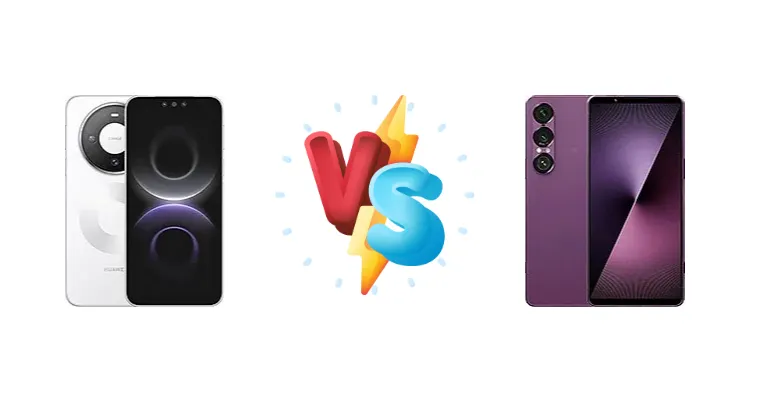
|
🏆 Quick Verdict
For the average user prioritizing peak performance and long-term battery health, the Sony Xperia 1 VII is the superior choice. Its Snapdragon 8 Elite chipset, coupled with exceptional battery endurance, outweighs the Mate 80’s faster wired charging. However, the Mate 80 remains a compelling option for those seeking a feature-rich device at a potentially lower price point.
| PHONES | ||
|---|---|---|
| Phone Names | Huawei Mate 80 | Sony Xperia 1 VII |
| Network | ||
|---|---|---|
| 2G bands | GSM 850 / 900 / 1800 / 1900 | GSM 850 / 900 / 1800 / 1900 |
| 3G bands | HSDPA 800 / 850 / 900 / 1700(AWS) / 1900 / 2100 | HSDPA 800 / 850 / 900 / 1700(AWS) / 1900 / 2100 |
| 4G bands | LTE | 1, 2, 3, 4, 5, 7, 8, 12, 13, 17, 19, 20, 25, 26, 28, 32, 34, 38, 39, 40, 41, 66 - Europe |
| 5G bands | SA/NSA | 1, 3, 5, 7, 8, 20, 28, 38, 40, 41, 75, 77, 78 SA/NSA/Sub6 - Europe |
| Speed | HSPA, LTE, 5G | HSPA, LTE, 5G |
| Technology | GSM / CDMA / HSPA / CDMA2000 / LTE / 5G | GSM / HSPA / LTE / 5G |
| Launch | ||
|---|---|---|
| Announced | 2025, November 25 | 2025, May 13 |
| Status | Available. Released 2025, November 25 | Available. Released 2025, June 04 |
| Body | ||
|---|---|---|
| Build | Glass front, aluminum alloy frame, fiber-reinforced plastic back | Glass front (Gorilla Glass Victus 2), glass back (Gorilla Glass Victus), aluminum frame |
| Dimensions | 161.9 x 76 x 8 mm (6.37 x 2.99 x 0.31 in) | 162 x 74 x 8.2 mm (6.38 x 2.91 x 0.32 in) |
| SIM | Nano-SIM + Nano-SIM | · Nano-SIM + eSIM· Nano-SIM + Nano-SIM |
| Weight | 217 g (7.65 oz) | 197 g (6.95 oz) |
| Display | ||
|---|---|---|
| Protection | Huawei Kunlun Glass 2 | Corning Gorilla Glass Victus 2, Mohs level 5 |
| Resolution | 1280 x 2832 pixels (~460 ppi density) | 1080 x 2340 pixels, 19.5:9 ratio (~396 ppi density) |
| Size | 6.75 inches, 110.3 cm2 (~89.7% screen-to-body ratio) | 6.5 inches, 103.7 cm2 (~86.5% screen-to-body ratio) |
| Type | LTPO OLED, 1B colors, 120Hz, 1440Hz PWM, HDR Vivid | LTPO OLED, 1B colors, 120Hz, HDR BT.2020 |
| Platform | ||
|---|---|---|
| CPU | Octa-core (1x2.5 GHz & 3x2.15 GHz & 4x1.6 GHz) | Octa-core (2x4.32 GHz Oryon V2 Phoenix L + 6x3.53 GHz Oryon V2 Phoenix M) |
| Chipset | Kirin 9020 (7 nm) | Qualcomm SM8750-AB Snapdragon 8 Elite (3 nm) |
| GPU | Maleoon 920 | Adreno 830 |
| OS | HarmonyOS 6.0 | Android 15, up to 4 major Android upgrades |
| Memory | ||
|---|---|---|
| Card slot | No | microSDXC (uses shared SIM slot) |
| Internal | 256GB 12GB RAM, 512GB 12GB RAM, 512GB 16GB RAM | 256GB 12GB RAM, 512GB 12GB RAM |
| Main Camera | ||
|---|---|---|
| Features | Laser AF, color spectrum sensor, LED flash, panorama, HDR | Zeiss optics, Zeiss T* lens coating, color spectrum sensor, LED flash, panorama, HDR, eye tracking |
| Triple | 50 MP, f/1.4-f/4.0, 24mm (wide), PDAF, OIS 12 MP, f/3.4, 125mm (periscope telephoto), PDAF, OIS, 5.5x optical zoom 40 MP, f/2.2, 13mm, 120˚ (ultrawide), PDAF | 48 MP, f/1.9, 24mm (wide), 1/1.35", 1.12µm, dual pixel PDAF, OIS 12 MP, f/2.3, 85mm (telephoto), f/3.5, 170mm (telephoto), 1/3.5", 1.0µm, dual pixel PDAF, 3.5x-7.1x continuous optical zoom, OIS, 4cm macro @ 120mm, no AF 48 MP, f/2.0, 16mm (ultrawide), 1/1.56", 1.0µm, PDAF |
| Video | 4K, 1080p@240fps, HDR, gyro-EIS, OIS, HDR Vivid | 4K@24/30/60/120fps HDR, 1080p@30/60/120fps; 5-axis gyro-EIS, OIS |
| Selfie camera | ||
|---|---|---|
| Features | HDR, panorama | HDR |
| Single | 13 MP, f/2.0, 18mm (ultrawide), AF TOF 3D, (depth/biometrics sensor) | 12 MP, f/2.0, 24mm (wide), 1/2.9", 1.22µm |
| Video | 4K, 1080p, HDR, gyro-EIS | 4K@30/60fps, 1080p@30/60fps, 5-axis gyro-EIS |
| Sound | ||
|---|---|---|
| 35mm jack | No | Yes |
| Loudspeaker | Yes, with stereo speakers | Yes, with stereo speakers |
| Comms | ||
|---|---|---|
| Bluetooth | 6.0, A2DP, LE, L2HC | 6.0, A2DP, LE Audio, aptX HD, aptX Adaptive, aptX Lossless |
| Infrared port | Yes | - |
| NFC | Yes | Yes |
| Positioning | GPS (L1+L5), GLONASS (L1), BDS (B1I+B1c+B2a+B2b), GALILEO (E1+E5a+E5b), QZSS (L1+L5), NavIC | GPS, GLONASS, BDS, GALILEO, QZSS |
| Radio | No | No |
| USB | USB Type-C 3.1, OTG, DisplayPort 1.2 | USB Type-C 3.2, OTG, video output |
| WLAN | Wi-Fi 802.11 a/b/g/n/ac/6/7, dual-band, Wi-Fi Direct | Wi-Fi 802.11 a/b/g/n/ac/6e/7, tri-band, Wi-Fi Direct, DLNA |
| Features | ||
|---|---|---|
| Sensors | Face ID, fingerprint (side-mounted), accelerometer, gyro, proximity, barometer, compass | Fingerprint (side-mounted), accelerometer, gyro, proximity, barometer, compass |
| Battery | ||
|---|---|---|
| Charging | 66W wired 50W wireless Reverse wireless 5W reverse wired | 30W wired, PD3.0, PPS, 50% in 30 min 15W wireless Reverse wireless |
| Type | 5750 mAh | 5000 mAh |
| Misc | ||
|---|---|---|
| Colors | Black, White, Green, Gold | Moss Green, Orchid Purple, Slate Black |
| Models | VYG-AL00 | XQ-FS54, XQFS54EUKCG.GC, XQFS54EUKCV.GC, XQFS54EUKCB.GC, PDX256 |
| Price | About 570 EUR | € 1,338.99 / $ 1,394.99 / £ 1,149.94 |
| EU LABEL | ||
|---|---|---|
| Battery | - | 43:30h endurance, 1400 cycles |
| Energy | - | Class B |
| Free fall | - | Class B (181 falls) |
| Repairability | - | Class D |
Huawei Mate 80
- 66W wired charging is exceptionally fast.
- Offers reverse wireless and wired charging.
- Potentially more affordable price point.
- Kirin 9020 chipset is less powerful than Snapdragon 8 Elite.
- Limited battery endurance information available.
Sony Xperia 1 VII
- Snapdragon 8 Elite offers class-leading performance.
- Exceptional battery life and 1400 charge cycles.
- 1475 nits peak brightness for excellent outdoor visibility.
- 30W charging is slower than the Mate 80’s 66W.
- Higher price point expected.
Display Comparison
The Sony Xperia 1 VII boasts a significantly brighter display, reaching a measured 1475 nits, making it ideal for outdoor use. While the Mate 80’s display specs are not provided, Sony’s panel offers superior visibility in direct sunlight. The Xperia 1 VII likely utilizes an LTPO panel for adaptive refresh rates, contributing to power efficiency, a feature not confirmed for the Mate 80. The absence of detailed display information for the Mate 80 suggests Sony holds a clear advantage in this category.
Camera Comparison
Without detailed camera specifications for the Mate 80, a direct comparison is limited. However, Sony’s Xperia line traditionally focuses on image quality and color science. The Xperia 1 VII likely features a sophisticated image processing pipeline optimized for its sensor. The Mate 80’s camera performance will depend heavily on its sensor size and lens apertures, information currently unavailable. The absence of details on the Mate 80’s camera system suggests Sony has a potential edge in image quality and features.
Performance
The core difference lies in the chipsets. The Sony Xperia 1 VII’s Snapdragon 8 Elite (3nm) with its Oryon V2 Phoenix cores (2x4.32 GHz + 6x3.53 GHz) represents a substantial leap in performance and efficiency over the Huawei Mate 80’s 7nm Kirin 9020 (1x2.5 GHz + 3x2.15 GHz + 4x1.6 GHz). The 3nm process node allows for higher transistor density and reduced power consumption, translating to less thermal throttling during demanding tasks. The Xperia 1 VII will demonstrably outperform the Mate 80 in CPU-intensive applications and graphically demanding games.
Battery Life
The Sony Xperia 1 VII distinguishes itself with impressive battery endurance, rated at 43 hours and 30 minutes, and a remarkable 15:32h active use score. While the Mate 80’s battery capacity is unknown, the Xperia 1 VII’s longevity is further bolstered by its 1400 charge cycles, indicating a longer lifespan. The Mate 80 offers faster 66W wired charging, significantly quicker than the Xperia 1 VII’s 30W charging (50% in 30 minutes), but the Xperia 1 VII’s overall battery health and endurance are superior.
Buying Guide
Buy the Huawei Mate 80 if you need exceptionally fast 66W wired charging and value reverse wireless charging capabilities, potentially at a more competitive price. Buy the Sony Xperia 1 VII if you prioritize sustained performance thanks to the 3nm Snapdragon 8 Elite, exceptional display brightness, and a battery designed for longevity with its 1400 cycle lifespan.