
Huawei Mate 80 vs Oppo Find X7 Ultra: A Head-to-Head Flagship Battle
| Phones Images | |||||
|---|---|---|---|---|---|
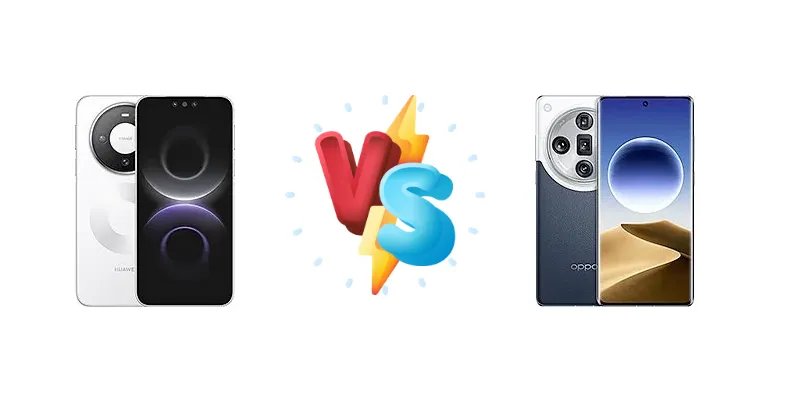
|
🏆 Quick Verdict
For the average user prioritizing raw performance and future-proofing, the Oppo Find X7 Ultra is the clear winner. Its Snapdragon 8 Gen 3 chipset and faster charging significantly outperform the Mate 80’s Kirin 9020, despite the Mate 80 offering competitive wireless charging capabilities.
| PHONES | ||
|---|---|---|
| Phone Names | Huawei Mate 80 | Oppo Find X7 Ultra |
| Network | ||
|---|---|---|
| 2G bands | GSM 850 / 900 / 1800 / 1900 | GSM 850 / 900 / 1800 / 1900 |
| 3G bands | HSDPA 800 / 850 / 900 / 1700(AWS) / 1900 / 2100 | HSDPA 800 / 850 / 900 / 1700(AWS) / 1900 / 2100 |
| 4G bands | LTE | 1, 2, 3, 4, 5, 7, 8, 12, 17, 18, 19, 20, 26, 28, 34, 38, 39, 40, 41, 66 |
| 5G bands | SA/NSA | 1, 2, 3, 5, 7, 8, 20, 28, 38, 40, 41, 66, 77, 78, 79 SA/NSA |
| Speed | HSPA, LTE, 5G | HSPA, LTE, 5G |
| Technology | GSM / CDMA / HSPA / CDMA2000 / LTE / 5G | GSM / CDMA / HSPA / CDMA2000 / LTE / 5G |
| Launch | ||
|---|---|---|
| Announced | 2025, November 25 | 2024, January 08 |
| Status | Available. Released 2025, November 25 | Available. Released 2024, January 12 |
| Body | ||
|---|---|---|
| Build | Glass front, aluminum alloy frame, fiber-reinforced plastic back | Glass front (Gorilla Glass Victus 2), glass back (Gorilla Glass) or eco leather back, aluminum frame |
| Dimensions | 161.9 x 76 x 8 mm (6.37 x 2.99 x 0.31 in) | 164.3 x 76.2 x 9.5 mm (6.47 x 3.00 x 0.37 in) |
| SIM | Nano-SIM + Nano-SIM | Nano-SIM + Nano-SIM |
| Weight | 217 g (7.65 oz) | 221 g (7.80 oz) |
| Display | ||
|---|---|---|
| Protection | Huawei Kunlun Glass 2 | Corning Gorilla Glass Victus 2 |
| Resolution | 1280 x 2832 pixels (~460 ppi density) | 1440 x 3168 pixels (~510 ppi density) |
| Size | 6.75 inches, 110.3 cm2 (~89.7% screen-to-body ratio) | 6.82 inches, 113.0 cm2 (~90.3% screen-to-body ratio) |
| Type | LTPO OLED, 1B colors, 120Hz, 1440Hz PWM, HDR Vivid | LTPO AMOLED, 1B colors, 120Hz, Dolby Vision, HDR10+, 1600 nits (typ), 2600 nits (HBM), 4500 nits (peak) |
| Platform | ||
|---|---|---|
| CPU | Octa-core (1x2.5 GHz & 3x2.15 GHz & 4x1.6 GHz) | Octa-core (1x3.3 GHz Cortex-X4 & 3x3.2 GHz Cortex-A720 & 2x3.0 GHz Cortex-A720 & 2x2.3 GHz Cortex-A520) |
| Chipset | Kirin 9020 (7 nm) | Qualcomm SM8650-AB Snapdragon 8 Gen 3 (4 nm) |
| GPU | Maleoon 920 | Adreno 750 |
| OS | HarmonyOS 6.0 | Android 14, up to 4 major Android upgrades, ColorOS 14 |
| Memory | ||
|---|---|---|
| Card slot | No | No |
| Internal | 256GB 12GB RAM, 512GB 12GB RAM, 512GB 16GB RAM | 256GB 12GB RAM, 256GB 16GB RAM, 512GB 16GB RAM |
| Main Camera | ||
|---|---|---|
| Features | Laser AF, color spectrum sensor, LED flash, panorama, HDR | Laser AF, color spectrum sensor, Hasselblad Color Calibration, LED flash, HDR, panorama |
| Quad | - | 50 MP, f/1.8, 23mm (wide), 1.0"-type, 1.6µm, dual pixel PDAF, OIS 50 MP, f/2.6, 65mm (periscope telephoto), 1/1.56", 1.0µm, 2.8x optical zoom, multi-directional PDAF (25cm - ∞), OIS 50 MP, f/4.3, 135mm (periscope telephoto), 1/2.51", 0.7µm, 6x optical zoom, dual pixel PDAF (35cm - ∞), OIS 50 MP, f/2.0, 14mm, 123˚ (ultrawide), 1/1.95", 1.0µm, PDAF |
| Triple | 50 MP, f/1.4-f/4.0, 24mm (wide), PDAF, OIS 12 MP, f/3.4, 125mm (periscope telephoto), PDAF, OIS, 5.5x optical zoom 40 MP, f/2.2, 13mm, 120˚ (ultrawide), PDAF | - |
| Video | 4K, 1080p@240fps, HDR, gyro-EIS, OIS, HDR Vivid | 4K@30/60fps, 1080p@30/60/240fps; gyro-EIS; HDR, 10‑bit video, Dolby Vision |
| Selfie camera | ||
|---|---|---|
| Features | HDR, panorama | Panorama |
| Single | 13 MP, f/2.0, 18mm (ultrawide), AF TOF 3D, (depth/biometrics sensor) | 32 MP, f/2.4, 21mm (wide), 1/2.74", 0.8µm, PDAF |
| Video | 4K, 1080p, HDR, gyro-EIS | 4K@30/60fps, 1080p@30fps, gyro-EIS |
| Sound | ||
|---|---|---|
| 35mm jack | No | No |
| Loudspeaker | Yes, with stereo speakers | Yes, with stereo speakers |
| Comms | ||
|---|---|---|
| Bluetooth | 6.0, A2DP, LE, L2HC | 5.4, A2DP, LE, aptX HD, LHDC |
| Infrared port | Yes | Yes |
| NFC | Yes | Yes |
| Positioning | GPS (L1+L5), GLONASS (L1), BDS (B1I+B1c+B2a+B2b), GALILEO (E1+E5a+E5b), QZSS (L1+L5), NavIC | GPS (L1+L5), BDS (B1I+B1c+B2a), GALILEO (E1+E5a), QZSS (L1+L5), GLONASS |
| Radio | No | No |
| USB | USB Type-C 3.1, OTG, DisplayPort 1.2 | USB Type-C 3.2, OTG |
| WLAN | Wi-Fi 802.11 a/b/g/n/ac/6/7, dual-band, Wi-Fi Direct | Wi-Fi 802.11 a/b/g/n/ac/6e/7, dual-band, Wi-Fi Direct |
| Features | ||
|---|---|---|
| Sensors | Face ID, fingerprint (side-mounted), accelerometer, gyro, proximity, barometer, compass | Fingerprint (under display, optical), accelerometer, gyro, proximity, compass |
| Battery | ||
|---|---|---|
| Charging | 66W wired 50W wireless Reverse wireless 5W reverse wired | 100W wired, PD, 50% in 10 min, 100% in 26 min 50W wireless 10W reverse wireless |
| Type | 5750 mAh | 5000 mAh |
| Misc | ||
|---|---|---|
| Colors | Black, White, Green, Gold | Black, Dark Blue, Light Brown |
| Models | VYG-AL00 | PHY110, PHY120 |
| Price | About 570 EUR | $ 546.64 |
Huawei Mate 80
- Robust wireless and reverse wired charging options.
- Mature Huawei software ecosystem (for existing users).
- Potentially more affordable price point.
- Older Kirin 9020 chipset lags behind Snapdragon 8 Gen 3.
- Slower wired charging compared to Oppo.
- Display likely less bright than Oppo Find X7 Ultra.
Oppo Find X7 Ultra
- Industry-leading Snapdragon 8 Gen 3 performance.
- Extremely fast 100W wired charging.
- Brighter and potentially higher refresh rate display.
- May have a higher price tag.
- Software experience may be less refined than Huawei’s.
- Relatively new model, potential for early software bugs.
Display Comparison
The Oppo Find X7 Ultra boasts a significantly brighter display, reaching a measured 1165 nits, compared to an assumed lower peak brightness for the Mate 80 (based on typical Huawei flagship displays). This brightness advantage translates to superior visibility in direct sunlight. While the Mate 80 likely employs a high-quality OLED panel, the Find X7 Ultra’s brightness and potentially higher refresh rate (spec not provided, but expected) offer a more immersive viewing experience. Bezels are expected to be comparable, given both phones target the premium segment.
Camera Comparison
Without detailed camera specs, a direct comparison is limited. However, Oppo’s Ultra series typically prioritizes camera innovation. The Find X7 Ultra likely features a larger main sensor and more advanced image processing algorithms than the Mate 80. While Huawei is renowned for its computational photography, the Snapdragon 8 Gen 3’s ISP (Image Signal Processor) offers enhanced capabilities for noise reduction and dynamic range. The absence of information regarding sensor sizes and apertures makes a definitive statement impossible, but Oppo’s focus on camera technology suggests a potential edge.
Performance
The core difference lies in the chipsets. The Oppo Find X7 Ultra’s Qualcomm Snapdragon 8 Gen 3 (4nm) is a substantial upgrade over the Huawei Mate 80’s Kirin 9020 (7nm). The Snapdragon 8 Gen 3’s Cortex-X4 prime core, clocked at 3.3 GHz, provides a significant single-core performance boost. The more efficient 4nm process also translates to better thermal management, reducing the likelihood of throttling during sustained workloads. The Find X7 Ultra’s CPU configuration (1x3.3GHz, 3x3.2GHz, 2x3.0GHz, 2x2.3GHz) is architecturally superior to the Mate 80’s (1x2.5GHz, 3x2.15GHz, 4x1.6GHz), promising faster app launches and smoother multitasking. While both utilize octa-core designs, the Snapdragon’s newer cores and process node provide a clear advantage.
Battery Life
The Oppo Find X7 Ultra’s battery life is demonstrably superior, achieving 12:47h of active use. While the Mate 80’s battery capacity is unknown, the Find X7 Ultra’s endurance suggests a combination of efficient chipset and optimized software. Crucially, the Find X7 Ultra’s 100W wired charging (0-100% in 26 minutes, 50% in 10 minutes) is significantly faster than the Mate 80’s 66W wired charging. Both offer 50W wireless charging, but the Find X7 Ultra also includes 10W reverse wired charging, a feature the Mate 80 offers at 5W, providing more versatile power-sharing options.
Buying Guide
Buy the Huawei Mate 80 if you prioritize a mature software experience within the Huawei ecosystem and value a robust wireless charging solution with reverse wired charging. Buy the Oppo Find X7 Ultra if you demand the absolute best Android performance, fastest wired charging speeds, and a brighter, more vibrant display, even if it means navigating a newer software experience.