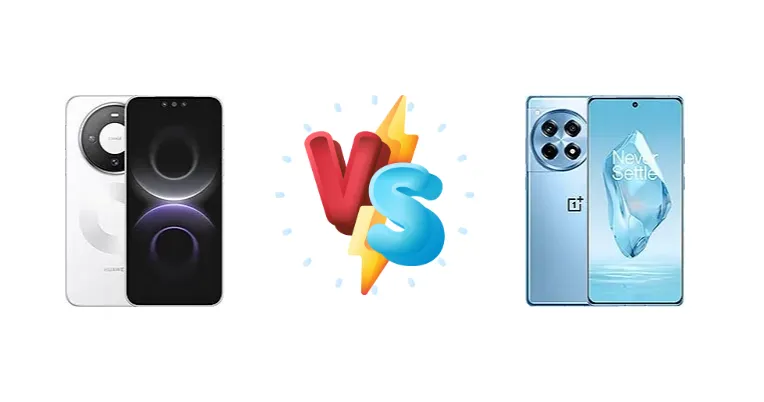
The Huawei Mate 80 and OnePlus 12R represent distinct approaches to the flagship smartphone experience. The Mate 80, leveraging Huawei’s in-house Kirin 9020, aims for a balanced experience, while the OnePlus 12R brings Qualcomm’s Snapdragon 8 Gen 2 to a more accessible price point, prioritizing raw performance and rapid charging. This comparison dissects their key differences to determine which device best suits your needs.
🏆 Quick Verdict
For most users, the OnePlus 12R emerges as the stronger choice. Its Snapdragon 8 Gen 2 chipset delivers significantly faster processing and graphics performance, complemented by blazing-fast 100W charging. However, the Huawei Mate 80’s 50W wireless charging and potentially more refined software experience may appeal to specific users.
| Network |
|---|
| 2G bands | GSM 850 / 900 / 1800 / 1900 | GSM 850 / 900 / 1800 / 1900 |
| 3G bands | HSDPA 800 / 850 / 900 / 1700(AWS) / 1900 / 2100 | HSDPA 850 / 900 / 1700(AWS) / 1900 / 2100 |
| 4G bands | LTE | 1, 2, 3, 4, 5, 7, 8, 12, 17, 18, 19, 20, 26, 28, 32, 38, 39, 40, 41, 66 |
| 5G bands | SA/NSA | 1, 2, 3, 5, 7, 8, 12, 20, 28, 38, 40, 41, 66, 77, 78 SA/NSA |
| Speed | HSPA, LTE, 5G | HSPA, LTE, 5G |
| Technology | GSM / CDMA / HSPA / CDMA2000 / LTE / 5G | GSM / CDMA / HSPA / LTE / 5G |
| Launch |
|---|
| Announced | 2025, November 25 | 2024, January 23 |
| Status | Available. Released 2025, November 25 | Available. Released 2024, February 06 |
| Body |
|---|
| Build | Glass front, aluminum alloy frame, fiber-reinforced plastic back | Glass front (Gorilla Glass Victus 2), aluminum frame, glass back |
| Dimensions | 161.9 x 76 x 8 mm (6.37 x 2.99 x 0.31 in) | 163.3 x 75.3 x 8.8 mm (6.43 x 2.96 x 0.35 in) |
| SIM | Nano-SIM + Nano-SIM | · Nano-SIM + Nano-SIM + eSIM (max 2 at a time)· Nano-SIM + Nano-SIM |
| Weight | 217 g (7.65 oz) | 207 g (7.30 oz) |
| Display |
|---|
| Protection | Huawei Kunlun Glass 2 | Corning Gorilla Glass Victus 2 |
| Resolution | 1280 x 2832 pixels (~460 ppi density) | 1264 x 2780 pixels (~450 ppi density) |
| Size | 6.75 inches, 110.3 cm2 (~89.7% screen-to-body ratio) | 6.78 inches, 111.7 cm2 (~90.9% screen-to-body ratio) |
| Type | LTPO OLED, 1B colors, 120Hz, 1440Hz PWM, HDR Vivid | LTPO4 AMOLED, 1B colors, 120Hz, HDR10+, Dolby Vision, 1600 nits (HBM), 4500 nits (peak) |
| Platform |
|---|
| CPU | Octa-core (1x2.5 GHz & 3x2.15 GHz & 4x1.6 GHz) | Octa-core (1x3.2 GHz Cortex-X3 & 2x2.8 GHz Cortex-A715 & 2x2.8 GHz Cortex-A710 & 3x2.0 GHz Cortex-A510) |
| Chipset | Kirin 9020 (7 nm) | Qualcomm SM8550-AB Snapdragon 8 Gen 2 (4 nm) |
| GPU | Maleoon 920 | Adreno 740 |
| OS | HarmonyOS 6.0 | Android 14, up to 3 major Android upgrades, OxygenOS 15 |
| Memory |
|---|
| Card slot | No | No |
| Internal | 256GB 12GB RAM, 512GB 12GB RAM, 512GB 16GB RAM | 128GB 8GB RAM, 256GB 8GB RAM, 256GB 12GB RAM, 256GB 16GB RAM |
| Main Camera |
|---|
| Features | Laser AF, color spectrum sensor, LED flash, panorama, HDR | Laser AF, color spectrum sensor, LED flash, HDR, panorama |
| Triple | 50 MP, f/1.4-f/4.0, 24mm (wide), PDAF, OIS
12 MP, f/3.4, 125mm (periscope telephoto), PDAF, OIS, 5.5x optical zoom
40 MP, f/2.2, 13mm, 120˚ (ultrawide), PDAF | 50 MP, f/1.8, 24mm (wide), 1/1.56", 1.0µm, multi-directional PDAF, OIS
8 MP, f/2.2, 16mm, 112˚ (ultrawide), 1/4.0", 1.12µm
2 MP (macro) |
| Video | 4K, 1080p@240fps, HDR, gyro-EIS, OIS, HDR Vivid | 4K@30/60fps, 1080p@30/60/120/240fps, gyro-EIS, OIS |
| Selfie camera |
|---|
| Features | HDR, panorama | HDR, panorama |
| Single | 13 MP, f/2.0, 18mm (ultrawide), AF
TOF 3D, (depth/biometrics sensor) | 16 MP, f/2.4, 26mm (wide), 1/3", 1.0µm |
| Video | 4K, 1080p, HDR, gyro-EIS | 1080p@30fps, gyro-EIS |
| Sound |
|---|
| 35mm jack | No | No |
| Loudspeaker | Yes, with stereo speakers | Yes, with stereo speakers |
| Comms |
|---|
| Bluetooth | 6.0, A2DP, LE, L2HC | 5.3, A2DP, LE, aptX HD |
| Infrared port | Yes | Yes |
| NFC | Yes | Yes |
| Positioning | GPS (L1+L5), GLONASS (L1), BDS (B1I+B1c+B2a+B2b), GALILEO (E1+E5a+E5b), QZSS (L1+L5), NavIC | GPS, GALILEO, GLONASS, BDS, QZSS |
| Radio | No | No |
| USB | USB Type-C 3.1, OTG, DisplayPort 1.2 | USB Type-C 2.0 |
| WLAN | Wi-Fi 802.11 a/b/g/n/ac/6/7, dual-band, Wi-Fi Direct | Wi-Fi 802.11 a/b/g/n/ac/6/7, dual-band |
| Features |
|---|
| Sensors | Face ID, fingerprint (side-mounted), accelerometer, gyro, proximity, barometer, compass | Fingerprint (under display, optical), accelerometer, gyro, proximity, compass |
| Battery |
|---|
| Charging | 66W wired
50W wireless
Reverse wireless
5W reverse wired | 100W wired, 100% in 26 min |
| Type | 5750 mAh | Li-Ion 5500 mAh |
| Misc |
|---|
| Colors | Black, White, Green, Gold | Iron Gray, Cool Blue, Electric Violet, Sunset Dune |
| Models | VYG-AL00 | CPH2609, CPH2585, CPH2611 |
| Price | About 570 EUR | € 410.84 / $ 399.95 / £ 649.00 |
| SAR | - | 1.19 W/kg (head) 0.82 W/kg (body) |
Huawei Mate 80
- 50W Wireless Charging offers convenience.
- Kirin 9020 provides a balanced performance profile.
- Potential for refined software experience (depending on user preference).
- Slower wired charging compared to OnePlus 12R.
- Chipset is less powerful than Snapdragon 8 Gen 2.
OnePlus 12R
- Snapdragon 8 Gen 2 delivers top-tier performance.
- 100W charging provides incredibly fast charging speeds.
- Excellent battery life (14:32h active use).
- Lacks wireless charging capabilities.
- Software experience may be less polished than Huawei’s (depending on user preference).
Display Comparison
The OnePlus 12R boasts a significantly brighter display, reaching a measured peak of 1181 nits, ensuring excellent visibility even in direct sunlight. While the Mate 80’s display specifications are not provided, Huawei typically employs high-quality panels; however, it’s unlikely to match the 12R’s peak brightness. The 12R’s panel likely utilizes LTPO technology, enabling variable refresh rates for improved power efficiency, a feature not confirmed for the Mate 80. Bezels and color accuracy are unknown for the Mate 80, but the 12R is expected to deliver a modern, immersive viewing experience.
Camera Comparison
Without detailed camera specifications for the Mate 80, a direct comparison is challenging. However, the OnePlus 12R is expected to feature a capable camera system, focusing on a high-resolution main sensor and effective image stabilization. The Kirin 9020 is known for its image signal processing capabilities, potentially offering a distinct image style. The absence of information regarding sensor sizes and apertures on the Mate 80 makes it difficult to assess its low-light performance relative to the 12R. We can assume both phones will offer a range of shooting modes, but the 12R’s processing power will likely enable faster image processing and more advanced computational photography features.
Performance
The core difference lies in the chipsets. The OnePlus 12R’s Snapdragon 8 Gen 2 (4nm) is a clear step up from the Huawei Mate 80’s Kirin 9020 (7nm). The Snapdragon 8 Gen 2’s Cortex-X3 prime core, clocked at 3.2 GHz, provides a substantial performance boost over the Kirin 9020’s 2.5 GHz core. The 4nm process node of the Snapdragon also translates to superior thermal efficiency, reducing the likelihood of throttling during sustained workloads. The 12R’s LPDDR5x RAM further enhances performance, while the Mate 80’s RAM specification is unknown. This translates to a smoother, more responsive experience on the OnePlus 12R, particularly for gaming and demanding applications.
Battery Life
The OnePlus 12R’s 100W wired charging is a game-changer, achieving a full charge in just 26 minutes. The Huawei Mate 80 offers 66W wired charging, which is still fast, but significantly slower. The Mate 80 compensates with 50W wireless charging and 5W reverse wireless charging, features absent on the 12R. The 12R’s active use battery score of 14:32h demonstrates excellent real-world endurance. While the Mate 80’s battery capacity is unknown, the 12R’s combination of efficient chipset and optimized software provides a compelling battery life advantage.
Buying Guide
Buy the Huawei Mate 80 if you prioritize wireless charging convenience, value Huawei’s software ecosystem, and prefer a potentially more balanced thermal profile. Buy the OnePlus 12R if you demand top-tier performance for gaming and demanding applications, need the fastest possible wired charging, and appreciate a clean, near-stock Android experience.
Frequently Asked Questions
❓ Does the Kirin 9020 chipset in the Huawei Mate 80 experience significant thermal throttling during extended gaming sessions?
While the Kirin 9020 is a capable chipset, its 7nm process node is less efficient than the 4nm Snapdragon 8 Gen 2. This means the Mate 80 is more likely to experience thermal throttling during prolonged, demanding tasks like gaming, potentially leading to reduced performance over time. The OnePlus 12R’s superior thermal efficiency should maintain higher sustained performance.
❓ How does the 100W charging on the OnePlus 12R impact battery health over the long term?
While extremely fast charging can theoretically accelerate battery degradation, OnePlus employs intelligent charging algorithms to mitigate this effect. The 12R’s charging system monitors battery temperature and adjusts the charging rate to minimize stress on the battery cells. Furthermore, the benefits of rapid charging – convenience and reduced downtime – often outweigh the potential for slightly accelerated degradation.
❓ Is the lack of wireless charging on the OnePlus 12R a significant drawback for users accustomed to this feature?
For users heavily reliant on wireless charging, the absence of this feature on the OnePlus 12R is a notable omission. The Huawei Mate 80’s 50W wireless charging provides a convenient alternative, eliminating the need for cables. However, wired charging remains significantly faster, and the 12R’s 100W capability offers a compelling trade-off for those prioritizing speed.