
Huawei Mate 80 RS Ultimate vs Xiaomi 14 Ultra: A Deep Dive into Flagship Power
| Phones Images | |||||
|---|---|---|---|---|---|
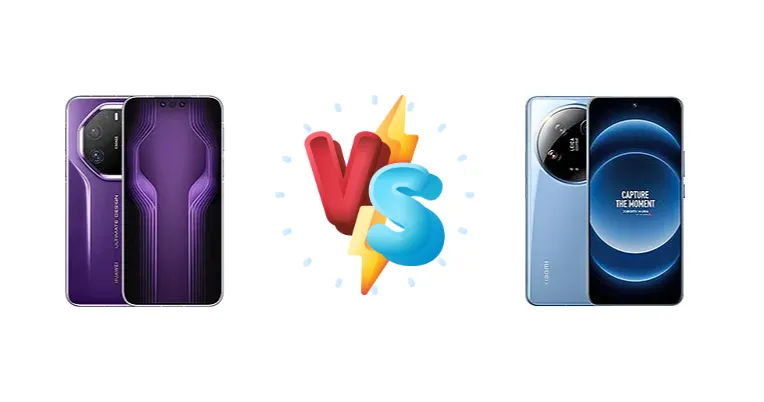
|
🏆 Quick Verdict
For the average user prioritizing raw performance and a modern Android experience, the Xiaomi 14 Ultra emerges as the winner. Its Snapdragon 8 Gen 3 chipset and impressive 11:25h active use battery life offer a compelling package. However, the Mate 80 RS Ultimate’s 100W wired and 80W wireless charging remain class-leading.
| PHONES | ||
|---|---|---|
| Phone Names | Huawei Mate 80 RS Ultimate | Xiaomi 14 Ultra |
| Network | ||
|---|---|---|
| 2G bands | GSM 850 / 900 / 1800 / 1900 | GSM 850 / 900 / 1800 / 1900 |
| 3G bands | HSDPA 800 / 850 / 900 / 1700(AWS) / 1900 / 2100 | HSDPA 800 / 850 / 900 / 1700(AWS) / 1900 / 2100 |
| 4G bands | LTE | 1, 2, 3, 4, 5, 7, 8, 18, 19, 20, 26, 28, 38, 40, 41, 42, 48, 66 - International |
| 5G bands | SA/NSA | 1, 2, 3, 5, 7, 8, 20, 28, 38, 40, 41, 48, 66, 77, 78, 79 SA/NSA - International |
| Speed | HSPA, LTE, 5G | HSPA, LTE, 5G |
| Technology | GSM / CDMA / HSPA / CDMA2000 / LTE / 5G | GSM / CDMA / HSPA / EVDO / LTE / 5G |
| Launch | ||
|---|---|---|
| Announced | 2025, November 25 | 2024, February 22 |
| Status | Available. Released 2025, November 26 | Available. Released 2024, February 22 |
| Body | ||
|---|---|---|
| Build | Glass front, titanium alloy frame | Glass front (Shield Glass), glass back or silicone polymer back (eco leather), titanium frame (grade 5) or aluminum alloy frame |
| Dimensions | 164.4 x 79 x 8.3 mm (6.47 x 3.11 x 0.33 in) | 161.4 x 75.3 x 9.2 mm (6.35 x 2.96 x 0.36 in) |
| SIM | Nano-SIM + Nano-SIM + eSIM (max 2 at a time) | Nano-SIM + Nano-SIM |
| Weight | 249 g (8.78 oz) | 219.8 / 224.4 / 229.5 g (7.76 oz) |
| Display | ||
|---|---|---|
| Protection | Huawei Kunlun Glass 3 (basalt tempered) | Xiaomi Shield Glass |
| Resolution | 1320 x 2848 pixels, 19.5:9 ratio (~455 ppi density) | 1440 x 3200 pixels, 20:9 ratio (~522 ppi density) |
| Size | 6.9 inches, 117.2 cm2 (~90.2% screen-to-body ratio) | 6.73 inches, 108.9 cm2 (~89.6% screen-to-body ratio) |
| Type | Dual-layer LTPO OLED, 1B colors, 120Hz, 1440Hz PWM, BT.2020, HDR Vivid, 8000 nits (peak) | LTPO AMOLED, 68B colors, 120Hz, 1920Hz PWM, Dolby Vision, HDR10+, 1000 nits (typ), 3000 nits (peak) |
| Platform | ||
|---|---|---|
| CPU | 9-core (1x2.75 GHz & 4x2.27 GHz & 4x1.72 GHz) | Octa-core (1x3.3 GHz Cortex-X4 & 3x3.2 GHz Cortex-A720 & 2x3.0 GHz Cortex-A720 & 2x2.3 GHz Cortex-A520) |
| Chipset | Kirin 9030 Pro (6 nm) | Qualcomm SM8650-AB Snapdragon 8 Gen 3 (4 nm) |
| GPU | Maleoon 935 | Adreno 750 |
| OS | HarmonyOS 6.0 | Android 14, up to 4 major Android upgrades, HyperOS |
| Memory | ||
|---|---|---|
| Card slot | No | No |
| Internal | 512GB 20GB RAM, 1TB 20GB RAM | 256GB 12GB RAM, 512GB 16GB RAM, 1TB 16GB RAM |
| Main Camera | ||
|---|---|---|
| Features | Laser AF, color spectrum sensor, LED flash, panorama, HDR | Laser AF, color spectrum sensor, Leica lenses, Dual-LED flash, HDR, panorama, 67mm filter ring holder (optional) |
| Quad | 50 MP, f/1.4-f/4.0, 24mm (wide), PDAF, OIS 50 MP, f/2.1, 91mm (periscope telephoto), PDAF, OIS, 4x optical zoom 50 MP, f/3.2, 140mm (periscope telephoto), PDAF, OIS, 6.2x optical zoom 40 MP, f/2.2, 13mm, 120˚ (ultrawide), PDAF | 50 MP, f/1.6-f/4.0, 23mm (wide), 1.0"-type, 1.6µm, dual pixel PDAF, OIS 50 MP, f/1.8, 75mm (telephoto), 1/2.51", 0.7µm, dual pixel PDAF (10cm - ∞), OIS, 3.2x optical zoom 50 MP, f/2.5, 120mm (periscope telephoto), 1/2.51", 0.7µm, dual pixel PDAF (30cm - ∞), OIS, 5x optical zoom 50 MP, f/1.8, 12mm, 122˚ (ultrawide), 1/2.51", 0.7µm, dual pixel PDAF TOF 3D, (depth) |
| Video | 4K, 1080p, 1080p@240fps, HDR, gyro-EIS, OIS, HDR Vivid | 8K@24/30fps, 4K@24/30/60/120fps, 1080p@30/60/120/240/480/960/1920fps, gyro-EIS, Dolby Vision HDR 10-bit rec. (4K@60fps, 1080p) |
| Selfie camera | ||
|---|---|---|
| Features | HDR, panorama | HDR, panorama |
| Single | 13 MP, f/2.0, 18mm (ultrawide), AF TOF 3D, (depth/biometrics sensor) | 32 MP, f/2.0, 22mm (wide), 1/3.14", 0.7µm |
| Video | 4K, 1080p | 4K@30/60fps, 1080p@30/60fps, gyro-EIS |
| Sound | ||
|---|---|---|
| 35mm jack | No | No |
| Loudspeaker | Yes, with stereo speakers | Yes, with stereo speakers |
| Comms | ||
|---|---|---|
| Bluetooth | 6.0, A2DP, LE, L2HC | 5.4, A2DP, LE, aptX HD, aptX Adaptive, LHDC |
| Infrared port | Yes | Yes |
| NFC | Yes | Yes |
| Positioning | GPS (L1+L5), GLONASS (L1), BDS (B1I+B1c+B2a+B2b), GALILEO (E1+E5a+E5b), QZSS (L1+L5), NavIC | GPS (L1+L5), GLONASS (L1), BDS (B1I+B1c+B2a), GALILEO (E1+E5a), QZSS (L1+L5), NavIC (L5) |
| Radio | No | No |
| USB | USB Type-C 3.1, OTG, DisplayPort 1.2 | USB Type-C 3.2 Gen 2, DisplayPort, OTG |
| WLAN | Wi-Fi 802.11 a/b/g/n/ac/6/7, dual-band, Wi-Fi Direct | Wi-Fi 802.11 a/b/g/n/ac/6e/7, tri-band, Wi-Fi Direct |
| Features | ||
|---|---|---|
| Sensors | Face ID, fingerprint (side-mounted), accelerometer, gyro, proximity, barometer, compass | Fingerprint (under display, optical), accelerometer, proximity, gyro, compass, barometer |
| Battery | ||
|---|---|---|
| Charging | 100W wired 80W wireless 20W reverse wireless 18W reverse wired | 90W wired, PD3.0, QC4, 100% in 33 min 80W wireless, 100% in 46 min 10W reverse wireless |
| Type | 6000 mAh | Market-dependent versions:· 5000 mAh (Global)· 5300 mAh (China only) |
| Misc | ||
|---|---|---|
| Colors | Black, White, Violet | Black, Blue, White, Titanium Gray |
| Models | SGU-AL10 | 24031PN0DC, 24030PN60G |
| Price | About 1470 EUR | € 663.14 |
| SAR | - | 0.83 W/kg (head) 0.82 W/kg (body) |
| SAR EU | - | 1.00 W/kg (head) 1.00 W/kg (body) |
Huawei Mate 80 RS Ultimate
- Industry-leading 100W wired and 80W wireless charging
- Unique and luxurious design aesthetic
- Established brand reputation
- Older 6nm chipset may throttle under heavy load
- Likely lower peak display brightness
- Potentially less efficient battery life
Xiaomi 14 Ultra
- Powerful Snapdragon 8 Gen 3 (4nm) chipset
- Brighter display with potential LTPO technology
- Longer battery life (11:25h active use)
- Charging speeds, while fast, are slightly slower than Huawei
- May lack the premium design feel of the Mate 80 RS Ultimate
- Software experience may differ from Huawei's EMUI
Display Comparison
The Xiaomi 14 Ultra boasts a significantly brighter display, peaking at 1281 nits, which translates to superior visibility in direct sunlight compared to the Mate 80 RS Ultimate (brightness data unavailable). While the Mate 80 RS Ultimate likely employs a high-quality OLED panel, the Xiaomi’s brightness advantage is a clear win for outdoor users. The Xiaomi 14 Ultra’s panel technology is also likely to include LTPO for adaptive refresh rates, improving battery efficiency, a feature not confirmed for the Mate 80 RS Ultimate.
Camera Comparison
Without detailed camera specs for the Mate 80 RS Ultimate, a direct comparison is limited. However, the Xiaomi 14 Ultra is expected to feature a cutting-edge camera system, likely with a large main sensor and advanced image processing algorithms. The Xiaomi’s focus on computational photography and potentially variable aperture lenses will likely deliver superior image quality in challenging conditions. The Mate 80 RS Ultimate will likely offer a competent camera experience, but the Xiaomi 14 Ultra is positioned to excel in this area.
Performance
The core difference lies in the chipsets. The Xiaomi 14 Ultra’s Snapdragon 8 Gen 3 (4nm) is built on a more advanced node than the Huawei Mate 80 RS Ultimate’s Kirin 9030 Pro (6nm). This smaller node generally equates to improved power efficiency and thermal performance, meaning the Xiaomi is less likely to throttle under sustained load. The Snapdragon 8 Gen 3’s octa-core configuration, featuring a Cortex-X4 prime core clocked at 3.3 GHz, provides a substantial performance uplift over the Kirin 9030 Pro’s 9-core setup, particularly in CPU-intensive tasks. The Xiaomi also benefits from faster LPDDR5x RAM, further enhancing responsiveness.
Battery Life
The Xiaomi 14 Ultra demonstrates a clear advantage in battery endurance, achieving 11:25 hours of active use. While the Mate 80 RS Ultimate’s battery capacity is unknown, the Xiaomi’s combination of a power-efficient chipset and optimized software delivers superior longevity. However, Huawei counters with unparalleled charging speeds: 100W wired, 80W wireless, and even 20W reverse wireless, significantly faster than the Xiaomi’s 90W wired and 80W wireless. The Mate 80 RS Ultimate can fully charge in a fraction of the time, a crucial benefit for users who frequently need a quick power boost.
Buying Guide
Buy the Huawei Mate 80 RS Ultimate if you prioritize exceptionally fast charging speeds (both wired and wireless) and appreciate a premium, established brand with a unique aesthetic. Buy the Xiaomi 14 Ultra if you demand the latest processor technology, a brighter display, and a longer-lasting battery for demanding daily use and gaming.