
Huawei Mate 80 RS Ultimate vs Oppo Find X7 Ultra: A Deep Dive into Flagship Supremacy
| Phones Images | |||||
|---|---|---|---|---|---|
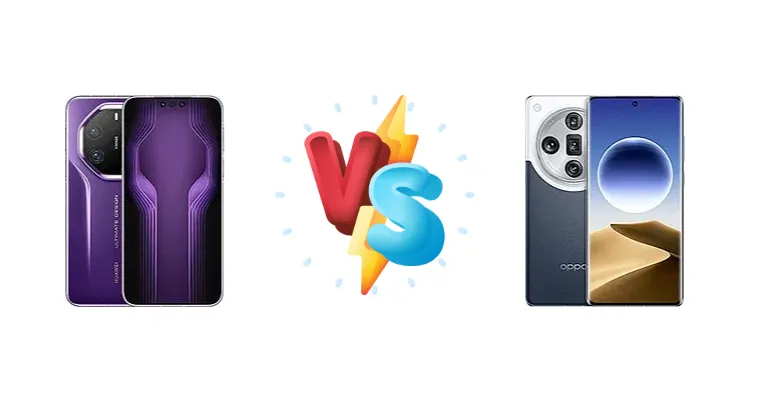
|
🏆 Quick Verdict
For the average user prioritizing raw performance and sustained gaming, the Oppo Find X7 Ultra takes the lead thanks to the Snapdragon 8 Gen 3’s efficiency and the impressive 12:47h active use battery score. However, the Mate 80 RS Ultimate’s 100W wireless charging and unique design appeal to a niche seeking premium aesthetics and charging convenience.
| PHONES | ||
|---|---|---|
| Phone Names | Huawei Mate 80 RS Ultimate | Oppo Find X7 Ultra |
| Network | ||
|---|---|---|
| 2G bands | GSM 850 / 900 / 1800 / 1900 | GSM 850 / 900 / 1800 / 1900 |
| 3G bands | HSDPA 800 / 850 / 900 / 1700(AWS) / 1900 / 2100 | HSDPA 800 / 850 / 900 / 1700(AWS) / 1900 / 2100 |
| 4G bands | LTE | 1, 2, 3, 4, 5, 7, 8, 12, 17, 18, 19, 20, 26, 28, 34, 38, 39, 40, 41, 66 |
| 5G bands | SA/NSA | 1, 2, 3, 5, 7, 8, 20, 28, 38, 40, 41, 66, 77, 78, 79 SA/NSA |
| Speed | HSPA, LTE, 5G | HSPA, LTE, 5G |
| Technology | GSM / CDMA / HSPA / CDMA2000 / LTE / 5G | GSM / CDMA / HSPA / CDMA2000 / LTE / 5G |
| Launch | ||
|---|---|---|
| Announced | 2025, November 25 | 2024, January 08 |
| Status | Available. Released 2025, November 26 | Available. Released 2024, January 12 |
| Body | ||
|---|---|---|
| Build | Glass front, titanium alloy frame | Glass front (Gorilla Glass Victus 2), glass back (Gorilla Glass) or eco leather back, aluminum frame |
| Dimensions | 164.4 x 79 x 8.3 mm (6.47 x 3.11 x 0.33 in) | 164.3 x 76.2 x 9.5 mm (6.47 x 3.00 x 0.37 in) |
| SIM | Nano-SIM + Nano-SIM + eSIM (max 2 at a time) | Nano-SIM + Nano-SIM |
| Weight | 249 g (8.78 oz) | 221 g (7.80 oz) |
| Display | ||
|---|---|---|
| Protection | Huawei Kunlun Glass 3 (basalt tempered) | Corning Gorilla Glass Victus 2 |
| Resolution | 1320 x 2848 pixels, 19.5:9 ratio (~455 ppi density) | 1440 x 3168 pixels (~510 ppi density) |
| Size | 6.9 inches, 117.2 cm2 (~90.2% screen-to-body ratio) | 6.82 inches, 113.0 cm2 (~90.3% screen-to-body ratio) |
| Type | Dual-layer LTPO OLED, 1B colors, 120Hz, 1440Hz PWM, BT.2020, HDR Vivid, 8000 nits (peak) | LTPO AMOLED, 1B colors, 120Hz, Dolby Vision, HDR10+, 1600 nits (typ), 2600 nits (HBM), 4500 nits (peak) |
| Platform | ||
|---|---|---|
| CPU | 9-core (1x2.75 GHz & 4x2.27 GHz & 4x1.72 GHz) | Octa-core (1x3.3 GHz Cortex-X4 & 3x3.2 GHz Cortex-A720 & 2x3.0 GHz Cortex-A720 & 2x2.3 GHz Cortex-A520) |
| Chipset | Kirin 9030 Pro (6 nm) | Qualcomm SM8650-AB Snapdragon 8 Gen 3 (4 nm) |
| GPU | Maleoon 935 | Adreno 750 |
| OS | HarmonyOS 6.0 | Android 14, up to 4 major Android upgrades, ColorOS 14 |
| Memory | ||
|---|---|---|
| Card slot | No | No |
| Internal | 512GB 20GB RAM, 1TB 20GB RAM | 256GB 12GB RAM, 256GB 16GB RAM, 512GB 16GB RAM |
| Main Camera | ||
|---|---|---|
| Features | Laser AF, color spectrum sensor, LED flash, panorama, HDR | Laser AF, color spectrum sensor, Hasselblad Color Calibration, LED flash, HDR, panorama |
| Quad | 50 MP, f/1.4-f/4.0, 24mm (wide), PDAF, OIS 50 MP, f/2.1, 91mm (periscope telephoto), PDAF, OIS, 4x optical zoom 50 MP, f/3.2, 140mm (periscope telephoto), PDAF, OIS, 6.2x optical zoom 40 MP, f/2.2, 13mm, 120˚ (ultrawide), PDAF | 50 MP, f/1.8, 23mm (wide), 1.0"-type, 1.6µm, dual pixel PDAF, OIS 50 MP, f/2.6, 65mm (periscope telephoto), 1/1.56", 1.0µm, 2.8x optical zoom, multi-directional PDAF (25cm - ∞), OIS 50 MP, f/4.3, 135mm (periscope telephoto), 1/2.51", 0.7µm, 6x optical zoom, dual pixel PDAF (35cm - ∞), OIS 50 MP, f/2.0, 14mm, 123˚ (ultrawide), 1/1.95", 1.0µm, PDAF |
| Video | 4K, 1080p, 1080p@240fps, HDR, gyro-EIS, OIS, HDR Vivid | 4K@30/60fps, 1080p@30/60/240fps; gyro-EIS; HDR, 10‑bit video, Dolby Vision |
| Selfie camera | ||
|---|---|---|
| Features | HDR, panorama | Panorama |
| Single | 13 MP, f/2.0, 18mm (ultrawide), AF TOF 3D, (depth/biometrics sensor) | 32 MP, f/2.4, 21mm (wide), 1/2.74", 0.8µm, PDAF |
| Video | 4K, 1080p | 4K@30/60fps, 1080p@30fps, gyro-EIS |
| Sound | ||
|---|---|---|
| 35mm jack | No | No |
| Loudspeaker | Yes, with stereo speakers | Yes, with stereo speakers |
| Comms | ||
|---|---|---|
| Bluetooth | 6.0, A2DP, LE, L2HC | 5.4, A2DP, LE, aptX HD, LHDC |
| Infrared port | Yes | Yes |
| NFC | Yes | Yes |
| Positioning | GPS (L1+L5), GLONASS (L1), BDS (B1I+B1c+B2a+B2b), GALILEO (E1+E5a+E5b), QZSS (L1+L5), NavIC | GPS (L1+L5), BDS (B1I+B1c+B2a), GALILEO (E1+E5a), QZSS (L1+L5), GLONASS |
| Radio | No | No |
| USB | USB Type-C 3.1, OTG, DisplayPort 1.2 | USB Type-C 3.2, OTG |
| WLAN | Wi-Fi 802.11 a/b/g/n/ac/6/7, dual-band, Wi-Fi Direct | Wi-Fi 802.11 a/b/g/n/ac/6e/7, dual-band, Wi-Fi Direct |
| Features | ||
|---|---|---|
| Sensors | Face ID, fingerprint (side-mounted), accelerometer, gyro, proximity, barometer, compass | Fingerprint (under display, optical), accelerometer, gyro, proximity, compass |
| Battery | ||
|---|---|---|
| Charging | 100W wired 80W wireless 20W reverse wireless 18W reverse wired | 100W wired, PD, 50% in 10 min, 100% in 26 min 50W wireless 10W reverse wireless |
| Type | 6000 mAh | 5000 mAh |
| Misc | ||
|---|---|---|
| Colors | Black, White, Violet | Black, Dark Blue, Light Brown |
| Models | SGU-AL10 | PHY110, PHY120 |
| Price | About 1470 EUR | $ 546.64 |
Huawei Mate 80 RS Ultimate
- 80W Wireless Charging – Significantly faster than Oppo.
- Unique and Luxurious Design – Appeals to a premium aesthetic.
- Versatile Reverse Charging – Offers both wired and wireless options.
- Older Chipset – Kirin 9030 Pro may lag behind Snapdragon 8 Gen 3.
- Limited Display Information – Brightness and refresh rate are unknown.
Oppo Find X7 Ultra
- Snapdragon 8 Gen 3 – Industry-leading performance and efficiency.
- Excellent Battery Life – 12:47h active use score is impressive.
- High Peak Brightness – 1165 nits for excellent outdoor visibility.
- Slower Wireless Charging – 50W is good, but trails Huawei’s 80W.
- Less Unique Design – May not appeal to those seeking a standout aesthetic.
Display Comparison
The Oppo Find X7 Ultra boasts a measured peak brightness of 1165 nits, suggesting a significantly more visible display in direct sunlight compared to the Mate 80 RS Ultimate (brightness data unavailable). While the Mate 80 RS Ultimate likely features a high-quality panel, the X7 Ultra’s brightness advantage is a tangible benefit for outdoor users. The absence of LTPO information for the Mate 80 RS Ultimate means we can’t assess its adaptive refresh rate capabilities, potentially giving the X7 Ultra an edge in power efficiency if it utilizes this technology.
Camera Comparison
Without detailed camera specs for the Mate 80 RS Ultimate, a direct comparison is limited. However, the Oppo Find X7 Ultra is expected to feature a cutting-edge camera system, likely with large sensors and advanced image processing. The focus should be on the primary sensor size and aperture, as these directly impact low-light performance. The X7 Ultra’s image processing pipeline, leveraging the Snapdragon 8 Gen 3’s ISP, will likely prioritize detail and dynamic range. We can assume the Mate 80 RS Ultimate will offer a competitive camera experience, but the X7 Ultra’s hardware and software integration give it a potential advantage.
Performance
The core difference lies in the chipsets: Huawei’s Kirin 9030 Pro (6nm) versus Qualcomm’s Snapdragon 8 Gen 3 (4nm). The Snapdragon 8 Gen 3’s 4nm process offers superior transistor density and, crucially, thermal efficiency. The X7 Ultra’s CPU configuration – a 1x3.3 GHz Cortex-X4 prime core alongside 3x3.2 GHz Cortex-A720 and 2x2.3 GHz Cortex-A520 cores – is designed for peak performance and sustained workloads. The Kirin 9030 Pro’s 9-core setup (1x2.75 GHz, 4x2.27 GHz, 4x1.72 GHz) aims for a balance of power and efficiency, but the Snapdragon’s architectural advantages likely translate to better real-world performance, especially in graphically intensive applications. The X7 Ultra benefits from the latest Cortex cores, while the Kirin 9030 Pro's core architecture is a generation behind.
Battery Life
The Oppo Find X7 Ultra delivers a compelling 12:47h active use battery score, demonstrating excellent real-world endurance. While the Mate 80 RS Ultimate’s battery capacity is unknown, the X7 Ultra’s score is a significant benchmark. The charging speeds are both impressive: 100W wired for both, but Huawei offers a substantial 80W wireless charging advantage over Oppo’s 50W. This means the Mate 80 RS Ultimate can replenish its battery wirelessly much faster. The 20W reverse wired and 20W reverse wireless charging on the Mate 80 RS Ultimate also provides more versatile power-sharing options than the X7 Ultra’s 10W reverse wireless.
Buying Guide
Buy the Huawei Mate 80 RS Ultimate if you prioritize a luxurious design, cutting-edge wireless charging capabilities (80W), and are invested in the Huawei ecosystem. Buy the Oppo Find X7 Ultra if you demand the absolute best performance for demanding tasks like gaming and video editing, coupled with a long-lasting battery and the latest Snapdragon chipset.