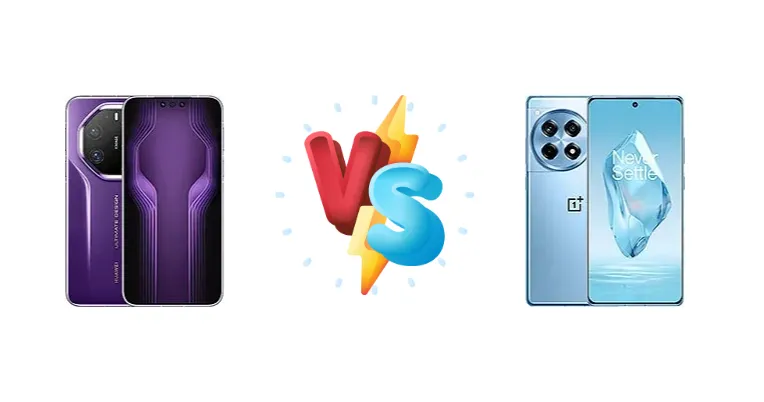
The Huawei Mate 80 RS Ultimate represents a pinnacle of luxury smartphone design and wireless charging technology, while the OnePlus 12R aims to deliver flagship-level performance at a more accessible price point. This comparison dissects their core strengths – Huawei’s focus on refinement and the OnePlus’s emphasis on raw power – to determine which device best suits your needs.
🏆 Quick Verdict
For the average user prioritizing performance and value, the OnePlus 12R emerges as the stronger choice. Its Snapdragon 8 Gen 2 chipset and impressive 14:32h active use battery life offer a compelling package. However, the Mate 80 RS Ultimate’s 100W wireless charging and unique design appeal to a niche audience willing to pay a premium.
| Network |
|---|
| 2G bands | GSM 850 / 900 / 1800 / 1900 | GSM 850 / 900 / 1800 / 1900 |
| 3G bands | HSDPA 800 / 850 / 900 / 1700(AWS) / 1900 / 2100 | HSDPA 850 / 900 / 1700(AWS) / 1900 / 2100 |
| 4G bands | LTE | 1, 2, 3, 4, 5, 7, 8, 12, 17, 18, 19, 20, 26, 28, 32, 38, 39, 40, 41, 66 |
| 5G bands | SA/NSA | 1, 2, 3, 5, 7, 8, 12, 20, 28, 38, 40, 41, 66, 77, 78 SA/NSA |
| Speed | HSPA, LTE, 5G | HSPA, LTE, 5G |
| Technology | GSM / CDMA / HSPA / CDMA2000 / LTE / 5G | GSM / CDMA / HSPA / LTE / 5G |
| Launch |
|---|
| Announced | 2025, November 25 | 2024, January 23 |
| Status | Available. Released 2025, November 26 | Available. Released 2024, February 06 |
| Body |
|---|
| Build | Glass front, titanium alloy frame | Glass front (Gorilla Glass Victus 2), aluminum frame, glass back |
| Dimensions | 164.4 x 79 x 8.3 mm (6.47 x 3.11 x 0.33 in) | 163.3 x 75.3 x 8.8 mm (6.43 x 2.96 x 0.35 in) |
| SIM | Nano-SIM + Nano-SIM + eSIM (max 2 at a time) | · Nano-SIM + Nano-SIM + eSIM (max 2 at a time)· Nano-SIM + Nano-SIM |
| Weight | 249 g (8.78 oz) | 207 g (7.30 oz) |
| Display |
|---|
| Protection | Huawei Kunlun Glass 3 (basalt tempered) | Corning Gorilla Glass Victus 2 |
| Resolution | 1320 x 2848 pixels, 19.5:9 ratio (~455 ppi density) | 1264 x 2780 pixels (~450 ppi density) |
| Size | 6.9 inches, 117.2 cm2 (~90.2% screen-to-body ratio) | 6.78 inches, 111.7 cm2 (~90.9% screen-to-body ratio) |
| Type | Dual-layer LTPO OLED, 1B colors, 120Hz, 1440Hz PWM, BT.2020, HDR Vivid, 8000 nits (peak) | LTPO4 AMOLED, 1B colors, 120Hz, HDR10+, Dolby Vision, 1600 nits (HBM), 4500 nits (peak) |
| Platform |
|---|
| CPU | 9-core (1x2.75 GHz & 4x2.27 GHz & 4x1.72 GHz) | Octa-core (1x3.2 GHz Cortex-X3 & 2x2.8 GHz Cortex-A715 & 2x2.8 GHz Cortex-A710 & 3x2.0 GHz Cortex-A510) |
| Chipset | Kirin 9030 Pro (6 nm) | Qualcomm SM8550-AB Snapdragon 8 Gen 2 (4 nm) |
| GPU | Maleoon 935 | Adreno 740 |
| OS | HarmonyOS 6.0 | Android 14, up to 3 major Android upgrades, OxygenOS 15 |
| Memory |
|---|
| Card slot | No | No |
| Internal | 512GB 20GB RAM, 1TB 20GB RAM | 128GB 8GB RAM, 256GB 8GB RAM, 256GB 12GB RAM, 256GB 16GB RAM |
| Main Camera |
|---|
| Features | Laser AF, color spectrum sensor, LED flash, panorama, HDR | Laser AF, color spectrum sensor, LED flash, HDR, panorama |
| Quad | 50 MP, f/1.4-f/4.0, 24mm (wide), PDAF, OIS
50 MP, f/2.1, 91mm (periscope telephoto), PDAF, OIS, 4x optical zoom
50 MP, f/3.2, 140mm (periscope telephoto), PDAF, OIS, 6.2x optical zoom
40 MP, f/2.2, 13mm, 120˚ (ultrawide), PDAF | - |
| Triple | - | 50 MP, f/1.8, 24mm (wide), 1/1.56", 1.0µm, multi-directional PDAF, OIS
8 MP, f/2.2, 16mm, 112˚ (ultrawide), 1/4.0", 1.12µm
2 MP (macro) |
| Video | 4K, 1080p, 1080p@240fps, HDR, gyro-EIS, OIS, HDR Vivid | 4K@30/60fps, 1080p@30/60/120/240fps, gyro-EIS, OIS |
| Selfie camera |
|---|
| Features | HDR, panorama | HDR, panorama |
| Single | 13 MP, f/2.0, 18mm (ultrawide), AF
TOF 3D, (depth/biometrics sensor) | 16 MP, f/2.4, 26mm (wide), 1/3", 1.0µm |
| Video | 4K, 1080p | 1080p@30fps, gyro-EIS |
| Sound |
|---|
| 35mm jack | No | No |
| Loudspeaker | Yes, with stereo speakers | Yes, with stereo speakers |
| Comms |
|---|
| Bluetooth | 6.0, A2DP, LE, L2HC | 5.3, A2DP, LE, aptX HD |
| Infrared port | Yes | Yes |
| NFC | Yes | Yes |
| Positioning | GPS (L1+L5), GLONASS (L1), BDS (B1I+B1c+B2a+B2b), GALILEO (E1+E5a+E5b), QZSS (L1+L5), NavIC | GPS, GALILEO, GLONASS, BDS, QZSS |
| Radio | No | No |
| USB | USB Type-C 3.1, OTG, DisplayPort 1.2 | USB Type-C 2.0 |
| WLAN | Wi-Fi 802.11 a/b/g/n/ac/6/7, dual-band, Wi-Fi Direct | Wi-Fi 802.11 a/b/g/n/ac/6/7, dual-band |
| Features |
|---|
| Sensors | Face ID, fingerprint (side-mounted), accelerometer, gyro, proximity, barometer, compass | Fingerprint (under display, optical), accelerometer, gyro, proximity, compass |
| Battery |
|---|
| Charging | 100W wired
80W wireless
20W reverse wireless
18W reverse wired | 100W wired, 100% in 26 min |
| Type | 6000 mAh | Li-Ion 5500 mAh |
| Misc |
|---|
| Colors | Black, White, Violet | Iron Gray, Cool Blue, Electric Violet, Sunset Dune |
| Models | SGU-AL10 | CPH2609, CPH2585, CPH2611 |
| Price | About 1470 EUR | € 410.84 / $ 399.95 / £ 649.00 |
| SAR | - | 1.19 W/kg (head) 0.82 W/kg (body) |
Huawei Mate 80 RS Ultimate
- 100W Wireless Charging: Unmatched convenience and speed for wireless power.
- Premium Design: Likely features high-end materials and craftsmanship.
- Huawei Ecosystem Integration: Seamless connectivity with other Huawei devices.
- Kirin 9030 Pro: Potentially less efficient and lower peak performance than Snapdragon 8 Gen 2.
- Limited Global Availability: Huawei’s market access is restricted in some regions.
OnePlus 12R
- Snapdragon 8 Gen 2: Top-tier performance and thermal efficiency.
- Excellent Battery Life: 14:32h of active use provides all-day power.
- Fast Charging: 100W wired charging delivers quick top-ups.
- Less Luxurious Design: May not offer the same premium feel as the Mate 80 RS Ultimate.
- OxygenOS: While clean, some users may prefer Huawei's EMUI.
Display Comparison
The OnePlus 12R boasts a bright display, peaking at 1181 nits, ensuring excellent visibility even in direct sunlight. While the Mate 80 RS Ultimate’s display specifications are not provided, Huawei typically employs high-quality OLED panels. The 12R’s brightness advantage is significant, and its likely higher refresh rate (based on OnePlus’s recent offerings) contributes to smoother scrolling and animations. The lack of detailed display specs for the Mate 80 RS Ultimate makes a direct comparison challenging, but the 12R’s measured brightness provides a concrete advantage.
Camera Comparison
Without detailed camera specifications for the Mate 80 RS Ultimate, a direct comparison is limited. However, Huawei historically focuses on computational photography and image processing. The OnePlus 12R likely features a more conventional camera setup, prioritizing sensor size and optical image stabilization (OIS). While the Mate 80 RS Ultimate may excel in specific scenarios through software enhancements, the 12R’s hardware foundation – assuming a large main sensor – provides a solid base for versatile photography. We can assume the Mate 80 RS Ultimate will have a more refined image processing pipeline, but the 12R's sensor size will likely be larger.
Performance
The OnePlus 12R’s Snapdragon 8 Gen 2 (4nm) chipset is a powerhouse, featuring a Cortex-X3 prime core clocked at 3.2 GHz. This contrasts with the Huawei Mate 80 RS Ultimate’s Kirin 9030 Pro (6nm). The Snapdragon 8 Gen 2’s 4nm process offers superior thermal efficiency, reducing throttling during sustained workloads like gaming. The Kirin 9030 Pro’s 9-core configuration attempts to balance performance and efficiency, but the Snapdragon’s architectural advantages, particularly the Cortex-X3, provide a noticeable edge in CPU-intensive tasks. The 12R’s LPDDR5x RAM further enhances performance, ensuring faster data access.
Battery Life
The OnePlus 12R shines in battery life, achieving an impressive 14:32h of active use. While the Mate 80 RS Ultimate offers both 100W wired and 80W wireless charging, the 12R’s 100W wired charging (0-100% in 26 minutes) is competitive. The Mate 80 RS Ultimate’s 80W wireless charging is a unique advantage, offering unparalleled convenience, but wireless charging is inherently less efficient than wired. The 12R’s longer battery life mitigates any concerns about charging speed, making it a more practical choice for all-day use.
Buying Guide
Buy the Huawei Mate 80 RS Ultimate if you demand the convenience of 100W wireless charging, appreciate a luxurious design aesthetic, and are invested in the Huawei ecosystem. Buy the OnePlus 12R if you prioritize gaming performance, long battery life, and a clean Android experience without breaking the bank. The 12R is the clear choice for those seeking maximum performance per dollar.
Frequently Asked Questions
❓ Does the Kirin 9030 Pro in the Mate 80 RS Ultimate suffer from significant thermal throttling during extended gaming sessions?
The Kirin 9030 Pro, built on a 6nm process, is likely to experience more thermal throttling than the Snapdragon 8 Gen 2 (4nm) in the OnePlus 12R during prolonged, demanding gaming. The Snapdragon’s more efficient process allows it to maintain higher clock speeds for longer periods without overheating.
❓ How does the 80W wireless charging on the Mate 80 RS Ultimate compare to the 100W wired charging on the OnePlus 12R in terms of real-world convenience?
While 80W wireless charging is incredibly convenient, it's inherently less efficient than 100W wired charging. The OnePlus 12R can fully charge in 26 minutes via wired connection, whereas the Mate 80 RS Ultimate will take longer wirelessly. The convenience of simply placing the phone on a pad is offset by the slower charging speed.
❓ Is the lack of detailed camera specifications for the Huawei Mate 80 RS Ultimate a cause for concern?
It is a concern. Huawei typically excels in computational photography, but without knowing sensor sizes, apertures, and OIS capabilities, it's difficult to assess its camera performance relative to the OnePlus 12R. The 12R's likely larger sensor provides a strong foundation for image quality.