
Huawei Mate 80 Pro vs Samsung Galaxy S24 Ultra: A Clash of Charging and Processing Titans
| Phones Images | |||||
|---|---|---|---|---|---|
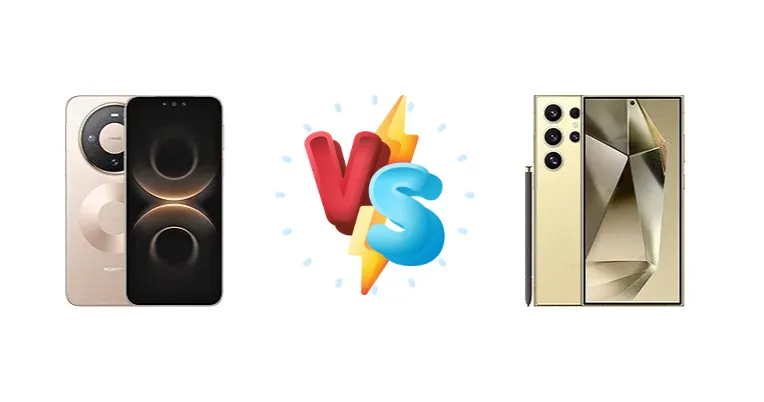
|
🏆 Quick Verdict
For the average user prioritizing sustained performance and a polished software experience, the Samsung Galaxy S24 Ultra emerges as the winner. Its Snapdragon 8 Gen 3 chipset and impressive 13:49h active use battery life provide a more consistent and reliable experience, despite the Mate 80 Pro’s blistering 100W charging.
| PHONES | ||
|---|---|---|
| Phone Names | Huawei Mate 80 Pro | Samsung Galaxy S24 Ultra |
| Network | ||
|---|---|---|
| 2G bands | GSM 850 / 900 / 1800 / 1900 | GSM 850 / 900 / 1800 / 1900 |
| 3G bands | HSDPA 800 / 850 / 900 / 1700(AWS) / 1900 / 2100 | HSDPA 850 / 900 / 1700(AWS) / 1900 / 2100 |
| 4G bands | LTE | 1, 2, 3, 4, 5, 7, 8, 12, 13, 17, 18, 19, 20, 25, 26, 28, 32, 38, 39, 40, 41, 66 - International |
| 5G bands | SA/NSA | 1, 2, 3, 5, 7, 8, 12, 20, 25, 26, 28, 38, 40, 41, 66, 75, 77, 78 SA/NSA/Sub6 - International |
| Speed | HSPA, LTE, 5G | HSPA, LTE (up to 7CA), 5G |
| Technology | GSM / CDMA / HSPA / CDMA2000 / LTE / 5G | GSM / CDMA / HSPA / EVDO / LTE / 5G |
| Launch | ||
|---|---|---|
| Announced | 2025, November 25 | 2024, January 17 |
| Status | Available. Released 2025, November 25 | Available. Released 2024, January 24 |
| Body | ||
|---|---|---|
| Build | Glass front, aluminum alloy frame, fiber-reinforced plastic back | Glass front (Corning Gorilla Armor), glass back (Corning Gorilla Armor), titanium frame (grade 2) |
| Dimensions | 161.9 x 76 x 8 mm (6.37 x 2.99 x 0.31 in) | 162.3 x 79 x 8.6 mm (6.39 x 3.11 x 0.34 in) |
| SIM | Nano-SIM + Nano-SIM | · Nano-SIM + Nano-SIM + eSIM + eSIM (max 2 at a time) - INT· Nano-SIM + eSIM + eSIM (max 2 at a time) - USA· Nano-SIM + Nano-SIM - CN |
| Weight | 219 g (7.72 oz) | 232 g or 233 g (8.18 oz) |
| Display | ||
|---|---|---|
| Protection | Huawei Kunlun Glass 2 | Corning Gorilla Armor |
| Resolution | 1280 x 2832 pixels (~460 ppi density) | 1440 x 3120 pixels, 19.5:9 ratio (~505 ppi density) |
| Size | 6.75 inches, 110.3 cm2 (~89.7% screen-to-body ratio) | 6.8 inches, 113.5 cm2 (~88.5% screen-to-body ratio) |
| Type | LTPO OLED, 1B colors, 120Hz, 1440Hz PWM, HDR Vivid | Dynamic LTPO AMOLED 2X, 120Hz, HDR10+, 2600 nits (peak) |
| Platform | ||
|---|---|---|
| CPU | 9-core (1x2.75 GHz & 4x2.27 GHz & 4x1.72 GHz) (512GB / 1TB 16GB RAM)9-core (2.75 GHz & 2.27 GHz & 1.72 GHz) (256GB / 512GB 12GB RAM) | 8-core (1x3.39GHz Cortex-X4 & 3x3.1GHz Cortex-A720 & 2x2.9GHz Cortex-A720 & 2x2.2GHz Cortex-A520) |
| Chipset | Kirin 9030 Pro (6 nm) (512GB / 1TB 16GB RAM)Kirin 9030 (6 nm) (256GB / 512GB 12GB RAM) | Qualcomm SM8650-AC Snapdragon 8 Gen 3 (4 nm) |
| GPU | Maleoon 935 | Adreno 750 (1 GHz) |
| OS | HarmonyOS 6.0 | Android 14, up to 7 major Android upgrades, One UI 8.0 |
| Memory | ||
|---|---|---|
| Card slot | No | No |
| Internal | 256GB 12GB RAM, 512GB 12GB RAM, 512GB 16GB RAM, 1TB 16GB RAM | 256GB 12GB RAM, 512GB 12GB RAM, 1TB 12GB RAM |
| Main Camera | ||
|---|---|---|
| Features | Laser AF, color spectrum sensor, LED flash, panorama, HDR | Laser AF, LED flash, auto-HDR, panorama |
| Quad | - | 200 MP, f/1.7, 24mm (wide), 1/1.3", 0.6µm, multi-directional PDAF, OIS 10 MP, f/2.4, 67mm (telephoto), 1/3.52", 1.12µm, PDAF, OIS, 3x optical zoom 50 MP, f/3.4, 111mm (periscope telephoto), 1/2.52", 0.7µm, PDAF, OIS, 5x optical zoom 12 MP, f/2.2, 13mm, 120˚ (ultrawide), 1/2.55", 1.4µm, dual pixel PDAF, Super Steady video |
| Triple | 50 MP, f/1.4-f/4.0, 24mm (wide), PDAF, OIS 48 MP, f/2.1, 93mm (periscope telephoto), PDAF, OIS, 4x optical zoom 40 MP, f/2.2, 13mm, 120˚ (ultrawide), PDAF | - |
| Video | 4K, 1080p@240fps, HDR, gyro-EIS, OIS, HDR Vivid | 8K@24/30fps, 4K@30/60/120fps, 1080p@30/60/120/240fps, HDR10+, stereo sound rec., gyro-EIS |
| Selfie camera | ||
|---|---|---|
| Features | HDR, panorama | HDR, HDR10+ |
| Single | 13 MP, f/2.0, 18mm (ultrawide), AF TOF 3D, (depth/biometrics sensor) | 12 MP, f/2.2, 26mm (wide), 1/3.2", 1.12µm, dual pixel PDAF |
| Video | 4K, 1080p, HDR, gyro-EIS | 4K@30/60fps, 1080p@30fps |
| Sound | ||
|---|---|---|
| 35mm jack | No | No |
| Loudspeaker | Yes, with stereo speakers | Yes, with stereo speakers |
| Comms | ||
|---|---|---|
| Bluetooth | 6.0, A2DP, LE, L2HC | 5.3, A2DP, LE |
| Infrared port | Yes | - |
| NFC | Yes | Yes |
| Positioning | GPS (L1+L5), GLONASS (L1), BDS (B1I+B1c+B2a+B2b), GALILEO (E1+E5a+E5b), QZSS (L1+L5), NavIC | GPS, GLONASS, BDS, GALILEO, QZSS |
| Radio | No | No |
| USB | USB Type-C 3.1, OTG, DisplayPort 1.2 | USB Type-C 3.2, DisplayPort 1.2, OTG |
| WLAN | Wi-Fi 802.11 a/b/g/n/ac/6/7, dual-band, Wi-Fi Direct | Wi-Fi 802.11 a/b/g/n/ac/6e/7, tri-band, Wi-Fi Direct |
| Features | ||
|---|---|---|
| Sensors | Face ID, fingerprint (side-mounted), accelerometer, gyro, proximity, barometer, compass | Fingerprint (under display, ultrasonic), accelerometer, gyro, proximity, compass, barometer |
| Battery | ||
|---|---|---|
| Charging | 100W wired 80W wireless 20W reverse wireless 18W reverse wired | 45W wired, PD3.0, 65% in 30 min 15W wireless (Qi) 4.5W reverse wireless |
| Type | 5750 mAh | Li-Ion 5000 mAh |
| Misc | ||
|---|---|---|
| Colors | Black, White, Green, Gold | Titanium Black, Titanium Gray, Titanium Violet, Titanium Yellow, Titanium Blue, Titanium Green, Titanium Orange |
| Models | SGT-AL50 | SM-S928B, SM-S928B/DS, SM-S928U, SM-S928U1, SM-S928W, SM-S928N, SM-S9280, SM-S928E, SM-S928E/DS |
| Price | About 730 EUR | $ 514.94 / C$ 929.99 / £ 630.00 / € 658.53 / ₹ 84,999 |
| SAR | - | 1.26 W/kg (head) 0.62 W/kg (body) |
| SAR EU | - | 1.06 W/kg (head) 1.30 W/kg (body) |
Huawei Mate 80 Pro
- Industry-leading 100W wired charging
- 80W wireless charging is significantly faster than the S24 Ultra
- Potentially unique software features and customization options
- Kirin 9030 Pro may exhibit more thermal throttling
- Software ecosystem may be less mature than Samsung's
Samsung Galaxy S24 Ultra
- Snapdragon 8 Gen 3 delivers superior sustained performance
- Exceptional battery life (13:49h active use)
- Bright and adaptive display with LTPO technology
- Slower charging speeds compared to the Mate 80 Pro
- Reverse wireless charging is limited to 4.5W
Display Comparison
The Samsung Galaxy S24 Ultra boasts a peak brightness of 1447 nits, ensuring excellent visibility even in direct sunlight. While the Mate 80 Pro’s display specifications are not provided, Huawei typically employs high-quality OLED panels. The S24 Ultra’s likely use of LTPO technology allows for dynamic refresh rate scaling, conserving battery life. The S24 Ultra’s superior brightness and adaptive refresh rate give it a clear edge for outdoor use and power efficiency.
Camera Comparison
While both phones are expected to deliver excellent image quality, the S24 Ultra’s camera system is likely to be more versatile. Details on the Mate 80 Pro’s camera are missing, but Samsung’s history suggests a focus on larger sensors and advanced image processing. The S24 Ultra’s image processing algorithms are renowned for their dynamic range and detail preservation. The S24 Ultra’s superior image stabilization and video recording capabilities further solidify its advantage.
Performance
The Snapdragon 8 Gen 3 in the S24 Ultra, fabricated on a 4nm process, offers a significant advantage in power efficiency compared to the Kirin 9030 Pro’s 6nm node. The S24 Ultra’s 8-core CPU, featuring a Cortex-X4 prime core clocked at 3.39GHz, is designed for peak performance. The Kirin 9030 Pro’s 9-core configuration, while potentially strong, is likely to generate more heat under sustained load. The S24 Ultra’s architecture is optimized for demanding tasks like gaming and video editing, with less thermal throttling expected.
Battery Life
The Galaxy S24 Ultra’s 13:49h active use score demonstrates exceptional battery life. While the Mate 80 Pro’s battery capacity is unknown, its 100W wired charging and 80W wireless charging are unparalleled. The Mate 80 Pro can potentially recoup a significant charge in a very short time, but the S24 Ultra’s longevity minimizes the need for frequent top-ups. The S24 Ultra’s 45W charging, while slower, is still respectable and benefits from PD3.0 compatibility.
Buying Guide
Buy the Huawei Mate 80 Pro if you absolutely need the fastest possible charging speeds – 100W wired and 80W wireless are unmatched – and are comfortable navigating a potentially different software ecosystem. Buy the Samsung Galaxy S24 Ultra if you prioritize a consistently powerful processor, a long-lasting battery, a superior camera system, and the seamless integration of the Android ecosystem.