
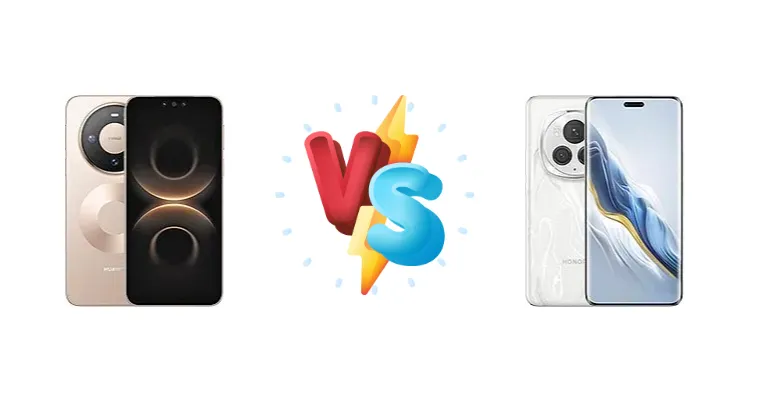
Huawei Mate 80 Pro vs Honor Magic6 Pro: A Deep Dive into Flagship Power
| Phones Images | |||||
|---|---|---|---|---|---|
|
🏆 Quick Verdict
For most users, the Honor Magic6 Pro emerges as the stronger contender. The Snapdragon 8 Gen 3’s superior efficiency and gaming performance, coupled with its impressive 1578 nit display, outweigh the Mate 80 Pro’s faster wired and wireless charging capabilities. However, those prioritizing extreme charging speeds may find the Mate 80 Pro appealing.
| PHONES | ||
|---|---|---|
| Phone Names | Huawei Mate 80 Pro | Honor Magic6 Pro |
| Network | ||
|---|---|---|
| 2G bands | GSM 850 / 900 / 1800 / 1900 | GSM 850 / 900 / 1800 / 1900 |
| 3G bands | HSDPA 800 / 850 / 900 / 1700(AWS) / 1900 / 2100 | HSDPA 800 / 850 / 900 / 1700(AWS) / 1900 / 2100 |
| 4G bands | LTE | LTE |
| 5G bands | SA/NSA | SA/NSA |
| Speed | HSPA, LTE, 5G | HSPA, LTE, 5G |
| Technology | GSM / CDMA / HSPA / CDMA2000 / LTE / 5G | GSM / CDMA / HSPA / CDMA2000 / LTE / 5G |
| Launch | ||
|---|---|---|
| Announced | 2025, November 25 | 2024, January 11 |
| Status | Available. Released 2025, November 25 | Available. Released 2024, January 18 |
| Body | ||
|---|---|---|
| Build | Glass front, aluminum alloy frame, fiber-reinforced plastic back | Glass front (NanoCrystal Shield), glass back or silicone polymer back (eco leather) |
| Dimensions | 161.9 x 76 x 8 mm (6.37 x 2.99 x 0.31 in) | 162.5 x 75.8 x 8.9 mm (6.40 x 2.98 x 0.35 in) |
| SIM | Nano-SIM + Nano-SIM | · Nano-SIM + eSIM· Nano-SIM + Nano-SIM |
| Weight | 219 g (7.72 oz) | 225 g or 229 g (7.94 oz) |
| Display | ||
|---|---|---|
| Protection | Huawei Kunlun Glass 2 | NanoCrystal Shield |
| Resolution | 1280 x 2832 pixels (~460 ppi density) | 1280 x 2800 pixels, 19.5:9 ratio (~453 ppi density) |
| Size | 6.75 inches, 110.3 cm2 (~89.7% screen-to-body ratio) | 6.8 inches, 112.8 cm2 (~91.6% screen-to-body ratio) |
| Type | LTPO OLED, 1B colors, 120Hz, 1440Hz PWM, HDR Vivid | LTPO OLED, 1B colors, 120Hz, Dolby Vision, HDR, 1600 nits (HBM), 5000 nits (peak) |
| Platform | ||
|---|---|---|
| CPU | 9-core (1x2.75 GHz & 4x2.27 GHz & 4x1.72 GHz) (512GB / 1TB 16GB RAM)9-core (2.75 GHz & 2.27 GHz & 1.72 GHz) (256GB / 512GB 12GB RAM) | Octa-core (1x3.3 GHz Cortex-X4 & 3x3.2 GHz Cortex-A720 & 2x3.0 GHz Cortex-A720 & 2x2.3 GHz Cortex-A520) |
| Chipset | Kirin 9030 Pro (6 nm) (512GB / 1TB 16GB RAM)Kirin 9030 (6 nm) (256GB / 512GB 12GB RAM) | Qualcomm SM8650-AB Snapdragon 8 Gen 3 (4 nm) |
| GPU | Maleoon 935 | Adreno 750 |
| OS | HarmonyOS 6.0 | Android 14, up to 4 major Android upgrades, MagicOS 8 |
| Memory | ||
|---|---|---|
| Card slot | No | No |
| Internal | 256GB 12GB RAM, 512GB 12GB RAM, 512GB 16GB RAM, 1TB 16GB RAM | 256GB 12GB RAM, 256GB 16GB RAM, 512GB 12GB RAM, 512GB 16GB RAM, 1TB 16GB RAM |
| Main Camera | ||
|---|---|---|
| Features | Laser AF, color spectrum sensor, LED flash, panorama, HDR | Laser AF, color spectrum sensor, LED flash, HDR, panorama |
| Triple | 50 MP, f/1.4-f/4.0, 24mm (wide), PDAF, OIS 48 MP, f/2.1, 93mm (periscope telephoto), PDAF, OIS, 4x optical zoom 40 MP, f/2.2, 13mm, 120˚ (ultrawide), PDAF | 50 MP, f/1.4-2.0, 23mm (wide), 1/1.3", 1.2µm, PDAF, OIS 180 MP, f/2.6, (periscope telephoto), 1/1.49", 0.56µm, PDAF, OIS, 2.5x optical zoom 50 MP, f/2.0, 13mm, 122˚ (ultrawide), 1/2.88", 0.61µm, AF |
| Video | 4K, 1080p@240fps, HDR, gyro-EIS, OIS, HDR Vivid | 4K@24/30/60fps, 1080p@30/60/120/240fps, gyro-EIS, OIS, HDR, 10-bit video |
| Selfie camera | ||
|---|---|---|
| Features | HDR, panorama | - |
| Single | 13 MP, f/2.0, 18mm (ultrawide), AF TOF 3D, (depth/biometrics sensor) | 50 MP, f/2.0, 22mm (wide), 1/2.93", 0.6µm, AF TOF 3D, (depth/biometrics sensor) |
| Video | 4K, 1080p, HDR, gyro-EIS | 4K@30fps, 1080p@30/60fps, gyro-EIS |
| Sound | ||
|---|---|---|
| 35mm jack | No | No |
| Loudspeaker | Yes, with stereo speakers | Yes, with stereo speakers |
| Comms | ||
|---|---|---|
| Bluetooth | 6.0, A2DP, LE, L2HC | 5.3, A2DP, LE, aptX HD |
| Infrared port | Yes | Yes |
| NFC | Yes | Yes |
| Positioning | GPS (L1+L5), GLONASS (L1), BDS (B1I+B1c+B2a+B2b), GALILEO (E1+E5a+E5b), QZSS (L1+L5), NavIC | GPS (L1+L5), GLONASS, BDS (B1I+B1c+B2a), GALILEO (E1+E5a) |
| Radio | No | No |
| USB | USB Type-C 3.1, OTG, DisplayPort 1.2 | USB Type-C 3.2, DisplayPort 1.2, OTG |
| WLAN | Wi-Fi 802.11 a/b/g/n/ac/6/7, dual-band, Wi-Fi Direct | Wi-Fi 802.11 a/b/g/n/ac/6/7, dual-band, Wi-Fi Direct |
| Features | ||
|---|---|---|
| Sensors | Face ID, fingerprint (side-mounted), accelerometer, gyro, proximity, barometer, compass | Fingerprint (under display, optical), Face ID, accelerometer, gyro, proximity, compass |
| Battery | ||
|---|---|---|
| Charging | 100W wired 80W wireless 20W reverse wireless 18W reverse wired | 80W wired 66W wireless Reverse wireless 5W reverse wired |
| Type | 5750 mAh | Si/C Li-Ion 5600 mAh |
| Misc | ||
|---|---|---|
| Colors | Black, White, Green, Gold | Black, Green, Blue, Purple, White |
| Models | SGT-AL50 | BVL-AN16, BVL-N49 |
| Price | About 730 EUR | € 455.54 / $ 899.00 / £ 598.99 |
Huawei Mate 80 Pro
- Unmatched 100W wired charging speed
- High 80W wireless charging speed
- Potentially superior image processing (based on Huawei’s history)
- Less efficient 6nm Kirin 9030 Pro chipset
- Display brightness likely lower than Magic6 Pro
- Software ecosystem limitations
Honor Magic6 Pro
- More efficient 4nm Snapdragon 8 Gen 3 chipset
- Significantly brighter 1578 nit display
- Longer battery life (14:06h active use)
- Slower wired and wireless charging speeds
- Potentially less refined image processing (compared to Huawei)
- Reliance on Qualcomm ecosystem
Display Comparison
The Honor Magic6 Pro boasts a significantly brighter display, peaking at 1578 nits, compared to an unstated peak brightness for the Mate 80 Pro. This translates to superior visibility in direct sunlight. While both likely employ high refresh rate OLED panels, the Magic6 Pro’s brightness advantage is a clear win. The absence of detailed display specs for the Mate 80 Pro (like PWM dimming frequency) makes a comprehensive comparison difficult, but the Magic6 Pro’s brightness is a standout feature.
Camera Comparison
Without detailed camera specifications for either device, a direct comparison is limited. However, given Huawei’s historical strength in mobile photography, the Mate 80 Pro likely prioritizes image processing and computational photography. The Magic6 Pro, leveraging the Snapdragon’s ISP, will likely offer faster image processing and potentially better video recording capabilities. The absence of sensor size information prevents a definitive judgment, but the Snapdragon’s image signal processor is known for its advanced features.
Performance
The core difference lies in the chipsets. The Honor Magic6 Pro’s Snapdragon 8 Gen 3 (4nm) is built on a more efficient process node than the Huawei Mate 80 Pro’s Kirin 9030 Pro (6nm). This 4nm process allows for higher performance at lower temperatures, reducing thermal throttling during sustained workloads. The Snapdragon 8 Gen 3’s octa-core configuration, featuring a Cortex-X4 prime core clocked at 3.3 GHz, is architecturally more advanced than the Kirin 9030 Pro’s 9-core setup. While the Kirin 9030 Pro offers a high core count, the Snapdragon’s core design and efficiency are likely to deliver a smoother, more responsive experience, particularly in demanding games.
Battery Life
The Honor Magic6 Pro demonstrates a clear advantage in battery life, achieving an active use score of 14:06 hours. While the Mate 80 Pro’s battery capacity is unstated, its charging speeds are its defining feature: 100W wired, 80W wireless, and 20W reverse wireless. The Magic6 Pro offers 80W wired and 66W wireless, alongside 5W reverse wired. The Mate 80 Pro will charge significantly faster, but the Magic6 Pro’s superior battery life suggests better overall efficiency and longer usage between charges.
Buying Guide
Buy the Huawei Mate 80 Pro if you absolutely need the fastest charging available – its 100W wired and 80W wireless charging are unmatched. It’s also a good choice if you prefer the Huawei ecosystem and are comfortable with the potential software limitations. Buy the Honor Magic6 Pro if you prioritize raw performance, especially for gaming, and demand a brighter, more efficient display. It’s the better option for users seeking a smoother, more versatile Android experience.