
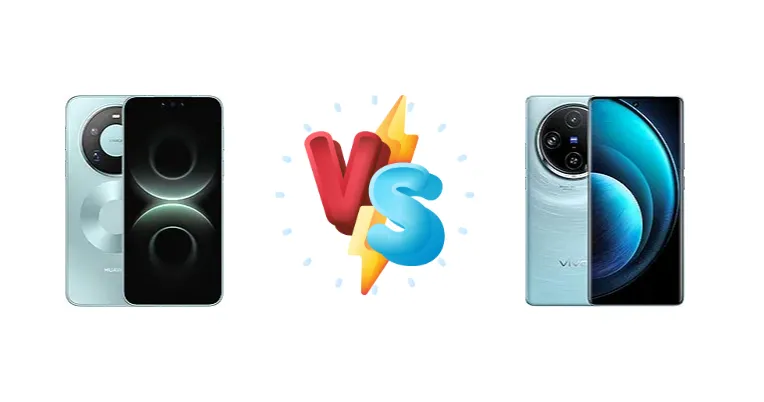
Huawei Mate 80 Pro Max vs vivo X100 Pro: A Deep Dive into Flagship Power
| Phones Images | |||||
|---|---|---|---|---|---|
|
🏆 Quick Verdict
For the average user prioritizing all-day battery life and consistent performance, the vivo X100 Pro emerges as the winner. Its Dimensity 9300 chipset and impressive 13:53h active use score provide a smoother, more reliable experience. However, the Huawei Mate 80 Pro Max’s unparalleled 100W wired and 80W wireless charging remain a compelling advantage for those who demand the fastest possible top-ups.
| PHONES | ||
|---|---|---|
| Phone Names | Huawei Mate 80 Pro Max | vivo X100 Pro |
| Network | ||
|---|---|---|
| 2G bands | GSM 850 / 900 / 1800 / 1900 | GSM 850 / 900 / 1800 / 1900 |
| 3G bands | HSDPA 800 / 850 / 900 / 1700(AWS) / 1900 / 2100 | HSDPA 800 / 850 / 900 / 1700(AWS) / 1900 / 2100 |
| 4G bands | LTE | 1, 2, 3, 4, 5, 7, 8, 12, 17, 18, 19, 20, 26, 28, 32, 38, 39, 40, 41, 42, 66 - International |
| 5G bands | SA/NSA | 1, 3, 5, 7, 8, 20, 28, 38, 40, 41, 66, 75, 77, 78, 79 SA/NSA - International |
| Speed | HSPA, LTE, 5G | HSPA, LTE, 5G |
| Technology | GSM / CDMA / HSPA / CDMA2000 / LTE / 5G | GSM / CDMA / HSPA / LTE / 5G |
| Launch | ||
|---|---|---|
| Announced | 2025, November 25 | 2023, November 13 |
| Status | Available. Released 2025, November 25 | Available. Released 2023, November 21 |
| Body | ||
|---|---|---|
| Build | Glass front, aluminum alloy frame, aluminum alloy back | Glass front, aluminum frame, glass back |
| Dimensions | 164.4 x 79 x 8.3 mm (6.47 x 3.11 x 0.33 in) | 164.1 x 75.3 x 8.9 mm or 9.1 mm |
| SIM | Nano-SIM + Nano-SIM | · Nano-SIM + eSIM· Nano-SIM + Nano-SIM |
| Weight | 239 g (8.43 oz) | 221 g or 225 g (7.80 oz) |
| Display | ||
|---|---|---|
| Protection | Huawei Kunlun Glass 2 | - |
| Resolution | 1320 x 2848 pixels, 19.5:9 ratio (~455 ppi density) | 1260 x 2800 pixels, 20:9 ratio (~452 ppi density) |
| Size | 6.9 inches, 117.2 cm2 (~90.2% screen-to-body ratio) | 6.78 inches, 111.5 cm2 (~90.2% screen-to-body ratio) |
| Type | LTPO OLED, 1B colors, 120Hz, 1440Hz PWM, HDR Vivid, 8000 nits (peak) | LTPO AMOLED, 1B colors, 120Hz, HDR10+, 3000 nits (peak) |
| Platform | ||
|---|---|---|
| CPU | 9-core (1x2.75 GHz & 4x2.27 GHz & 4x1.72 GHz) | Octa-core (1x3.25 GHz Cortex-X4 & 3x2.85 GHz Cortex-X4 & 4x2.0 GHz Cortex-A720) |
| Chipset | Kirin 9030 Pro (6 nm) | Mediatek Dimensity 9300 (4 nm) |
| GPU | Maleoon 935 | Immortalis-G720 MC12 |
| OS | HarmonyOS 6.0 | Android 14, upgradable to Android 15, Funtouch 15 (International), OriginOS 4 (China) |
| Memory | ||
|---|---|---|
| Card slot | No | No |
| Internal | 512GB 16GB RAM | 256GB 12GB RAM, 256GB 16GB RAM, 512GB 16GB RAM, 1TB 16GB RAM |
| Main Camera | ||
|---|---|---|
| Features | Laser AF, color spectrum sensor, LED flash, panorama, HDR | Laser AF, color spectrum sensor, Zeiss optics, Zeiss T* lens coating, LED flash, panorama, HDR, 3D LUT import |
| Quad | 50 MP, f/1.4-f/4.0, 24mm (wide), PDAF, OIS 50 MP, f/2.1, 91mm (periscope telephoto), PDAF, OIS, 4x optical zoom 50 MP, f/3.2, 140mm (periscope telephoto), PDAF, OIS, 6.2x optical zoom 40 MP, f/2.2, 13mm, 120˚ (ultrawide), PDAF | - |
| Triple | - | 50 MP, f/1.8, 23mm (wide), 1/0.98", 1.6µm, dual pixel PDAF, OIS 50 MP, f/2.5, 100mm (periscope telephoto), 1/2.51", 0.7µm, PDAF (18cm - ∞), OIS, 4.3x optical zoom 50 MP, f/2.0, 15mm, 119˚ (ultrawide), 1/2.76", 0.64µm, AF |
| Video | 4K, 1080p@960fps, HDR, gyro-EIS, OIS, HDR Vivid | 8K@30fps, 4K@30/60fps, 1080p, gyro-EIS |
| Selfie camera | ||
|---|---|---|
| Features | HDR, panorama | HDR |
| Single | 13 MP, f/2.0, 18mm (ultrawide), AF TOF 3D, (depth/biometrics sensor) | 32 MP, f/2.0, 20mm (ultrawide) |
| Video | 4K, 1080p, HDR, gyro-EIS | 4K@30/60fps, 1080p@30/60fps |
| Sound | ||
|---|---|---|
| 35mm jack | No | No |
| Loudspeaker | Yes, with stereo speakers | Yes, with stereo speakers |
| Comms | ||
|---|---|---|
| Bluetooth | 6.0, A2DP, LE, L2HC | 5.4, A2DP, LE, aptX HD, LHDC |
| Infrared port | Yes | Yes |
| NFC | Yes | Yes |
| Positioning | GPS (L1+L5), GLONASS (L1), BDS (B1I+B1c+B2a+B2b), GALILEO (E1+E5a+E5b), QZSS (L1+L5), NavIC | GPS (L1+L5), GLONASS (L1), BDS (B1I+B1c+B2a+B2b), GALILEO (E1+E5a+E5b), QZSS (L1+L5), NavIC (L5) |
| Radio | No | No |
| USB | USB Type-C 3.1, OTG, DisplayPort 1.2 | USB Type-C 3.2, OTG |
| WLAN | Wi-Fi 802.11 a/b/g/n/ac/6/7, dual-band, Wi-Fi Direct | Wi-Fi 802.11 a/b/g/n/ac/6/7, tri-band, Wi-Fi Direct |
| Features | ||
|---|---|---|
| Sensors | Face ID, fingerprint (side-mounted), accelerometer, gyro, proximity, barometer, compass | Fingerprint (under display, optical), accelerometer, gyro, proximity, compass |
| Battery | ||
|---|---|---|
| Charging | 100W wired 80W wireless 20W reverse wireless 18W reverse wired | 100W wired, 50% in 14 min 50W wireless Reverse wired |
| Type | 6000 mAh | Li-Ion 5400 mAh |
| Misc | ||
|---|---|---|
| Colors | Black, Silver, Blue, Gold | Startrail Blue, Asteroid Black, Sunset Orange, White |
| Models | SGT-AL10 | V2324A, V2309 |
| Price | About 980 EUR | ₹ 59,999 |
| SAR EU | - | 0.99 W/kg (head) 1.19 W/kg (body) |
Huawei Mate 80 Pro Max
- Unmatched 100W wired and 80W wireless charging speeds
- Potentially strong multi-core CPU performance
- 18W reverse wired charging for versatile power sharing
- 6nm chipset may suffer from thermal throttling
- Battery life likely inferior to the vivo X100 Pro
- Camera specs currently unknown, potential for inconsistency
vivo X100 Pro
- Excellent 13:53h active use battery life
- Efficient 4nm Dimensity 9300 chipset for sustained performance
- Bright 1472 nit display for outdoor visibility
- Wireless charging speed is slower than the Mate 80 Pro Max
- Reverse charging options are limited
- May lack the ultra-fast charging convenience of the Huawei
Display Comparison
The vivo X100 Pro boasts a significantly brighter display, reaching a measured 1472 nits, which translates to superior visibility in direct sunlight compared to the likely lower peak brightness of the Mate 80 Pro Max (Huawei doesn't publish this spec). While both are expected to utilize high-refresh-rate OLED panels, the X100 Pro’s brightness advantage is a clear win for outdoor usability. Details regarding PWM dimming rates are missing for both, but are crucial for users sensitive to flicker.
Camera Comparison
Without detailed camera specs for the Mate 80 Pro Max, a direct comparison is challenging. However, the X100 Pro is expected to feature a sophisticated camera system with advanced image processing capabilities. The focus should be on sensor size and lens apertures, as these directly impact low-light performance and dynamic range. The X100 Pro’s video capabilities are also likely to be a strong point, given vivo’s history of camera innovation. Ignoring the likely inclusion of low-resolution auxiliary lenses on both devices, the primary sensor quality will be the deciding factor.
Performance
The core architectural difference lies in the chipsets. The vivo X100 Pro’s Mediatek Dimensity 9300, fabricated on a 4nm process, offers a more efficient design than the Huawei Mate 80 Pro Max’s 6nm Kirin 9030 Pro. The Dimensity 9300’s Cortex-X4 prime core at 3.25 GHz, coupled with three additional X4 cores, suggests a focus on sustained peak performance. The Kirin 9030 Pro’s 9-core configuration, while potentially strong in multi-threaded tasks, may struggle with thermal management under prolonged stress. The X100 Pro’s LPDDR5x RAM is also likely to contribute to faster data transfer speeds.
Battery Life
The vivo X100 Pro’s 13:53h active use score is a significant advantage, indicating superior battery optimization. While the Mate 80 Pro Max offers incredibly fast 100W wired and 80W wireless charging – a clear lead over the X100 Pro’s 100W wired and 50W wireless – this speed comes at the cost of efficiency. The X100 Pro’s 50% charge in 14 minutes is competitive, but the Mate 80 Pro Max will likely achieve a full charge much faster. The Mate 80 Pro Max also offers 18W reverse wired charging, a feature the X100 Pro only offers in a wired format, providing more versatility.
Buying Guide
Buy the Huawei Mate 80 Pro Max if you absolutely need the fastest charging available on a smartphone, and are willing to potentially manage thermal throttling during extended intensive tasks. Buy the vivo X100 Pro if you prioritize long-lasting battery life, consistent performance under load, and a more efficient chipset that delivers a smoother overall experience, even during demanding gaming or video recording.