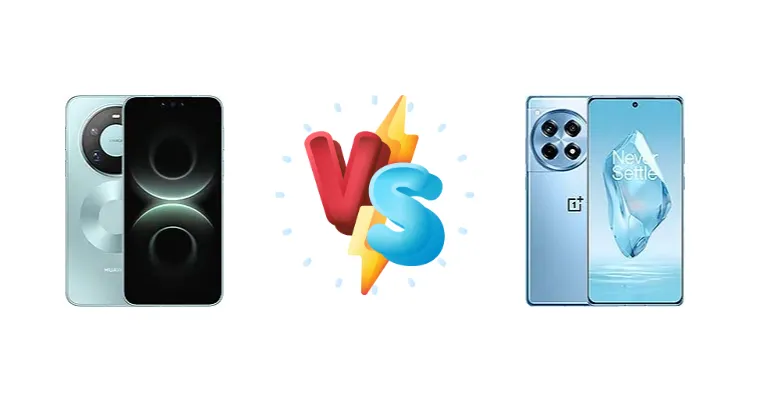
The Huawei Mate 80 Pro Max represents a continuation of Huawei’s premium smartphone strategy, boasting a powerful in-house chipset and cutting-edge charging technology. The OnePlus 12R, meanwhile, aims to deliver flagship-level performance at a more accessible price point, leveraging the proven Qualcomm Snapdragon 8 Gen 2. This comparison dissects these two devices to determine which offers the best overall experience.
🏆 Quick Verdict
For the average user prioritizing raw performance and established software support, the OnePlus 12R emerges as the stronger choice. Its Snapdragon 8 Gen 2, built on a 4nm process, provides a more efficient and consistently powerful experience than the Huawei Mate 80 Pro Max’s Kirin 9030 Pro, despite the latter’s impressive core count. However, Huawei’s 100W wireless charging is a significant differentiator.
| Network |
|---|
| 2G bands | GSM 850 / 900 / 1800 / 1900 | GSM 850 / 900 / 1800 / 1900 |
| 3G bands | HSDPA 800 / 850 / 900 / 1700(AWS) / 1900 / 2100 | HSDPA 850 / 900 / 1700(AWS) / 1900 / 2100 |
| 4G bands | LTE | 1, 2, 3, 4, 5, 7, 8, 12, 17, 18, 19, 20, 26, 28, 32, 38, 39, 40, 41, 66 |
| 5G bands | SA/NSA | 1, 2, 3, 5, 7, 8, 12, 20, 28, 38, 40, 41, 66, 77, 78 SA/NSA |
| Speed | HSPA, LTE, 5G | HSPA, LTE, 5G |
| Technology | GSM / CDMA / HSPA / CDMA2000 / LTE / 5G | GSM / CDMA / HSPA / LTE / 5G |
| Launch |
|---|
| Announced | 2025, November 25 | 2024, January 23 |
| Status | Available. Released 2025, November 25 | Available. Released 2024, February 06 |
| Body |
|---|
| Build | Glass front, aluminum alloy frame, aluminum alloy back | Glass front (Gorilla Glass Victus 2), aluminum frame, glass back |
| Dimensions | 164.4 x 79 x 8.3 mm (6.47 x 3.11 x 0.33 in) | 163.3 x 75.3 x 8.8 mm (6.43 x 2.96 x 0.35 in) |
| SIM | Nano-SIM + Nano-SIM | · Nano-SIM + Nano-SIM + eSIM (max 2 at a time)· Nano-SIM + Nano-SIM |
| Weight | 239 g (8.43 oz) | 207 g (7.30 oz) |
| Display |
|---|
| Protection | Huawei Kunlun Glass 2 | Corning Gorilla Glass Victus 2 |
| Resolution | 1320 x 2848 pixels, 19.5:9 ratio (~455 ppi density) | 1264 x 2780 pixels (~450 ppi density) |
| Size | 6.9 inches, 117.2 cm2 (~90.2% screen-to-body ratio) | 6.78 inches, 111.7 cm2 (~90.9% screen-to-body ratio) |
| Type | LTPO OLED, 1B colors, 120Hz, 1440Hz PWM, HDR Vivid, 8000 nits (peak) | LTPO4 AMOLED, 1B colors, 120Hz, HDR10+, Dolby Vision, 1600 nits (HBM), 4500 nits (peak) |
| Platform |
|---|
| CPU | 9-core (1x2.75 GHz & 4x2.27 GHz & 4x1.72 GHz) | Octa-core (1x3.2 GHz Cortex-X3 & 2x2.8 GHz Cortex-A715 & 2x2.8 GHz Cortex-A710 & 3x2.0 GHz Cortex-A510) |
| Chipset | Kirin 9030 Pro (6 nm) | Qualcomm SM8550-AB Snapdragon 8 Gen 2 (4 nm) |
| GPU | Maleoon 935 | Adreno 740 |
| OS | HarmonyOS 6.0 | Android 14, up to 3 major Android upgrades, OxygenOS 15 |
| Memory |
|---|
| Card slot | No | No |
| Internal | 512GB 16GB RAM | 128GB 8GB RAM, 256GB 8GB RAM, 256GB 12GB RAM, 256GB 16GB RAM |
| Main Camera |
|---|
| Features | Laser AF, color spectrum sensor, LED flash, panorama, HDR | Laser AF, color spectrum sensor, LED flash, HDR, panorama |
| Quad | 50 MP, f/1.4-f/4.0, 24mm (wide), PDAF, OIS
50 MP, f/2.1, 91mm (periscope telephoto), PDAF, OIS, 4x optical zoom
50 MP, f/3.2, 140mm (periscope telephoto), PDAF, OIS, 6.2x optical zoom
40 MP, f/2.2, 13mm, 120˚ (ultrawide), PDAF | - |
| Triple | - | 50 MP, f/1.8, 24mm (wide), 1/1.56", 1.0µm, multi-directional PDAF, OIS
8 MP, f/2.2, 16mm, 112˚ (ultrawide), 1/4.0", 1.12µm
2 MP (macro) |
| Video | 4K, 1080p@960fps, HDR, gyro-EIS, OIS, HDR Vivid | 4K@30/60fps, 1080p@30/60/120/240fps, gyro-EIS, OIS |
| Selfie camera |
|---|
| Features | HDR, panorama | HDR, panorama |
| Single | 13 MP, f/2.0, 18mm (ultrawide), AF
TOF 3D, (depth/biometrics sensor) | 16 MP, f/2.4, 26mm (wide), 1/3", 1.0µm |
| Video | 4K, 1080p, HDR, gyro-EIS | 1080p@30fps, gyro-EIS |
| Sound |
|---|
| 35mm jack | No | No |
| Loudspeaker | Yes, with stereo speakers | Yes, with stereo speakers |
| Comms |
|---|
| Bluetooth | 6.0, A2DP, LE, L2HC | 5.3, A2DP, LE, aptX HD |
| Infrared port | Yes | Yes |
| NFC | Yes | Yes |
| Positioning | GPS (L1+L5), GLONASS (L1), BDS (B1I+B1c+B2a+B2b), GALILEO (E1+E5a+E5b), QZSS (L1+L5), NavIC | GPS, GALILEO, GLONASS, BDS, QZSS |
| Radio | No | No |
| USB | USB Type-C 3.1, OTG, DisplayPort 1.2 | USB Type-C 2.0 |
| WLAN | Wi-Fi 802.11 a/b/g/n/ac/6/7, dual-band, Wi-Fi Direct | Wi-Fi 802.11 a/b/g/n/ac/6/7, dual-band |
| Features |
|---|
| Sensors | Face ID, fingerprint (side-mounted), accelerometer, gyro, proximity, barometer, compass | Fingerprint (under display, optical), accelerometer, gyro, proximity, compass |
| Battery |
|---|
| Charging | 100W wired
80W wireless
20W reverse wireless
18W reverse wired | 100W wired, 100% in 26 min |
| Type | 6000 mAh | Li-Ion 5500 mAh |
| Misc |
|---|
| Colors | Black, Silver, Blue, Gold | Iron Gray, Cool Blue, Electric Violet, Sunset Dune |
| Models | SGT-AL10 | CPH2609, CPH2585, CPH2611 |
| Price | About 980 EUR | € 410.84 / $ 399.95 / £ 649.00 |
| SAR | - | 1.19 W/kg (head) 0.82 W/kg (body) |
Huawei Mate 80 Pro Max
- Industry-leading 80W wireless charging
- Potentially superior image processing (Huawei's strength)
- Fast 100W wired charging
- Kirin 9030 Pro less efficient than Snapdragon 8 Gen 2
- Software ecosystem and update concerns
OnePlus 12R
- Snapdragon 8 Gen 2 offers superior performance and efficiency
- Clean Android experience with OxygenOS
- Excellent battery life (14:32h active use)
- Wireless charging speed is lower than Mate 80 Pro Max
- May lack some of Huawei's advanced camera features
Display Comparison
The OnePlus 12R boasts a measured peak brightness of 1181 nits, ensuring excellent visibility even in direct sunlight. While the Mate 80 Pro Max’s display specs are unavailable, Huawei typically employs high-quality OLED panels. The 12R’s brightness advantage is significant, and its likely use of LTPO technology (common in this segment) would contribute to improved power efficiency by dynamically adjusting the refresh rate. Without knowing the Mate 80 Pro Max’s refresh rate, it’s difficult to assess its smoothness, but the 12R is likely to offer a more fluid experience.
Camera Comparison
Without detailed camera specifications for the Mate 80 Pro Max, a direct comparison is challenging. However, Huawei historically focuses on computational photography and large sensor sizes. The OnePlus 12R’s camera system, while capable, is likely to prioritize a balanced approach. The Snapdragon 8 Gen 2’s ISP (Image Signal Processor) is highly advanced, offering excellent image processing capabilities. The efficiency of the Snapdragon’s ISP, combined with potentially larger sensor sizes in the Mate 80 Pro Max, will be key differentiators. We can assume both phones will offer competent camera performance, but Huawei’s strength in image processing could give it an edge in challenging lighting conditions.
Performance
The core architectural difference is stark: the OnePlus 12R’s Snapdragon 8 Gen 2 (4nm) utilizes a 1+2+2+3 core configuration with a prime Cortex-X3 core clocked at 3.2 GHz, designed for peak performance. The Huawei Mate 80 Pro Max’s Kirin 9030 Pro (6nm) employs a 1+4+4 configuration, topping out at 2.75 GHz. While the Kirin has more cores, the Snapdragon 8 Gen 2’s newer architecture and smaller process node translate to superior single-core and multi-core performance, alongside better thermal efficiency. This means the 12R is less likely to throttle under sustained load, making it the better choice for demanding tasks like gaming and video editing.
Battery Life
The OnePlus 12R delivers an impressive 14:32h of active use, demonstrating excellent battery life. The Mate 80 Pro Max’s battery capacity is unknown, but Huawei’s 100W wired charging and 80W wireless charging are significant advantages. The 12R’s 100W wired charging achieves a full charge in 26 minutes. While the Mate 80 Pro Max’s battery life may be comparable, its charging speeds, particularly the 80W wireless charging, are unmatched by the 12R. The 18W/20W reverse wireless/wired charging on the Mate 80 Pro Max also provides greater versatility.
Buying Guide
Buy the Huawei Mate 80 Pro Max if you prioritize extremely fast wireless charging (80W) and are comfortable with the Huawei ecosystem and potential software limitations. Buy the OnePlus 12R if you value a consistently high-performing processor, a cleaner Android experience, and a more globally accessible software update path. The 12R is the better choice for gamers and those who demand sustained performance.
Frequently Asked Questions
❓ Does the Kirin 9030 Pro overheat during extended gaming sessions?
The Kirin 9030 Pro, built on a 6nm process, is likely to generate more heat than the Snapdragon 8 Gen 2 (4nm) during prolonged gaming. This could lead to thermal throttling, reducing sustained performance. The OnePlus 12R is better equipped to maintain peak performance for longer periods.
❓ How does Huawei's software experience compare to OxygenOS on the OnePlus 12R?
Huawei's EMUI (or HarmonyOS) offers a different user experience than OxygenOS. OxygenOS is known for its clean, near-stock Android feel with useful customizations. Huawei's software is more heavily customized and may lack access to the full suite of Google services, depending on the region. Software updates can also be less frequent and predictable on Huawei devices.
❓ Is the 80W wireless charging on the Mate 80 Pro Max significantly faster in real-world use?
Yes, 80W wireless charging is substantially faster than typical wireless charging speeds. While the OnePlus 12R offers 100W wired charging, the Mate 80 Pro Max’s 80W wireless charging provides a convenience factor that the 12R cannot match, allowing for incredibly quick top-ups without cables.