
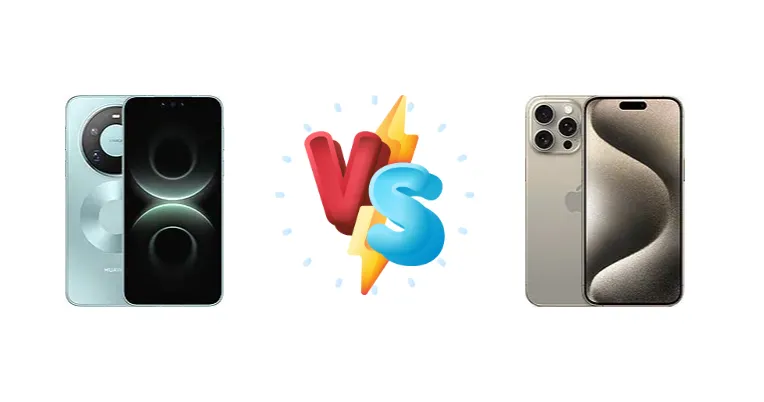
Huawei Mate 80 Pro Max vs. Apple iPhone 15 Pro Max: A Deep Dive Comparison
| Phones Images | |||||
|---|---|---|---|---|---|
|
🏆 Quick Verdict
For the average user prioritizing longevity and a seamless ecosystem, the Apple iPhone 15 Pro Max emerges as the winner. Its 16:01 hour active use battery life and optimized A17 Pro chip provide a consistently smooth experience. However, the Huawei Mate 80 Pro Max’s 100W charging is a game-changer for those who value speed above all else.
| PHONES | ||
|---|---|---|
| Phone Names | Huawei Mate 80 Pro Max | Apple iPhone 15 Pro Max |
| Network | ||
|---|---|---|
| 2G bands | GSM 850 / 900 / 1800 / 1900 | GSM 850 / 900 / 1800 / 1900 |
| 3G bands | HSDPA 800 / 850 / 900 / 1700(AWS) / 1900 / 2100 | HSDPA 850 / 900 / 1700(AWS) / 1900 / 2100 |
| 4G bands | LTE | 1, 2, 3, 4, 5, 7, 8, 12, 13, 17, 18, 19, 20, 25, 26, 28, 30, 32, 34, 38, 39, 40, 41, 42, 46, 48, 53, 66 - A3106 |
| 5G bands | SA/NSA | 1, 2, 3, 5, 7, 8, 12, 20, 25, 26, 28, 30, 38, 40, 41, 48, 53, 66, 70, 77, 78, 79 SA/NSA/Sub6 - A3106 |
| Speed | HSPA, LTE, 5G | HSPA, LTE, 5G, EV-DO Rev.A 3.1 Mbps |
| Technology | GSM / CDMA / HSPA / CDMA2000 / LTE / 5G | GSM / CDMA / HSPA / EVDO / LTE / 5G |
| Launch | ||
|---|---|---|
| Announced | 2025, November 25 | 2023, September 12 |
| Status | Available. Released 2025, November 25 | Available. Released 2023, September 22 |
| Body | ||
|---|---|---|
| Build | Glass front, aluminum alloy frame, aluminum alloy back | Glass front, glass back, titanium frame (grade 5) |
| Dimensions | 164.4 x 79 x 8.3 mm (6.47 x 3.11 x 0.33 in) | 159.9 x 76.7 x 8.3 mm (6.30 x 3.02 x 0.33 in) |
| SIM | Nano-SIM + Nano-SIM | · Nano-SIM + eSIM + eSIM (max 2 at a time; International)· eSIM + eSIM (8 or more, max 2 at a time; USA)· Nano-SIM + Nano-SIM (China) |
| Weight | 239 g (8.43 oz) | 221 g (7.80 oz) |
| Display | ||
|---|---|---|
| Protection | Huawei Kunlun Glass 2 | Ceramic Shield glass |
| Resolution | 1320 x 2848 pixels, 19.5:9 ratio (~455 ppi density) | 1290 x 2796 pixels, 19.5:9 ratio (~460 ppi density) |
| Size | 6.9 inches, 117.2 cm2 (~90.2% screen-to-body ratio) | 6.7 inches, 110.2 cm2 (~89.8% screen-to-body ratio) |
| Type | LTPO OLED, 1B colors, 120Hz, 1440Hz PWM, HDR Vivid, 8000 nits (peak) | LTPO Super Retina XDR OLED, 120Hz, HDR10, Dolby Vision, 1000 nits (typ), 2000 nits (HBM) |
| Platform | ||
|---|---|---|
| CPU | 9-core (1x2.75 GHz & 4x2.27 GHz & 4x1.72 GHz) | Hexa-core (2x3.78 GHz + 4x2.11 GHz) |
| Chipset | Kirin 9030 Pro (6 nm) | Apple A17 Pro (3 nm) |
| GPU | Maleoon 935 | Apple GPU (6-core graphics) |
| OS | HarmonyOS 6.0 | iOS 17, upgradable to iOS 26.1 |
| Memory | ||
|---|---|---|
| Card slot | No | No |
| Internal | 512GB 16GB RAM | 256GB 8GB RAM, 512GB 8GB RAM, 1TB 8GB RAM |
| Main Camera | ||
|---|---|---|
| Features | Laser AF, color spectrum sensor, LED flash, panorama, HDR | Dual-LED dual-tone flash, HDR (photo/panorama) |
| Quad | 50 MP, f/1.4-f/4.0, 24mm (wide), PDAF, OIS 50 MP, f/2.1, 91mm (periscope telephoto), PDAF, OIS, 4x optical zoom 50 MP, f/3.2, 140mm (periscope telephoto), PDAF, OIS, 6.2x optical zoom 40 MP, f/2.2, 13mm, 120˚ (ultrawide), PDAF | - |
| Triple | - | 48 MP, f/1.8, 24mm (wide), 1/1.28", 1.22µm, dual pixel PDAF, sensor-shift OIS 12 MP, f/2.8, 120mm (periscope telephoto), 1/3.06", 1.12µm, dual pixel PDAF, 3D sensor‑shift OIS, 5x optical zoom 12 MP, f/2.2, 13mm, 120˚ (ultrawide), 1/2.55", 1.4µm, dual pixel PDAF TOF 3D LiDAR scanner (depth) |
| Video | 4K, 1080p@960fps, HDR, gyro-EIS, OIS, HDR Vivid | 4K@24/25/30/60fps, 1080p@25/30/60/120/240fps, 10-bit HDR, Dolby Vision HDR (up to 60fps), ProRes, 3D (spatial) video, stereo sound rec. |
| Selfie camera | ||
|---|---|---|
| Features | HDR, panorama | HDR, Dolby Vision HDR |
| Single | 13 MP, f/2.0, 18mm (ultrawide), AF TOF 3D, (depth/biometrics sensor) | 12 MP, f/1.9, 23mm (wide), 1/3.6", 1.0µm, PDAF, OIS SL 3D, (depth/biometrics sensor) |
| Video | 4K, 1080p, HDR, gyro-EIS | 4K@24/25/30/60fps, 1080p@25/30/60/120fps, gyro-EIS |
| Sound | ||
|---|---|---|
| 35mm jack | No | No |
| Loudspeaker | Yes, with stereo speakers | Yes, with stereo speakers |
| Comms | ||
|---|---|---|
| Bluetooth | 6.0, A2DP, LE, L2HC | 5.3, A2DP, LE |
| Infrared port | Yes | - |
| NFC | Yes | Yes |
| Positioning | GPS (L1+L5), GLONASS (L1), BDS (B1I+B1c+B2a+B2b), GALILEO (E1+E5a+E5b), QZSS (L1+L5), NavIC | GPS (L1+L5), GLONASS, GALILEO, BDS, QZSS, NavIC |
| Radio | No | No |
| USB | USB Type-C 3.1, OTG, DisplayPort 1.2 | USB Type-C 3.2 Gen 2, DisplayPort |
| WLAN | Wi-Fi 802.11 a/b/g/n/ac/6/7, dual-band, Wi-Fi Direct | Wi-Fi 802.11 a/b/g/n/ac/6e, tri-band, hotspot |
| Features | ||
|---|---|---|
| Sensors | Face ID, fingerprint (side-mounted), accelerometer, gyro, proximity, barometer, compass | Face ID, accelerometer, gyro, proximity, compass, barometer |
| Battery | ||
|---|---|---|
| Charging | 100W wired 80W wireless 20W reverse wireless 18W reverse wired | Wired, PD2.0, 50% in 30 min 15W wireless (MagSafe) 15W wireless (Qi2) - requires iOS 17.2 update 4.5W reverse wired |
| Type | 6000 mAh | Li-Ion 4441 mAh |
| Misc | ||
|---|---|---|
| Colors | Black, Silver, Blue, Gold | Black Titanium, White Titanium, Blue Titanium, Natural Titanium |
| Models | SGT-AL10 | A2849, A3105, A3106, A3108, iPhone16,2 |
| Price | About 980 EUR | € 758.79 / $ 579.87 / £ 628.29 |
| SAR | - | 1.07 W/kg (head) 1.11 W/kg (body) |
| SAR EU | - | 0.98 W/kg (head) 0.98 W/kg (body) |
Huawei Mate 80 Pro Max
- Unrivaled 100W wired and 80W wireless charging speeds
- Potential for a more customizable software experience (depending on EMUI version)
- Reverse wireless charging at 20W offers versatile power sharing
- Potential software ecosystem limitations and app availability
- Chipset fabrication process (6nm) less efficient than iPhone's (3nm)
Apple iPhone 15 Pro Max
- Exceptional battery life (16:01h active use)
- Powerful and efficient A17 Pro chipset
- Seamless integration with the Apple ecosystem
- Long-term software support and updates
- Slower charging speeds compared to Huawei (50% in 30 min)
- MagSafe/Qi2 wireless charging limited to 15W
Display Comparison
The iPhone 15 Pro Max boasts a peak brightness of 1787 nits, a figure that significantly surpasses expectations and ensures excellent visibility even in direct sunlight. While the Huawei Mate 80 Pro Max’s display specs are not provided, Huawei typically employs OLED panels with vibrant colors. The iPhone’s likely use of LTPO technology allows for variable refresh rates, conserving battery life during static content viewing, a feature we anticipate the Mate 80 Pro Max may lack. The iPhone’s superior brightness is a clear advantage for outdoor usability.
Camera Comparison
Without detailed camera specs for the Mate 80 Pro Max, a direct comparison is challenging. However, Apple’s focus on computational photography and sensor-shift stabilization, combined with its advanced video capabilities, positions the iPhone 15 Pro Max as a strong contender. The iPhone’s image processing prioritizes natural colors and detail, while Huawei often leans towards more saturated and stylized images. The absence of specific sensor size information for the Mate 80 Pro Max makes it difficult to assess its low-light performance relative to the iPhone.
Performance
The core difference lies in the chipsets: Apple’s A17 Pro (3nm) versus Huawei’s Kirin 9030 Pro (6nm). The A17 Pro’s smaller node size translates to greater transistor density and improved power efficiency, meaning sustained performance under load with less thermal throttling. While the Kirin 9030 Pro’s 9-core configuration sounds impressive, the A17 Pro’s hexa-core design, coupled with Apple’s software optimization, delivers superior real-world performance. The iPhone’s LPDDR5X RAM further enhances data transfer speeds, contributing to a smoother multitasking experience.
Battery Life
The iPhone 15 Pro Max’s endurance rating of 118 hours and 16:01 hours of active use demonstrates exceptional battery life. While the Mate 80 Pro Max’s battery capacity is unknown, its charging capabilities are its standout feature. 100W wired charging can replenish the battery from 0-100% in a remarkably short time, while 80W wireless charging is equally impressive. However, the iPhone’s efficiency and optimized software mean it can often last a full day on a single charge, even with heavy use. The Mate 80 Pro Max relies on quick top-ups, while the iPhone prioritizes longevity.
Buying Guide
Buy the Huawei Mate 80 Pro Max if you absolutely need the fastest charging available and prioritize raw charging speed over ecosystem integration. Its 100W wired and 80W wireless charging capabilities are unmatched. Buy the Apple iPhone 15 Pro Max if you value a polished software experience, long-term software support, and a consistently high level of performance across all tasks, backed by the efficiency of the A17 Pro.