
Huawei Mate 8 vs Samsung Galaxy S7 edge: A 2024 Throwback Showdown
| Phones Images | |||||
|---|---|---|---|---|---|
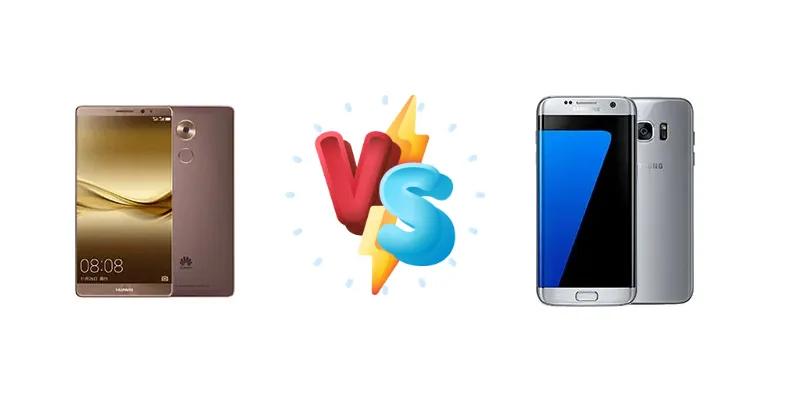
|
🏆 Quick Verdict
The Samsung Galaxy S7 edge edges out the Mate 8 thanks to its superior display, slightly more refined camera, and overall more polished software experience. While the Mate 8 boasts incredible battery life, the S7 edge's strengths make it the slightly better choice for most users.
| PHONES | ||
|---|---|---|
| Phone Names | Huawei Mate 8 | Samsung Galaxy S7 edge |
| Network | ||
|---|---|---|
| 2G bands | GSM 850 / 900 / 1800 / 1900 - SIM 1 & SIM 2 (optional) | GSM 850 / 900 / 1800 / 1900 - SIM 1 & SIM 2 - G935FD, G9350 |
| 3G bands | HSDPA 800 / 850 / 900 / 1700(AWS) / 1900 / 2100 - NXT-L29, NXT-L09 | HSDPA 850 / 900 / 1700(AWS) / 1900 / 2100 - G935F, G935FD, G935W8 |
| 4G bands | 1, 2, 3, 4, 5, 6, 7, 8, 12, 17, 18, 19, 20, 26, 38, 39, 40 - NXT-L29 | 1, 2, 3, 4, 5, 7, 8, 12, 13, 17, 18, 19, 20, 25, 26, 28, 38, 39, 40, 41 - G935F, G935FD |
| Speed | HSPA 42.2/5.76 Mbps, LTE (2CA) Cat6 300/50 Mbps | HSPA 42.2/5.76 Mbps, LTE (3CA) Cat9 450/50 Mbps |
| Technology | GSM / HSPA / LTE | GSM / HSPA / LTE |
| 1, 2, 3, 4, 5, 6, 7, 8, 12, 17, 18, 19, 20, 26, 28, 38, 39, 40 - NXT-L09 | - | |
| Launch | ||
|---|---|---|
| Announced | 2015, November. Released 2015, November | 2016, February 21. Released 2016, March 11 |
| Status | Discontinued | Discontinued |
| Body | ||
|---|---|---|
| Build | Glass front (Gorilla Glass 3), aluminum back, aluminum frame | Glass front (Gorilla Glass 4), glass back (Gorilla Glass 4), aluminum frame |
| Dimensions | 157.1 x 80.6 x 7.9 mm (6.19 x 3.17 x 0.31 in) | 150.9 x 72.6 x 7.7 mm (5.94 x 2.86 x 0.30 in) |
| SIM | · Nano-SIM (NXT-L09)· Nano-SIM + Nano-SIM (NXT-L29) | · Nano-SIM (G935F, G935W8)· Nano-SIM + Nano-SIM (G935FD) |
| Weight | 185 g (6.53 oz) | 157 g (5.54 oz) |
| Display | ||
|---|---|---|
| Protection | Corning Gorilla Glass 3 | Corning Gorilla Glass 4 |
| Resolution | 1080 x 1920 pixels, 16:9 ratio (~368 ppi density) | 1440 x 2560 pixels, 16:9 ratio (~534 ppi density) |
| Size | 6.0 inches, 98.7 cm2 (~78.0% screen-to-body ratio) | 5.5 inches, 83.4 cm2 (~76.1% screen-to-body ratio) |
| Type | IPS-NEO LCD | Super AMOLED |
| Platform | ||
|---|---|---|
| CPU | Octa-core (4x2.3 GHz Cortex-A72 & 4x1.8 GHz Cortex A53) | Quad-core (2x2.15 GHz Kryo & 2x1.6 GHz Kryo) - G9350Octa-core (4x2.3 GHz Mongoose & 4x1.6 GHz Cortex-A53) - G935FD, G935F, G935W8 |
| Chipset | Kirin 950 (16 nm) | Qualcomm MSM8996 Snapdragon 820 (14 nm) - G9350Exynos 8890 Octa (14 nm) - G935FD, G935F, G935W8 |
| GPU | Mali-T880 MP4 | Adreno 530 - G9350Mali-T880 MP12 - G935FD, G935F, G935W8 |
| OS | Android 6.0 (Marshmallow), upgradable to 7.0 (Nougat), EMUI 4 | Android 6.0 (Marshmallow), upgradable to Android 8.0 (Oreo), TouchWiz UI |
| Memory | ||
|---|---|---|
| Card slot | microSDXC (uses shared SIM slot) | microSDXC (uses shared SIM slot) - dual SIM model only |
| Internal | 32GB 3GB RAM, 64GB 4GB RAM, 128GB 4GB RAM | 32GB 4GB RAM, 64GB 4GB RAM, 128GB 4GB RAM |
| Main Camera | ||
|---|---|---|
| Features | Dual-LED dual-tone flash, panorama, HDR | LED flash, auto-HDR, panorama |
| Single | 16 MP, f/2.0, 27mm (wide), 1/2.8", PDAF, OIS | 12 MP, f/1.7, 26mm (wide), 1/2.55", 1.4µm, dual pixel PDAF, OIS |
| Video | 1080p@60fps, 1080p@30fps, 720p@120fps | 4K@30fps, 1080p@30fps (gyro-EIS), 1080p@60fps, 720p@240fps, HDR, stereo sound rec., OIS |
| Selfie camera | ||
|---|---|---|
| Features | - | HDR |
| Single | 8 MP, f/2.4, 26mm (wide) | 5 MP, f/1.7, 22mm (wide), 1/4.1", 1.34µm |
| Video | 1080p@30fps | - |
| Sound | ||
|---|---|---|
| 3.5mm jack | Yes | Yes |
| 35mm jack | Yes | Yes |
| Loudspeaker | Yes | Yes |
| 24-bit/192kHz audio | - | |
| Comms | ||
|---|---|---|
| Bluetooth | 4.2, A2DP, EDR, LE | 4.2, A2DP, LE, aptX |
| NFC | Yes | Yes |
| Positioning | GPS, GLONASS, BDS | GPS, GLONASS, BDS |
| Radio | FM radio | No |
| USB | microUSB 2.0, OTG | microUSB 2.0, OTG |
| WLAN | Wi-Fi 802.11 a/b/g/n/ac, dual-band, DLNA, Wi-Fi Direct | Wi-Fi 802.11 a/b/g/n/ac, dual-band, Wi-Fi Direct |
| Features | ||
|---|---|---|
| Sensors | Fingerprint (rear-mounted), accelerometer, gyro, proximity, barometer, compass | Fingerprint (front-mounted), accelerometer, gyro, proximity, compass, barometer, heart rate, SpO2 |
| Battery | ||
|---|---|---|
| Charging | 18W wired, 37% in 30 min | 15W wired, QC2 Wireless (Qi) (market dependent) |
| Music play | Up to 98 h | Up to 74 h |
| Stand-by | Up to 528 h (3G) | - |
| Talk time | - | Up to 27 h (3G) |
| Type | Li-Po 4000 mAh, non-removable | Li-Ion 3600 mAh, non-removable |
| Misc | ||
|---|---|---|
| Colors | Champagne Gold, Moonlight Silver, Space Gray, Mocha Brown | Black, White, Gold, Silver, Pink Gold, Black Pearl, Coral Blue |
| Models | NXT-AL10, NXT-CL00, NXT-DL00, NXT-TL00, NXT-L09, NXT-L29 | SM-G935F, SM-G935FD, SM-G935W8, SM-G9350, SM-G935S, SC-02H, SM-G935K, SM-G935L, SM-G935R4, SCV33, SM-G935X, SM-G935VC, SM-G935D |
| Price | About 300 EUR | About 330 EUR |
| SAR | 1.49 W/kg (head) 0.32 W/kg (body) | 0.56 W/kg (head) 0.66 W/kg (body) |
| SAR EU | 1.46 W/kg (head) 0.21 W/kg (body) | 0.26 W/kg (head) 1.43 W/kg (body) |
| Tests | ||
|---|---|---|
| Audio quality | Noise -97.8dB / Crosstalk -97.3dB | Noise -92.5dB / Crosstalk -92.2dB |
| Battery life | Endurance rating 103h | Endurance rating 92h |
| Camera | Photo / Video | Photo / Video |
| Display | Contrast ratio: 1361:1 (nominal), 2.949 (sunlight) | Contrast ratio: Infinite (nominal), 4.439 (sunlight) |
| Loudspeaker | Voice 67dB / Noise 65dB / Ring 66dB | Voice 70dB / Noise 69dB / Ring 71dB |
| Performance | Basemark OS II 2.0: 2017Basemark X: 15593 | GFXBench: 8.3fps (ES 3.1 onscreen) |
Huawei Mate 8
- Exceptional battery life
- Large display
- Competitive price (used)
- Solid build quality
- Outdated software
- Less vibrant display compared to S7 edge
- Camera not as refined as S7 edge
- Kirin chipset performance slightly behind Snapdragon/Exynos
Samsung Galaxy S7 edge
- Vibrant AMOLED display
- Excellent camera performance
- More polished software experience (initially)
- Wireless charging (market dependent)
- Battery life shorter than Mate 8
- Older hardware, potential for performance limitations
- Software updates discontinued
- Fragile design (curved screen prone to damage)
Display Comparison
The Galaxy S7 edge takes the display crown. Its 'Infinite' contrast ratio (though a marketing term) and 4.439 sunlight visibility are noticeably better than the Mate 8's 1361:1 contrast and 2.949 sunlight rating. The S7 edge's AMOLED panel also offers richer colors and deeper blacks, providing a more immersive viewing experience. The Mate 8's display is still good, but lacks the vibrancy of the S7 edge.
Camera Comparison
The Samsung Galaxy S7 edge consistently delivers better camera performance. Its image processing is more refined, producing more natural-looking photos. While both phones offer Photo/Video capabilities, the S7 edge's low-light performance and overall image quality are superior. The Mate 8's camera is still capable, but lacks the S7 edge's finesse.
Performance
Performance is a mixed bag. The Mate 8's Kirin 950, while powerful for its time, is generally outperformed by the Snapdragon 820 (or Exynos 8890) in the S7 edge, especially in graphics-intensive tasks. The S7 edge's CPU architecture also offers slightly better efficiency. However, both phones handle everyday tasks with ease.
Battery Life
The Huawei Mate 8 absolutely dominates in battery life. Its 103h endurance rating is significantly higher than the S7 edge's 92h. This means the Mate 8 can easily last for multiple days on a single charge, making it a champion for power users.
Buying Guide
The Huawei Mate 8 is ideal for users prioritizing exceptional battery life and a large screen on a budget. The Samsung Galaxy S7 edge is a better fit for those who value a vibrant display, a more versatile camera, and a generally smoother user experience, even with its age.