
Huawei Mate 8 vs Samsung Galaxy Note5: A 2024 Throwback Showdown
| Phones Images | |||||
|---|---|---|---|---|---|
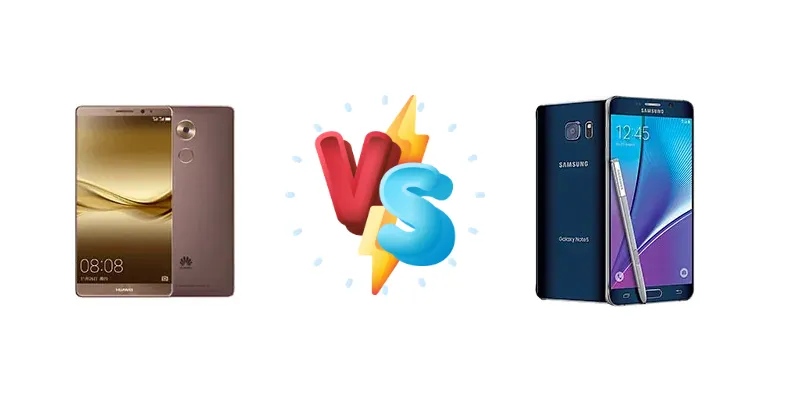
|
🏆 Quick Verdict
The Huawei Mate 8 edges out the Note5 thanks to its significantly longer battery life and exceptional sunlight visibility. While the Note5 boasts a slightly brighter display and potentially faster software responsiveness, the Mate 8's endurance and screen performance make it the winner for users prioritizing longevity.
| PHONES | ||
|---|---|---|
| Phone Names | Huawei Mate 8 | Samsung Galaxy Note5 |
| Network | ||
|---|---|---|
| 2G bands | GSM 850 / 900 / 1800 / 1900 - SIM 1 & SIM 2 (optional) | GSM 850 / 900 / 1800 / 1900 |
| 3G bands | HSDPA 800 / 850 / 900 / 1700(AWS) / 1900 / 2100 - NXT-L29, NXT-L09 | HSDPA 850 / 900 / 1900 / 2100 |
| 4G bands | 1, 2, 3, 4, 5, 6, 7, 8, 12, 17, 18, 19, 20, 26, 38, 39, 40 - NXT-L29 | 1, 2, 3, 4, 5, 7, 8, 12, 17, 18, 19, 25, 26, 28, 38, 39, 40, 41 |
| Speed | HSPA 42.2/5.76 Mbps, LTE (2CA) Cat6 300/50 Mbps | HSPA 42.2/5.76 Mbps, LTE Cat6 300/50 Mbps/ LTE (3CA) Cat9 450/50 Mbps |
| Technology | GSM / HSPA / LTE | GSM / HSPA / LTE |
| 1, 2, 3, 4, 5, 6, 7, 8, 12, 17, 18, 19, 20, 26, 28, 38, 39, 40 - NXT-L09 | - | |
| Launch | ||
|---|---|---|
| Announced | 2015, November. Released 2015, November | 2015, August 13. Released 2015, August |
| Status | Discontinued | Discontinued |
| Body | ||
|---|---|---|
| Build | Glass front (Gorilla Glass 3), aluminum back, aluminum frame | Glass front (Gorilla Glass 4), glass back (Gorilla Glass 4), aluminum frame |
| Dimensions | 157.1 x 80.6 x 7.9 mm (6.19 x 3.17 x 0.31 in) | 153.2 x 76.1 x 7.6 mm (6.03 x 3.00 x 0.30 in) |
| SIM | · Nano-SIM (NXT-L09)· Nano-SIM + Nano-SIM (NXT-L29) | Nano-SIM |
| Weight | 185 g (6.53 oz) | 171 g (6.03 oz) |
| - | Stylus | |
| Display | ||
|---|---|---|
| Protection | Corning Gorilla Glass 3 | Corning Gorilla Glass 4 |
| Resolution | 1080 x 1920 pixels, 16:9 ratio (~368 ppi density) | 1440 x 2560 pixels, 16:9 ratio (~518 ppi density) |
| Size | 6.0 inches, 98.7 cm2 (~78.0% screen-to-body ratio) | 5.7 inches, 88.5 cm2 (~75.9% screen-to-body ratio) |
| Type | IPS-NEO LCD | Super AMOLED |
| Platform | ||
|---|---|---|
| CPU | Octa-core (4x2.3 GHz Cortex-A72 & 4x1.8 GHz Cortex A53) | Octa-core (4x2.1 GHz Cortex-A57 & 4x1.5 GHz Cortex-A53) |
| Chipset | Kirin 950 (16 nm) | Exynos 7420 Octa (14 nm) |
| GPU | Mali-T880 MP4 | Mali-T760MP8 |
| OS | Android 6.0 (Marshmallow), upgradable to 7.0 (Nougat), EMUI 4 | Android 5.1.1 (Lollipop), upgradable to 7.0 (Nougat) |
| Memory | ||
|---|---|---|
| Card slot | microSDXC (uses shared SIM slot) | No |
| Internal | 32GB 3GB RAM, 64GB 4GB RAM, 128GB 4GB RAM | 32GB 4GB RAM, 64GB 4GB RAM, 128GB 4GB RAM |
| - | UFS 2.0 | |
| Main Camera | ||
|---|---|---|
| Features | Dual-LED dual-tone flash, panorama, HDR | LED flash, panorama, HDR |
| Single | 16 MP, f/2.0, 27mm (wide), 1/2.8", PDAF, OIS | 16 MP, f/1.9, 28mm (wide), 1/2.6", 1.12µm, AF, OIS |
| Video | 1080p@60fps, 1080p@30fps, 720p@120fps | 4K@30fps, 1080p@30/60fps, stereo sound rec., gyro-EIS |
| Selfie camera | ||
|---|---|---|
| Features | - | HDR |
| Single | 8 MP, f/2.4, 26mm (wide) | 5 MP, f/1.9, 22mm (wide), 1/4.1", 1.34µm |
| Video | 1080p@30fps | 1440p@30fps |
| Sound | ||
|---|---|---|
| 3.5mm jack | Yes | Yes |
| 35mm jack | Yes | Yes |
| Loudspeaker | Yes | Yes |
| 24-bit/192kHz audio | 24-bit/192kHz audio | |
| Comms | ||
|---|---|---|
| Bluetooth | 4.2, A2DP, EDR, LE | 4.2, A2DP, EDR, LE |
| NFC | Yes | Yes |
| Positioning | GPS, GLONASS, BDS | GPS, GLONASS, BDS |
| Radio | FM radio | No |
| USB | microUSB 2.0, OTG | microUSB 2.0, OTG |
| WLAN | Wi-Fi 802.11 a/b/g/n/ac, dual-band, DLNA, Wi-Fi Direct | Wi-Fi 802.11 a/b/g/n/ac, dual-band, Wi-Fi Direct, hotspot |
| Features | ||
|---|---|---|
| Sensors | Fingerprint (rear-mounted), accelerometer, gyro, proximity, barometer, compass | Fingerprint (front-mounted), accelerometer, gyro, proximity, compass, barometer, heart rate, SpO2 |
| - | ANT+ S-Voice natural language commands and dictation Samsung Pay (Visa, MasterCard certified) | |
| Battery | ||
|---|---|---|
| Charging | 18W wired, 37% in 30 min | 15W wired, QC2 Wireless (Qi) (market dependent) |
| Music play | Up to 98 h | Up to 64 h |
| Stand-by | Up to 528 h (3G) | - |
| Talk time | - | Up to 22 h (3G) |
| Type | Li-Po 4000 mAh, non-removable | Li-Po 3000 mAh, non-removable |
| Misc | ||
|---|---|---|
| Colors | Champagne Gold, Moonlight Silver, Space Gray, Mocha Brown | Black Sapphire, Gold Platinum, Silver Titan, White Pearl |
| Models | NXT-AL10, NXT-CL00, NXT-DL00, NXT-TL00, NXT-L09, NXT-L29 | SM-N920, SM-N920T, SM-N920A, SM-N920I, SM-N920G, SM-N920F, SM-N920S, SM-N920L, SM-N920K, SM-N9200 |
| Price | About 300 EUR | About 450 EUR |
| SAR | 1.49 W/kg (head) 0.32 W/kg (body) | 1.53 W/kg (head) 1.28 W/kg (body) |
| SAR EU | 1.46 W/kg (head) 0.21 W/kg (body) | 0.45 W/kg (head) 0.58 W/kg (body) |
| Tests | ||
|---|---|---|
| Audio quality | Noise -97.8dB / Crosstalk -97.3dB | Noise -93.6dB / Crosstalk -94.7dB |
| Battery life | Endurance rating 103h | Endurance rating 85h |
| Camera | Photo / Video | Photo / Video |
| Display | Contrast ratio: 1361:1 (nominal), 2.949 (sunlight) | Contrast ratio: Infinite (nominal), 4.090 (sunlight) |
| Loudspeaker | Voice 67dB / Noise 65dB / Ring 66dB | Voice 66dB / Noise 67dB / Ring 71dB |
| Performance | Basemark OS II 2.0: 2017Basemark X: 15593 | Basemark OS II 2.0: 1880Basemark X: 26281 |
Huawei Mate 8
- Exceptional battery life (103h endurance)
- Excellent sunlight display visibility (2.949 nits)
- Solid build quality
- Good value on the used market
- Older software, limited updates
- Kirin 950 chipset is showing its age
- Camera not as advanced as modern phones
Samsung Galaxy Note5
- Vibrant AMOLED display
- S Pen stylus offers unique functionality
- Slightly faster processor (at launch)
- Wireless charging (market dependent)
- Shorter battery life (85h endurance)
- Older software, no longer receiving updates
- Battery degradation likely on older units
- Fragile design
Display Comparison
Both phones feature excellent displays for their time. The Note5's 'Infinite' contrast ratio (marketing term) and 4.090 nits sunlight visibility are impressive, offering vibrant colors and good outdoor readability. However, the Mate 8's 1361:1 nominal contrast and 2.949 nits sunlight visibility still provide excellent viewing, and its sunlight performance is surprisingly strong. The Note5's AMOLED technology generally provides richer blacks.
Camera Comparison
Both phones offered capable cameras for their time. The Note5's camera was known for its vibrant colors and quick autofocus. The Mate 8's camera often produced more natural-looking images. Low-light performance on both was adequate but not exceptional by today's standards. Video recording capabilities were comparable.
Performance
The Note5's Exynos 7420, built on a 14nm process, generally offered a slight edge in raw processing power compared to the Mate 8's Kirin 950 (16nm). However, both phones handled everyday tasks and most games with ease. Software optimization played a larger role in perceived speed, and the Note5's software was generally considered more polished at launch. Both phones are showing their age in 2024.
Battery Life
This is where the Mate 8 truly shines. Its endurance rating of 103 hours significantly surpasses the Note5's 85 hours. The Mate 8's larger battery capacity and efficient Kirin chipset contribute to its exceptional battery life.
Buying Guide
The Huawei Mate 8 is ideal for users who prioritize battery life above all else and need a phone that can last for days. The Samsung Galaxy Note5 is a better choice for those who value a slightly more vibrant display and potentially quicker app loading times, though battery life will be a compromise.