
Huawei Mate 8 vs MediaPad M3 8.4: A Detailed Comparison
| Phones Images | |||||
|---|---|---|---|---|---|
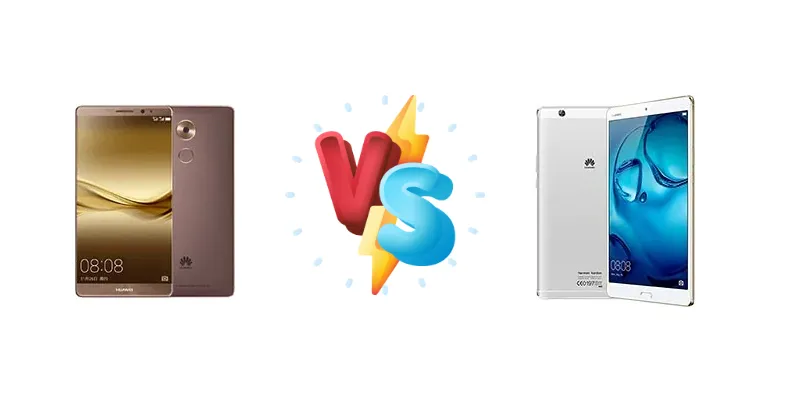
|
🏆 Quick Verdict
The Huawei Mate 8 is the clear winner for users prioritizing a full-fledged phone experience with a superior camera and exceptional battery life. The MediaPad M3 8.4 excels as a media consumption tablet, offering a pleasant display and portability, but lacks the Mate 8's overall versatility.
| PHONES | ||
|---|---|---|
| Phone Names | Huawei Mate 8 | Huawei MediaPad M3 8.4 |
| Network | ||
|---|---|---|
| 2G bands | GSM 850 / 900 / 1800 / 1900 - SIM 1 & SIM 2 (optional) | GSM 850 / 900 / 1800 / 1900 |
| 3G bands | HSDPA 800 / 850 / 900 / 1700(AWS) / 1900 / 2100 - NXT-L29, NXT-L09 | HSDPA 850 / 900 / 1900 / 2100 |
| 4G bands | 1, 2, 3, 4, 5, 6, 7, 8, 12, 17, 18, 19, 20, 26, 38, 39, 40 - NXT-L29 | 1, 3, 5, 7, 8, 19, 20, 28, 38, 39, 40, 41 |
| Speed | HSPA 42.2/5.76 Mbps, LTE (2CA) Cat6 300/50 Mbps | HSPA 42.2/5.76 Mbps, LTE (2CA) Cat6 300/50 Mbps |
| Technology | GSM / HSPA / LTE | GSM / HSPA / LTE |
| 1, 2, 3, 4, 5, 6, 7, 8, 12, 17, 18, 19, 20, 26, 28, 38, 39, 40 - NXT-L09 | - | |
| Launch | ||
|---|---|---|
| Announced | 2015, November. Released 2015, November | 2016, September. Released 2016, October |
| Status | Discontinued | Discontinued |
| Body | ||
|---|---|---|
| Build | Glass front (Gorilla Glass 3), aluminum back, aluminum frame | - |
| Dimensions | 157.1 x 80.6 x 7.9 mm (6.19 x 3.17 x 0.31 in) | 215.5 x 124.2 x 7.3 mm (8.48 x 4.89 x 0.29 in) |
| SIM | · Nano-SIM (NXT-L09)· Nano-SIM + Nano-SIM (NXT-L29) | Nano-SIM |
| Weight | 185 g (6.53 oz) | 326 g (11.50 oz) |
| Display | ||
|---|---|---|
| Protection | Corning Gorilla Glass 3 | - |
| Resolution | 1080 x 1920 pixels, 16:9 ratio (~368 ppi density) | 1600 x 2560 pixels, 16:10 ratio (~359 ppi density) |
| Size | 6.0 inches, 98.7 cm2 (~78.0% screen-to-body ratio) | 8.4 inches, 204.6 cm2 (~76.4% screen-to-body ratio) |
| Type | IPS-NEO LCD | IPS LCD |
| Platform | ||
|---|---|---|
| CPU | Octa-core (4x2.3 GHz Cortex-A72 & 4x1.8 GHz Cortex A53) | Octa-core (4x2.3 GHz Cortex-A72 & 4x1.8 GHz Cortex A53) |
| Chipset | Kirin 950 (16 nm) | Kirin 950 (16 nm) |
| GPU | Mali-T880 MP4 | Mali-T880 MP4 |
| OS | Android 6.0 (Marshmallow), upgradable to 7.0 (Nougat), EMUI 4 | Android 6.0 (Marshmallow), EMUI 4.1 |
| Memory | ||
|---|---|---|
| Card slot | microSDXC (uses shared SIM slot) | microSDXC (dedicated slot) |
| Internal | 32GB 3GB RAM, 64GB 4GB RAM, 128GB 4GB RAM | 32GB 4GB RAM, 64GB 4GB RAM |
| Main Camera | ||
|---|---|---|
| Features | Dual-LED dual-tone flash, panorama, HDR | HDR, panorama |
| Single | 16 MP, f/2.0, 27mm (wide), 1/2.8", PDAF, OIS | 8 MP, AF |
| Video | 1080p@60fps, 1080p@30fps, 720p@120fps | 1080p@30fps |
| Selfie camera | ||
|---|---|---|
| Single | 8 MP, f/2.4, 26mm (wide) | 8 MP |
| Video | 1080p@30fps | 1080p@30fps |
| Sound | ||
|---|---|---|
| 3.5mm jack | Yes | Yes |
| 35mm jack | Yes | Yes |
| Loudspeaker | Yes | Yes, with stereo speakers |
| 24-bit/192kHz audio | Tuned by Harman Kardon | |
| Comms | ||
|---|---|---|
| Bluetooth | 4.2, A2DP, EDR, LE | 4.1, A2DP, EDR, LE |
| NFC | Yes | No |
| Positioning | GPS, GLONASS, BDS | GPS, GLONASS/ BDS (market dependant) |
| Radio | FM radio | No |
| USB | microUSB 2.0, OTG | microUSB 2.0 |
| WLAN | Wi-Fi 802.11 a/b/g/n/ac, dual-band, DLNA, Wi-Fi Direct | Wi-Fi 802.11 a/b/g/n/ac |
| Features | ||
|---|---|---|
| Sensors | Fingerprint (rear-mounted), accelerometer, gyro, proximity, barometer, compass | Fingerprint (front-mounted), accelerometer, gyro, proximity, compass |
| Battery | ||
|---|---|---|
| Charging | 18W wired, 37% in 30 min | - |
| Music play | Up to 98 h | - |
| Stand-by | Up to 528 h (3G) | - |
| Type | Li-Po 4000 mAh, non-removable | Li-Po 5100 mAh, non-removable |
| Misc | ||
|---|---|---|
| Colors | Champagne Gold, Moonlight Silver, Space Gray, Mocha Brown | Silver, Gold |
| Models | NXT-AL10, NXT-CL00, NXT-DL00, NXT-TL00, NXT-L09, NXT-L29 | BTV-DL09, BTV-W09 |
| Price | About 300 EUR | About 280 EUR |
| SAR | 1.49 W/kg (head) 0.32 W/kg (body) | - |
| SAR EU | 1.46 W/kg (head) 0.21 W/kg (body) | - |
| Tests | ||
|---|---|---|
| Audio quality | Noise -97.8dB / Crosstalk -97.3dB | - |
| Battery life | Endurance rating 103h | - |
| Camera | Photo / Video | - |
| Display | Contrast ratio: 1361:1 (nominal), 2.949 (sunlight) | - |
| Loudspeaker | Voice 67dB / Noise 65dB / Ring 66dB | - |
| Performance | Basemark OS II 2.0: 2017Basemark X: 15593 | - |
Huawei Mate 8
- Exceptional battery life
- Powerful Kirin 950 chipset
- Excellent camera system
- Good display contrast
- Fast charging (18W)
- Design can feel dated
- Large size may not suit everyone
Huawei MediaPad M3 8.4
- Portable tablet form factor
- Good display for media consumption
- Decent performance for everyday tasks
- IPS display
- Weaker camera compared to Mate 8
- Shorter battery life
- Potential for thermal throttling
Display Comparison
The MediaPad M3 8.4 boasts an 8.4-inch IPS display, offering a larger canvas for media consumption. While the Mate 8 has a 6-inch display, both devices feature excellent contrast ratios (1361:1 nominal, 2.949 in sunlight for Mate 8). The MediaPad's larger size is its key advantage here.
Camera Comparison
The Mate 8 has a significant advantage in the camera department. It features a dual-lens rear camera system (12MP + 20MP) capable of capturing detailed photos and videos. The MediaPad M3 8.4's camera is adequate for casual snapshots but lacks the Mate 8's versatility and image quality.
Performance
Both devices share the Kirin 950 chipset and Octa-core CPU, suggesting similar performance in everyday tasks. However, the Mate 8's larger chassis allows for better thermal management, potentially sustaining peak performance for longer periods. The MediaPad M3 8.4 might throttle slightly under prolonged heavy load.
Battery Life
The Mate 8's battery life is legendary, achieving an endurance rating of 103 hours. This is a massive advantage over the MediaPad M3 8.4, which, while decent, doesn't come close to the Mate 8's longevity. The Mate 8's 18W fast charging is also a plus.
Buying Guide
The Huawei Mate 8 is ideal for users seeking a powerful, long-lasting smartphone with a good camera for everyday use. The Huawei MediaPad M3 8.4 is best suited for those wanting a portable tablet for watching videos, reading, and light gaming, prioritizing screen size over raw power.