
Huawei Mate 8 vs Mate 9: A Detailed Showdown
| Phones Images | |||||
|---|---|---|---|---|---|
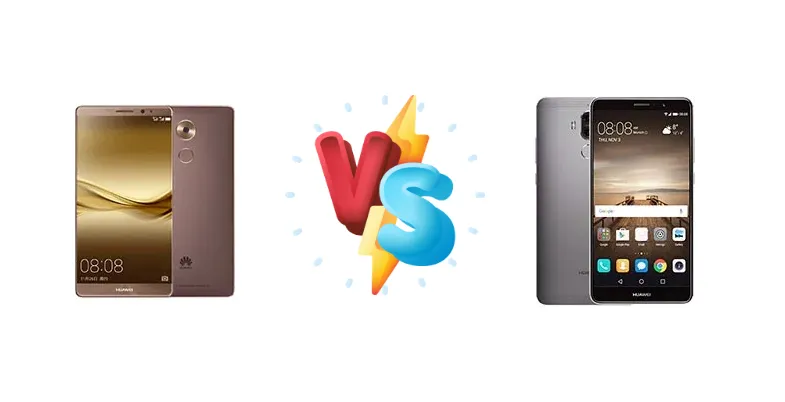
|
🏆 Quick Verdict
The Huawei Mate 9 edges out the Mate 8 thanks to its improved Kirin 960 chipset, brighter display, and slightly faster charging. While the Mate 8 boasts exceptional battery life, the Mate 9's overall performance and display enhancements make it the more compelling choice for most users.
| PHONES | ||
|---|---|---|
| Phone Names | Huawei Mate 8 | Huawei Mate 9 |
| Network | ||
|---|---|---|
| 2G bands | GSM 850 / 900 / 1800 / 1900 - SIM 1 & SIM 2 (optional) | GSM 850 / 900 / 1800 / 1900 - SIM 1 & SIM 2 (MHA-L29 model only) |
| 3G bands | HSDPA 800 / 850 / 900 / 1700(AWS) / 1900 / 2100 - NXT-L29, NXT-L09 | HSDPA 800 / 850 / 900 / 1700(AWS) / 1900 / 2100 - MHA-L29, MHA-L09 |
| 4G bands | 1, 2, 3, 4, 5, 6, 7, 8, 12, 17, 18, 19, 20, 26, 38, 39, 40 - NXT-L29 | 1, 2, 3, 4, 5, 7, 8, 9, 12, 17, 18, 19, 20, 26, 28, 29, 38, 39, 40, 41 - MHA-L29 |
| Speed | HSPA 42.2/5.76 Mbps, LTE (2CA) Cat6 300/50 Mbps | HSPA 42.2/5.76 Mbps, LTE (3CA) Cat12 600/150 Mbps |
| Technology | GSM / HSPA / LTE | GSM / CDMA / HSPA / EVDO / LTE |
| 1, 2, 3, 4, 5, 6, 7, 8, 12, 17, 18, 19, 20, 26, 28, 38, 39, 40 - NXT-L09 | 1, 2, 3, 4, 5, 7, 8, 9, 12, 17, 18, 19, 20, 26, 28, 29, 38, 39, 40 - MHA-L09 | |
| Launch | ||
|---|---|---|
| Announced | 2015, November. Released 2015, November | 2016, November. Released 2016, December |
| Status | Discontinued | Discontinued |
| Body | ||
|---|---|---|
| Build | Glass front (Gorilla Glass 3), aluminum back, aluminum frame | Glass front (Gorilla Glass 3), aluminum back, aluminum frame |
| Dimensions | 157.1 x 80.6 x 7.9 mm (6.19 x 3.17 x 0.31 in) | 156.9 x 78.9 x 7.9 mm (6.18 x 3.11 x 0.31 in) |
| SIM | · Nano-SIM (NXT-L09)· Nano-SIM + Nano-SIM (NXT-L29) | · Nano-SIM· Nano-SIM + Nano-SIM |
| Weight | 185 g (6.53 oz) | 190 g (6.70 oz) |
| Display | ||
|---|---|---|
| Protection | Corning Gorilla Glass 3 | Corning Gorilla Glass 3 |
| Resolution | 1080 x 1920 pixels, 16:9 ratio (~368 ppi density) | 1080 x 1920 pixels, 16:9 ratio (~373 ppi density) |
| Size | 6.0 inches, 98.7 cm2 (~78.0% screen-to-body ratio) | 5.9 inches, 96.0 cm2 (~77.5% screen-to-body ratio) |
| Type | IPS-NEO LCD | IPS LCD |
| Platform | ||
|---|---|---|
| CPU | Octa-core (4x2.3 GHz Cortex-A72 & 4x1.8 GHz Cortex A53) | Octa-core (4x2.4 GHz Cortex-A73 & 4x1.8 GHz Cortex-A53) |
| Chipset | Kirin 950 (16 nm) | Kirin 960 (16 nm) |
| GPU | Mali-T880 MP4 | Mali-G71 MP8 |
| OS | Android 6.0 (Marshmallow), upgradable to 7.0 (Nougat), EMUI 4 | Android 7.0 (Nougat), upgradable to Android 9.0 (Pie), EMUI 9.1 |
| Memory | ||
|---|---|---|
| Card slot | microSDXC (uses shared SIM slot) | microSDXC (uses shared SIM slot) - dual SIM model only |
| Internal | 32GB 3GB RAM, 64GB 4GB RAM, 128GB 4GB RAM | 32GB 4GB RAM, 64GB 4GB RAM |
| Main Camera | ||
|---|---|---|
| Dual | - | 12 MP, f/2.2, 27mm (wide), 1/2.9", 1.25µm, PDAF, OIS 20 MP B/W, f/2.2, 27mm (wide), 1/2.7" |
| Features | Dual-LED dual-tone flash, panorama, HDR | Laser AF, Leica optics, dual-LED dual-tone flash, panorama, HDR |
| Single | 16 MP, f/2.0, 27mm (wide), 1/2.8", PDAF, OIS | - |
| Video | 1080p@60fps, 1080p@30fps, 720p@120fps | 4K@30fps, 1080p@30/60fps |
| Selfie camera | ||
|---|---|---|
| Single | 8 MP, f/2.4, 26mm (wide) | 8 MP, f/1.9, 26mm (wide), 1/3.2", 1.4µm, AF |
| Video | 1080p@30fps | 1080p@30fps |
| Sound | ||
|---|---|---|
| 3.5mm jack | Yes | Yes |
| 35mm jack | Yes | Yes |
| Loudspeaker | Yes | Yes, with stereo speakers |
| 24-bit/192kHz audio | - | |
| Comms | ||
|---|---|---|
| Bluetooth | 4.2, A2DP, EDR, LE | 4.2, A2DP, EDR, LE |
| Infrared port | - | Yes |
| NFC | Yes | Yes |
| Positioning | GPS, GLONASS, BDS | GPS, GLONASS, BDS, GALILEO |
| Radio | FM radio | No |
| USB | microUSB 2.0, OTG | USB Type-C 2.0 |
| WLAN | Wi-Fi 802.11 a/b/g/n/ac, dual-band, DLNA, Wi-Fi Direct | Wi-Fi 802.11 a/b/g/n/ac, dual-band, DLNA, Wi-Fi Direct |
| Features | ||
|---|---|---|
| Sensors | Fingerprint (rear-mounted), accelerometer, gyro, proximity, barometer, compass | Fingerprint (rear-mounted), accelerometer, gyro, proximity, barometer, compass |
| Battery | ||
|---|---|---|
| Charging | 18W wired, 37% in 30 min | 22.5W wired |
| Music play | Up to 98 h | - |
| Stand-by | Up to 528 h (3G) | - |
| Type | Li-Po 4000 mAh, non-removable | Li-Po 4000 mAh, non-removable |
| Misc | ||
|---|---|---|
| Colors | Champagne Gold, Moonlight Silver, Space Gray, Mocha Brown | Agate Red, Topaz Blue, Space Gray, Moonlight Silver, Champagne Gold, Mocha Brown, Ceramic White, Black, Obsidian Black |
| Models | NXT-AL10, NXT-CL00, NXT-DL00, NXT-TL00, NXT-L09, NXT-L29 | MHA-L29, MHA-L09, MHA-AL00, MHA-TL00 |
| Price | About 300 EUR | About 320 EUR |
| SAR | 1.49 W/kg (head) 0.32 W/kg (body) | - |
| SAR EU | 1.46 W/kg (head) 0.21 W/kg (body) | - |
| Tests | ||
|---|---|---|
| Audio quality | Noise -97.8dB / Crosstalk -97.3dB | Noise -92.2dB / Crosstalk -93.3dB |
| Battery life | Endurance rating 103h | Endurance rating 82h |
| Camera | Photo / Video | Photo / Video |
| Display | Contrast ratio: 1361:1 (nominal), 2.949 (sunlight) | Contrast ratio: 1622 (nominal), 3.680 (sunlight) |
| Loudspeaker | Voice 67dB / Noise 65dB / Ring 66dB | Voice 83dB / Noise 74dB / Ring 85dB |
| Performance | Basemark OS II 2.0: 2017Basemark X: 15593 | Basemark OS II 2.0: 2637Basemark X: 36519 |
Huawei Mate 8
- Exceptional battery life
- Excellent value for money
- Good build quality
- Large display
- Older chipset
- Less bright display
- Slower charging
- Outdated software
Huawei Mate 9
- Improved performance (Kirin 960)
- Brighter and more readable display
- Faster charging
- Dual-lens Leica camera
- Slightly shorter battery life
- Potentially higher price (when new)
Display Comparison
The Mate 9 features a slightly improved display with a higher contrast ratio (1622:1 vs 1361:1) and significantly better sunlight readability (3.680 vs 2.949). Both phones utilize similar display technology (likely IPS LCD), but the Mate 9's enhancements provide a more enjoyable viewing experience, especially outdoors.
Camera Comparison
Both phones feature capable camera setups, but the Mate 9's camera benefits from software improvements and potentially a slightly upgraded sensor. The Mate 9 also introduced a dual-lens Leica camera system, offering improved depth of field effects and low-light performance compared to the Mate 8. Image quality is generally better on the Mate 9.
Performance
The Kirin 960 in the Mate 9 represents a significant performance leap over the Kirin 950 in the Mate 8. The Cortex-A73 cores in the 960 offer improved efficiency and raw power, resulting in smoother multitasking, faster app loading times, and better gaming performance. While both phones handle everyday tasks well, the Mate 9 feels noticeably snappier.
Battery Life
The Mate 8 holds a slight advantage in battery endurance, boasting an impressive 103h rating compared to the Mate 9's 82h. However, the Mate 9's faster 22.5W charging partially offsets this difference, allowing for quicker top-ups.
Buying Guide
The Huawei Mate 8 is a good option for users prioritizing extreme battery life and a budget-friendly price. The Huawei Mate 9 is ideal for those seeking better performance, a brighter display, and a more modern camera experience, even if it means sacrificing a bit of battery endurance.