
Huawei Mate 70 vs. Xiaomi 14 Pro: A Head-to-Head Flagship Battle
| Phones Images | |||||
|---|---|---|---|---|---|
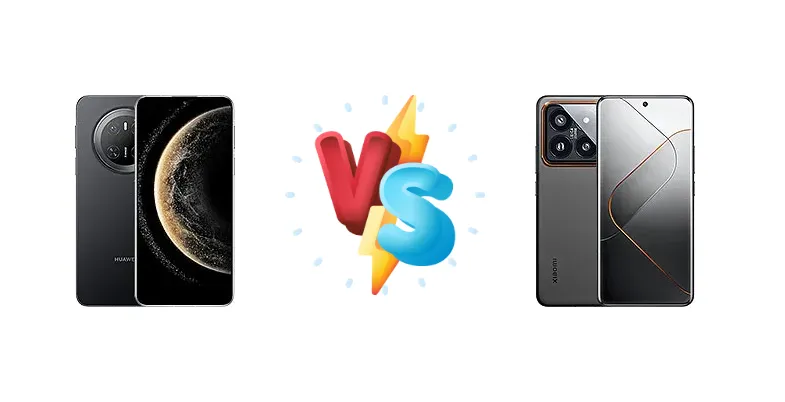
|
🏆 Quick Verdict
For the average user prioritizing peak performance and charging speed, the Xiaomi 14 Pro is the clear winner. Its Snapdragon 8 Gen 3 chipset and 120W charging significantly outperform the Mate 70’s Kirin 9020 and 66W charging. However, the Mate 70 may appeal to users within the Huawei ecosystem or those seeking a potentially more unique software experience.
| PHONES | ||
|---|---|---|
| Phone Names | Huawei Mate 70 | Xiaomi 14 Pro |
| Network | ||
|---|---|---|
| 2G bands | GSM 850 / 900 / 1800 / 1900 | GSM 850 / 900 / 1800 / 1900 |
| 3G bands | HSDPA 800 / 850 / 900 / 1700(AWS) / 1900 / 2100 | HSDPA 800 / 850 / 900 / 1700(AWS) / 1900 / 2100 |
| 4G bands | LTE | 1, 3, 4, 5, 7, 8, 18, 19, 26, 28, 34, 38, 39, 40, 41, 42, 48, 66 |
| 5G bands | SA/NSA | 1, 3, 5, 7, 8, 28, 38, 40, 41, 48, 66, 77, 78, 79 SA/NSA |
| Speed | HSPA, LTE, 5G | HSPA, LTE, 5G |
| Technology | GSM / CDMA / HSPA / CDMA2000 / LTE / 5G | GSM / CDMA / HSPA / CDMA2000 / LTE / 5G |
| Launch | ||
|---|---|---|
| Announced | 2024, November 26 | 2023, October 26 |
| Status | Available. Released 2024, November 26 | Available. Released 2023, November 01 |
| Body | ||
|---|---|---|
| Build | Glass front, aluminum alloy frame | Glass front, aluminum frame or titanium frame, glass back |
| Dimensions | 160.9 x 75.9 x 7.8 mm (6.33 x 2.99 x 0.31 in) | 161.4 x 75.3 x 8.5 mm |
| SIM | Nano-SIM + Nano-SIM | Nano-SIM + Nano-SIM |
| Weight | 203 g (7.16 oz) | 223 g or 230 g (7.87 oz) |
| Display | ||
|---|---|---|
| Protection | Huawei Kunlun Glass 2 | Shatterproof glass |
| Resolution | 1216 x 2688 pixels (~440 ppi density) | 1440 x 3200 pixels, 20:9 ratio (~522 ppi density) |
| Size | 6.7 inches, 108.8 cm2 (~89.1% screen-to-body ratio) | 6.73 inches, 108.9 cm2 (~89.6% screen-to-body ratio) |
| Type | LTPO OLED, 1B colors, 120Hz, 2500 nits (peak) | LTPO AMOLED, 68B colors, 120Hz, Dolby Vision, HDR10+, 3000 nits (peak) |
| Platform | ||
|---|---|---|
| CPU | Octa-core (1x2.5 GHz & 3x2.15 GHz & 4x1.6 GHz) | Octa-core (1x3.3 GHz Cortex-X4 & 3x3.2 GHz Cortex-A720 & 2x3.0 GHz Cortex-A720 & 2x2.3 GHz Cortex-A520) |
| Chipset | Kirin 9020 (7 nm) | Qualcomm SM8650-AB Snapdragon 8 Gen 3 (4 nm) |
| GPU | Maleoon 920 | Adreno 750 |
| OS | HarmonyOS 4.3 | Android 14, HyperOS |
| Memory | ||
|---|---|---|
| Card slot | No | No |
| Internal | 256GB 12GB RAM, 512GB 12GB RAM, 1TB 12GB RAM | 256GB 12GB RAM, 512GB 16GB RAM, 1TB 16GB RAM |
| Main Camera | ||
|---|---|---|
| Features | Laser AF, color spectrum sensor, LED flash, panorama, HDR | Laser AF, color spectrum sensor, Leica lens, Dual-LED dual-tone flash, HDR, panorama |
| Triple | 50 MP, f/1.4-f/4.0, 24mm (wide), PDAF, OIS 12 MP, f/3.4, 125mm (periscope telephoto), PDAF, OIS, 5x optical zoom 40 MP, f/2.2, 13mm, 120˚ (ultrawide), PDAF | 50 MP, f/1.4-f/4.0, 23mm (wide), 1/1.31", 1.2µm, dual pixel PDAF, OIS 50 MP, f/2.0, 75mm (telephoto), PDAF (10cm - ∞), OIS, 3.2x optical zoom 50 MP, f/2.2, 14mm, 115˚ (ultrawide), AF |
| Video | 4K, 1080p, HDR, gyro-EIS, OIS | 8K@24fps (HDR), 4K@24/30/60fps (HDR10+, 10-bit Dolby Vision HDR, 10-bit LOG), 1080p@30/60/120/240/960fps, 720p@1920fps, gyro-EIS |
| Selfie camera | ||
|---|---|---|
| Features | HDR, panorama | HDR, panorama |
| Single | 13 MP, f/2.4, 18mm (ultrawide) | 32 MP, f/2.0, 22mm (wide), 0.7µm |
| Video | 4K, 1080p | 4K@30/60fps, 1080p@30/60fps, gyro-EIS |
| Sound | ||
|---|---|---|
| 35mm jack | No | No |
| Loudspeaker | Yes, with stereo speakers | Yes, with stereo speakers |
| Comms | ||
|---|---|---|
| Bluetooth | 5.2, A2DP, LE, L2HC | 5.4, A2DP, LE, aptX HD, aptX Adaptive |
| Infrared port | Yes | Yes |
| NFC | Yes | Yes |
| Positioning | GPS (L1+L5), GLONASS (L1), BDS (B1I+B1c+B2a+B2b), GALILEO (E1+E5a+E5b), QZSS (L1+L5), NavIC | GPS (L1+L5), GLONASS (G1), BDS (B1I+B1c+B2a), GALILEO (E1+E5a), QZSS (L1+L5), NavIC (L5) |
| Radio | No | No |
| USB | USB Type-C 3.1, OTG, DisplayPort 1.2 | USB Type-C 3.2 Gen 2, OTG |
| WLAN | Wi-Fi 802.11 a/b/g/n/ac/6/7, dual-band, Wi-Fi Direct | Wi-Fi 802.11 a/b/g/n/ac/6e/7, dual-band, Wi-Fi Direct |
| Features | ||
|---|---|---|
| Sensors | Fingerprint (side-mounted), accelerometer, gyro, proximity, compass | Fingerprint (under display, optical), accelerometer, proximity, gyro, compass, barometer |
| Battery | ||
|---|---|---|
| Charging | 66W wired 50W wireless 7.5W reverse wireless 5W reverse wired | 120W wired, PD3.0, QC4, 100% in 18 min 50W wireless, 100% in 40 min 10W reverse wireless |
| Type | 5300 mAh | Li-Po 4880 mAh |
| Misc | ||
|---|---|---|
| Colors | Black, Purple, White, Green | Black, Silver, Titanium, Green |
| Models | CLS-AL00 | 23116PN5BC |
| Price | About 720 EUR | About 650 EUR |
Huawei Mate 70
- Potentially unique software experience within the Huawei ecosystem.
- Good balance of performance and battery life.
- 50W wireless charging and reverse charging options.
- Older 7nm chipset compared to the Snapdragon 8 Gen 3.
- Slower 66W wired charging.
- Potential app compatibility issues due to geopolitical restrictions.
Xiaomi 14 Pro
- Industry-leading Snapdragon 8 Gen 3 performance.
- Ultra-fast 120W wired charging (18 minutes to full).
- More open Android experience with wider app compatibility.
- May experience more thermal throttling under sustained load (requires further testing).
- Potentially less refined software experience compared to Huawei.
- Higher price point (likely).
Display Comparison
While both devices are expected to feature high-quality OLED displays, specific details like peak brightness and refresh rates are not provided. However, the Xiaomi 14 Pro, being a newer device, likely benefits from advancements in panel technology. The absence of LTPO information for the Mate 70 suggests it may not offer the same adaptive refresh rate efficiency as the Xiaomi 14 Pro, potentially impacting battery life during dynamic content viewing. Bezels are expected to be minimal on both, but Xiaomi typically prioritizes maximizing screen-to-body ratio.
Camera Comparison
Without detailed camera specifications, a direct comparison is challenging. However, Xiaomi’s flagship phones consistently prioritize camera innovation, often featuring large sensors and advanced image processing algorithms. The Xiaomi 14 Pro is likely to feature a larger main sensor and more sophisticated optical image stabilization (OIS) than the Mate 70. While Huawei is known for its computational photography prowess, the Snapdragon 8 Gen 3’s ISP (Image Signal Processor) offers significant improvements in image processing speed and quality. The absence of information regarding the Mate 70’s camera sensor size and aperture makes it difficult to assess its low-light performance relative to the Xiaomi 14 Pro.
Performance
The core difference lies in the chipsets. The Xiaomi 14 Pro’s Snapdragon 8 Gen 3 (4nm) boasts a significantly higher peak CPU clock speed (3.3 GHz Cortex-X4) compared to the Huawei Mate 70’s Kirin 9020 (7nm). This, combined with the more efficient 4nm process node, translates to superior performance and thermal efficiency for the Xiaomi device. The Snapdragon’s architecture – featuring Cortex-A720 and A520 cores – is also more modern, offering improvements in both single-core and multi-core tasks. The Mate 70’s Kirin 9020, while capable, will likely struggle to match the raw processing power of the Snapdragon, especially in demanding applications like gaming and video editing. The Xiaomi 14 Pro’s LPDDR5x RAM further enhances its performance advantage.
Battery Life
The Xiaomi 14 Pro’s 120W wired charging is a game-changer, promising a full charge in just 18 minutes. This is significantly faster than the Mate 70’s 66W charging. While the Mate 70 offers 50W wireless charging, matching the Xiaomi 14 Pro, the faster wired charging is a major advantage for users who frequently need to top up their battery quickly. The 10W reverse wired charging on the Mate 70 is slower than the Xiaomi 14 Pro’s, but both offer convenient reverse wireless charging capabilities. The actual battery life will depend on the mAh capacity of each device, which is currently unknown, but the Xiaomi 14 Pro’s more efficient chipset could offset a potentially smaller battery.
Buying Guide
Buy the Huawei Mate 70 if you prioritize a potentially more refined software experience within the Huawei ecosystem and value a balanced approach to performance and battery life. Buy the Xiaomi 14 Pro if you demand the absolute fastest performance, the quickest charging speeds, and a more open Android experience with broader app compatibility.