
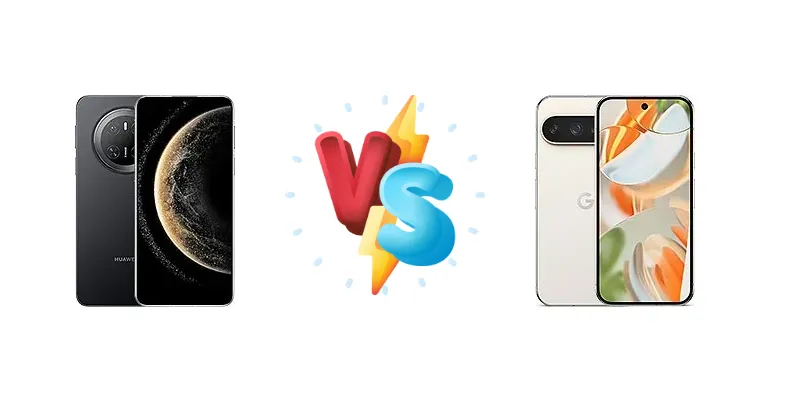
Huawei Mate 70 vs Google Pixel 9 Pro: A Head-to-Head Flagship Showdown
| Phones Images | |||||
|---|---|---|---|---|---|
|
🏆 Quick Verdict
For the average user prioritizing long-term software support and AI-powered features, the Google Pixel 9 Pro is the better choice. Its Tensor G4 chip, coupled with exceptional battery endurance and a brighter display, offers a smoother, more integrated experience. However, the Mate 70’s faster charging and potentially more efficient chipset appeal to power users.
| PHONES | ||
|---|---|---|
| Phone Names | Huawei Mate 70 | Google Pixel 9 Pro |
| Network | ||
|---|---|---|
| 2G bands | GSM 850 / 900 / 1800 / 1900 | GSM 850 / 900 / 1800 / 1900 |
| 3G bands | HSDPA 800 / 850 / 900 / 1700(AWS) / 1900 / 2100 | HSDPA 800 / 850 / 900 / 1700(AWS) / 1900 / 2100 |
| 4G bands | LTE | 1, 2, 3, 4, 5, 7, 8, 12, 13, 14, 17, 18, 19, 20, 25, 26, 28, 29, 30, 38, 40, 41, 48, 66, 71 - GR83Y |
| 5G bands | SA/NSA | 1, 2, 3, 5, 7, 8, 12, 14, 20, 25, 26, 28, 29, 30, 38, 40, 41, 48, 66, 70, 71, 77, 78, 258, 260, 261 SA/NSA/Sub6/mmWave - GR83Y |
| Speed | HSPA, LTE, 5G | HSPA, LTE, 5G |
| Technology | GSM / CDMA / HSPA / CDMA2000 / LTE / 5G | GSM / HSPA / LTE / 5G |
| Launch | ||
|---|---|---|
| Announced | 2024, November 26 | 2024, August 13 |
| Status | Available. Released 2024, November 26 | Available. Released 2024, September 09 |
| Body | ||
|---|---|---|
| Build | Glass front, aluminum alloy frame | Glass front (Gorilla Glass Victus 2), glass back (Gorilla Glass Victus 2), aluminum frame |
| Dimensions | 160.9 x 75.9 x 7.8 mm (6.33 x 2.99 x 0.31 in) | 152.8 x 72 x 8.5 mm (6.02 x 2.83 x 0.33 in) |
| SIM | Nano-SIM + Nano-SIM | Nano-SIM + eSIM |
| Weight | 203 g (7.16 oz) | 199 g (7.02 oz) |
| Display | ||
|---|---|---|
| Protection | Huawei Kunlun Glass 2 | Corning Gorilla Glass Victus 2, Mohs level 4 |
| Resolution | 1216 x 2688 pixels (~440 ppi density) | 1280 x 2856 pixels, 20:9 ratio (~495 ppi density) |
| Size | 6.7 inches, 108.8 cm2 (~89.1% screen-to-body ratio) | 6.3 inches, 96.3 cm2 (~87.6% screen-to-body ratio) |
| Type | LTPO OLED, 1B colors, 120Hz, 2500 nits (peak) | LTPO OLED, 120Hz, HDR10+, 2000 nits (HBM), 3000 nits (peak) |
| Platform | ||
|---|---|---|
| CPU | Octa-core (1x2.5 GHz & 3x2.15 GHz & 4x1.6 GHz) | Octa-core (1x3.1 GHz Cortex-X4 & 3x2.6 GHz Cortex-A720 & 4x1.92 GHz Cortex-A520) |
| Chipset | Kirin 9020 (7 nm) | Google Tensor G4 (4 nm) |
| GPU | Maleoon 920 | Mali-G715 MC7 |
| OS | HarmonyOS 4.3 | Android 14, upgradable to Android 16, up to 7 major Android upgrades |
| Memory | ||
|---|---|---|
| Card slot | No | No |
| Internal | 256GB 12GB RAM, 512GB 12GB RAM, 1TB 12GB RAM | 128GB 16GB RAM, 256GB 16GB RAM, 512GB 16GB RAM, 1TB 16GB RAM |
| Main Camera | ||
|---|---|---|
| Features | Laser AF, color spectrum sensor, LED flash, panorama, HDR | Multi-zone Laser AF, LED flash, Pixel Shift, Ultra-HDR, panorama, Best Take, Zoom Enhance |
| Triple | 50 MP, f/1.4-f/4.0, 24mm (wide), PDAF, OIS 12 MP, f/3.4, 125mm (periscope telephoto), PDAF, OIS, 5x optical zoom 40 MP, f/2.2, 13mm, 120˚ (ultrawide), PDAF | 50 MP, f/1.7, 25mm (wide), 1/1.31", 1.2µm, dual pixel PDAF, OIS 48 MP, f/2.8, 113mm (periscope telephoto), 1/2.55", dual pixel PDAF, OIS, 5x optical zoom 48 MP, f/1.7, 123˚ (ultrawide), 1/2.55", dual pixel PDAF |
| Video | 4K, 1080p, HDR, gyro-EIS, OIS | 8K@30fps (via cloud-based upscaling), 4K@24/30/60fps, 1080p@24/30/60/120/240fps; gyro-EIS, OIS, 10-bit HDR |
| Selfie camera | ||
|---|---|---|
| Features | HDR, panorama | HDR, panorama |
| Single | 13 MP, f/2.4, 18mm (ultrawide) | 42 MP, f/2.2, 17mm (ultrawide), PDAF |
| Video | 4K, 1080p | 4K@30/60fps, 1080p@30/60fps |
| Sound | ||
|---|---|---|
| 35mm jack | No | No |
| Loudspeaker | Yes, with stereo speakers | Yes, with stereo speakers |
| Comms | ||
|---|---|---|
| Bluetooth | 5.2, A2DP, LE, L2HC | 5.3, A2DP, LE, aptX HD |
| Infrared port | Yes | - |
| NFC | Yes | Yes |
| Positioning | GPS (L1+L5), GLONASS (L1), BDS (B1I+B1c+B2a+B2b), GALILEO (E1+E5a+E5b), QZSS (L1+L5), NavIC | GPS (L1+L5), GLONASS, GALILEO, BDS, QZSS, NavIC |
| Radio | No | No |
| USB | USB Type-C 3.1, OTG, DisplayPort 1.2 | USB Type-C 3.2 |
| WLAN | Wi-Fi 802.11 a/b/g/n/ac/6/7, dual-band, Wi-Fi Direct | Wi-Fi 802.11 a/b/g/n/ac/6e/7, tri-band |
| Features | ||
|---|---|---|
| Sensors | Fingerprint (side-mounted), accelerometer, gyro, proximity, compass | Fingerprint (under display, ultrasonic), accelerometer, gyro, proximity, compass, barometer, thermometer (skin temperature) |
| Battery | ||
|---|---|---|
| Charging | 66W wired 50W wireless 7.5W reverse wireless 5W reverse wired | 27W wired, PD3.0, PPS, 55% in 30 min 21W wireless (w/ Pixel Stand) 12W wireless (w/ Qi compatible charger) Reverse wireless Bypass charging |
| Type | 5300 mAh | Li-Ion 4700 mAh |
| Misc | ||
|---|---|---|
| Colors | Black, Purple, White, Green | Porcelain, Rose Quartz, Hazel, Obsidian |
| Models | CLS-AL00 | GR83Y, GEC77, GWVK6 |
| Price | About 720 EUR | $ 458.13 / C$ 796.95 / £ 593.99 / € 499.99 / ₹ 88,900 |
| SAR EU | - | 0.99 W/kg (head) 1.37 W/kg (body) |
| EU LABEL | ||
|---|---|---|
| Battery | - | 50:44h endurance, 1000 cycles |
| Energy | - | Class A |
| Free fall | - | Class A (270 falls) |
| Repairability | - | Class C |
Huawei Mate 70
- Significantly faster wired and wireless charging.
- Potentially more power-efficient chipset (7nm vs 4nm).
- Huawei’s ecosystem integration (for existing users).
- Software support and updates are uncertain.
- Camera performance is unknown without detailed specs.
Google Pixel 9 Pro
- Exceptional battery life and longevity.
- AI-powered features and software experience.
- Brighter display for outdoor visibility.
- Slower charging speeds compared to the Mate 70.
- Tensor G4 may throttle under sustained heavy loads.
Display Comparison
The Google Pixel 9 Pro boasts a significantly brighter display, peaking at 2331 nits, making it far more usable in direct sunlight compared to the Mate 70 (brightness unspecified). While the Mate 70’s panel technology isn’t detailed, the Pixel 9 Pro likely utilizes LTPO for adaptive refresh rates, conserving battery life. The Pixel 9 Pro’s superior brightness is a clear advantage for outdoor visibility and HDR content consumption.
Camera Comparison
Without detailed camera specs for the Mate 70, a direct comparison is limited. However, the Pixel 9 Pro’s image processing, driven by the Tensor G4’s AI capabilities, is a key strength. Google’s computational photography excels in dynamic range and low-light performance. The Pixel 9 Pro’s focus on software optimization likely delivers consistently high-quality images, even without relying on massive sensor sizes. The Mate 70 will need to demonstrate significant hardware advantages to compete.
Performance
The core architectural difference lies in the chipsets: Huawei’s Kirin 9020 (7nm) versus Google’s Tensor G4 (4nm). The Tensor G4’s 4nm process offers inherent thermal efficiency advantages, potentially leading to less throttling under sustained loads. The Tensor G4’s Cortex-X4 prime core, clocked at 3.1 GHz, is a performance powerhouse, exceeding the Kirin 9020’s 2.5 GHz peak. However, the Kirin 9020’s octa-core configuration might offer better multi-core performance in certain tasks. The Pixel 9 Pro’s LPDDR5x RAM further enhances memory bandwidth, contributing to a snappier overall experience.
Battery Life
The Pixel 9 Pro’s battery endurance is a standout feature, achieving a measured 50:44h endurance and 13:11h of active use. While the Mate 70’s battery capacity is unknown, its charging speeds are significantly faster: 66W wired and 50W wireless, compared to the Pixel 9 Pro’s 27W wired and 21W wireless (with Pixel Stand). The Mate 70 can reach 55% charge in 30 minutes, while the Pixel 9 Pro takes longer. The Pixel 9 Pro’s 1000-cycle battery longevity suggests a focus on long-term battery health.
Buying Guide
Buy the Huawei Mate 70 if you need blazing-fast charging speeds (66W wired, 50W wireless) and value a potentially more power-efficient chipset for extended use. Buy the Google Pixel 9 Pro if you prefer a seamless software experience, cutting-edge AI features, and exceptional battery life backed by Google’s long-term support commitment.