
Huawei Mate 70 Pro vs Xiaomi 14 Pro: A Head-to-Head Flagship Battle
| Phones Images | |||||
|---|---|---|---|---|---|
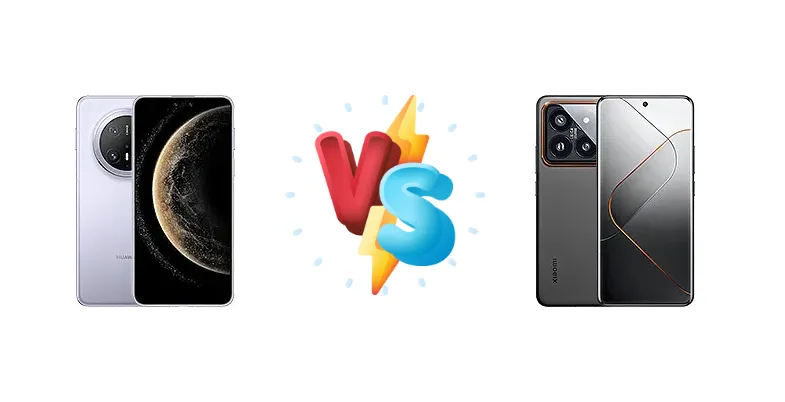
|
🏆 Quick Verdict
For the average user prioritizing raw speed and charging convenience, the Xiaomi 14 Pro is the clear winner. Its Snapdragon 8 Gen 3 chipset offers a significant performance advantage, coupled with the industry-leading 120W wired charging. However, the Mate 70 Pro’s unique software experience and robust wireless charging capabilities make it a compelling alternative for Huawei loyalists.
| PHONES | ||
|---|---|---|
| Phone Names | Huawei Mate 70 Pro | Xiaomi 14 Pro |
| Network | ||
|---|---|---|
| 2G bands | GSM 850 / 900 / 1800 / 1900 | GSM 850 / 900 / 1800 / 1900 |
| 3G bands | HSDPA 800 / 850 / 900 / 1700(AWS) / 1900 / 2100 | HSDPA 800 / 850 / 900 / 1700(AWS) / 1900 / 2100 |
| 4G bands | LTE | 1, 3, 4, 5, 7, 8, 18, 19, 26, 28, 34, 38, 39, 40, 41, 42, 48, 66 |
| 5G bands | SA/NSA | 1, 3, 5, 7, 8, 28, 38, 40, 41, 48, 66, 77, 78, 79 SA/NSA |
| Speed | HSPA, LTE, 5G | HSPA, LTE, 5G |
| Technology | GSM / CDMA / HSPA / CDMA2000 / LTE / 5G | GSM / CDMA / HSPA / CDMA2000 / LTE / 5G |
| Launch | ||
|---|---|---|
| Announced | 2024, November 26 | 2023, October 26 |
| Status | Available. Released 2024, November 26 | Available. Released 2023, November 01 |
| Body | ||
|---|---|---|
| Build | Glass front, aluminum alloy frame | Glass front, aluminum frame or titanium frame, glass back |
| Dimensions | 164.6 x 79.5 x 8.2 mm (6.48 x 3.13 x 0.32 in) | 161.4 x 75.3 x 8.5 mm |
| SIM | Nano-SIM + Nano-SIM | Nano-SIM + Nano-SIM |
| Weight | 221 g (7.80 oz) | 223 g or 230 g (7.87 oz) |
| Display | ||
|---|---|---|
| Protection | Huawei Kunlun Glass 2 | Shatterproof glass |
| Resolution | 1316 x 2832 pixels, 19.5:9 ratio (~453 ppi density) | 1440 x 3200 pixels, 20:9 ratio (~522 ppi density) |
| Size | 6.9 inches, 117.4 cm2 (~89.7% screen-to-body ratio) | 6.73 inches, 108.9 cm2 (~89.6% screen-to-body ratio) |
| Type | LTPO OLED, 1B colors, 120Hz, 2500 nits (peak) | LTPO AMOLED, 68B colors, 120Hz, Dolby Vision, HDR10+, 3000 nits (peak) |
| Platform | ||
|---|---|---|
| CPU | Octa-core (1x2.5 GHz & 3x2.15 GHz & 4x1.6 GHz) - PLR-AL00Octa-core (1x2.4 GHz & 3x2.0 GHz & 4x1.6 GHz) - PLR-AL50 | Octa-core (1x3.3 GHz Cortex-X4 & 3x3.2 GHz Cortex-A720 & 2x3.0 GHz Cortex-A720 & 2x2.3 GHz Cortex-A520) |
| Chipset | Kirin 9020 (7 nm) | Qualcomm SM8650-AB Snapdragon 8 Gen 3 (4 nm) |
| GPU | Maleoon 920 | Adreno 750 |
| OS | HarmonyOS 4.3 | Android 14, HyperOS |
| Memory | ||
|---|---|---|
| Card slot | No | No |
| Internal | 256GB 12GB RAM, 512GB 12GB RAM, 512GB 16GB RAM, 1TB 12GB RAM | 256GB 12GB RAM, 512GB 16GB RAM, 1TB 16GB RAM |
| Main Camera | ||
|---|---|---|
| Features | Laser AF, color spectrum sensor, LED flash, panorama, HDR | Laser AF, color spectrum sensor, Leica lens, Dual-LED dual-tone flash, HDR, panorama |
| Triple | 50 MP, f/1.4-f/4.0, 24mm (wide), PDAF, OIS 48 MP, f/2.1, 93mm (periscope telephoto), PDAF, OIS, 3.5x optical zoom 40 MP, f/2.2, 13mm, 120˚ (ultrawide), PDAF | 50 MP, f/1.4-f/4.0, 23mm (wide), 1/1.31", 1.2µm, dual pixel PDAF, OIS 50 MP, f/2.0, 75mm (telephoto), PDAF (10cm - ∞), OIS, 3.2x optical zoom 50 MP, f/2.2, 14mm, 115˚ (ultrawide), AF |
| Video | 4K, 1080p, HDR, gyro-EIS, OIS | 8K@24fps (HDR), 4K@24/30/60fps (HDR10+, 10-bit Dolby Vision HDR, 10-bit LOG), 1080p@30/60/120/240/960fps, 720p@1920fps, gyro-EIS |
| Selfie camera | ||
|---|---|---|
| Features | HDR, panorama | HDR, panorama |
| Single | 13 MP, f/2.4, 18mm (ultrawide) TOF 3D, (depth/biometrics sensor) | 32 MP, f/2.0, 22mm (wide), 0.7µm |
| Video | 4K, 1080p, HDR, gyro-EIS | 4K@30/60fps, 1080p@30/60fps, gyro-EIS |
| Sound | ||
|---|---|---|
| 35mm jack | No | No |
| Loudspeaker | Yes, with stereo speakers | Yes, with stereo speakers |
| Comms | ||
|---|---|---|
| Bluetooth | 5.2, A2DP, LE, L2HC | 5.4, A2DP, LE, aptX HD, aptX Adaptive |
| Infrared port | Yes | Yes |
| NFC | Yes | Yes |
| Positioning | GPS (L1+L5), GLONASS (L1), BDS (B1I+B1c+B2a+B2b), GALILEO (E1+E5a+E5b), QZSS (L1+L5), NavIC | GPS (L1+L5), GLONASS (G1), BDS (B1I+B1c+B2a), GALILEO (E1+E5a), QZSS (L1+L5), NavIC (L5) |
| Radio | No | No |
| USB | USB Type-C 3.1, OTG, DisplayPort 1.2 | USB Type-C 3.2 Gen 2, OTG |
| WLAN | Wi-Fi 802.11 a/b/g/n/ac/6/7, dual-band, Wi-Fi Direct | Wi-Fi 802.11 a/b/g/n/ac/6e/7, dual-band, Wi-Fi Direct |
| Features | ||
|---|---|---|
| Sensors | Face ID, fingerprint (side-mounted), accelerometer, gyro, proximity, barometer, compass | Fingerprint (under display, optical), accelerometer, proximity, gyro, compass, barometer |
| Battery | ||
|---|---|---|
| Charging | 100W wired 80W wireless 20W reverse wireless 18W reverse wired | 120W wired, PD3.0, QC4, 100% in 18 min 50W wireless, 100% in 40 min 10W reverse wireless |
| Type | 5500 mAh | Li-Po 4880 mAh |
| Misc | ||
|---|---|---|
| Colors | Black, Purple, White, Green | Black, Silver, Titanium, Green |
| Models | PLR-AL00, PLR-AL50 | 23116PN5BC |
| Price | About 860 EUR | About 650 EUR |
Huawei Mate 70 Pro
- Robust 80W wireless charging
- Comprehensive reverse wireless charging (20W)
- Potentially unique software features and ecosystem
- Huawei's established camera processing style
- Older 7nm chipset (Kirin 9020)
- Potential app compatibility issues
- Slower wired charging (100W)
- Less globally accessible software updates
Xiaomi 14 Pro
- Cutting-edge Snapdragon 8 Gen 3 (4nm)
- Industry-leading 120W wired charging
- Faster LPDDR5x RAM
- Globally accessible software and updates
- Wireless charging slower than Mate 70 Pro (50W)
- Reverse wireless charging limited to 10W
- May lack unique software features of Huawei
- Potential for aggressive thermal throttling under sustained load
Display Comparison
While both devices are expected to feature high-quality OLED displays, specific details like peak brightness and refresh rates are not provided. However, the focus should be on the underlying panel technology. The Xiaomi 14 Pro, being a newer device, likely benefits from advancements in LTPO technology, potentially offering more dynamic refresh rate scaling for improved power efficiency. The Mate 70 Pro, while likely excellent, may not reach the same level of efficiency. Bezels are expected to be minimal on both, but Xiaomi often prioritizes maximizing screen real estate.
Camera Comparison
Without detailed camera specs, a direct comparison is challenging. However, the market positioning suggests both phones will feature advanced camera systems. The Xiaomi 14 Pro is likely to emphasize computational photography and image processing capabilities leveraging the Snapdragon’s ISP. The Mate 70 Pro, historically, has focused on color science and dynamic range. Sensor size is a critical factor; a larger sensor generally captures more light and detail. The absence of information on sensor sizes necessitates speculation, but Xiaomi’s recent flagships have consistently featured large sensors. The 2MP macro cameras often found on both brands are largely marketing features and offer limited practical benefit.
Performance
The core difference lies in the chipsets. The Xiaomi 14 Pro’s Snapdragon 8 Gen 3 (4nm) boasts a significantly more advanced manufacturing process than the Huawei Mate 70 Pro’s Kirin 9020 (7nm). This translates to greater transistor density, improved power efficiency, and higher peak performance. The Snapdragon 8 Gen 3’s CPU configuration – 1x3.3 GHz Cortex-X4, 3x3.2 GHz Cortex-A720, 2x3.0 GHz Cortex-A720, and 2x2.3 GHz Cortex-A520 – is architecturally superior to the Kirin 9020’s octa-core setup. The Snapdragon’s Cortex-X4 prime core provides a substantial performance boost in demanding tasks. The Xiaomi 14 Pro also benefits from faster LPDDR5x RAM, further enhancing responsiveness. Thermal management will be crucial; the 4nm process of the Snapdragon should allow for sustained performance with less throttling compared to the 7nm Kirin.
Battery Life
The Xiaomi 14 Pro’s 120W wired charging is a game-changer, promising a full charge in just 18 minutes. This significantly outperforms the Mate 70 Pro’s 100W wired charging. While the Mate 70 Pro offers a more comprehensive wireless charging solution with 80W wireless and 20W reverse wireless, the Xiaomi 14 Pro’s 50W wireless charging is still competitive, reaching 100% in 40 minutes. Battery capacity isn’t specified, but the Snapdragon 8 Gen 3’s efficiency could allow the Xiaomi 14 Pro to achieve comparable battery life with a slightly smaller battery pack.
Buying Guide
Buy the Huawei Mate 70 Pro if you prioritize a unique software ecosystem, robust wireless charging (80W), and are comfortable with potential limitations in app availability due to the ongoing restrictions. Buy the Xiaomi 14 Pro if you demand the absolute fastest performance, the quickest wired charging (120W), and a more globally accessible software experience with guaranteed updates.