
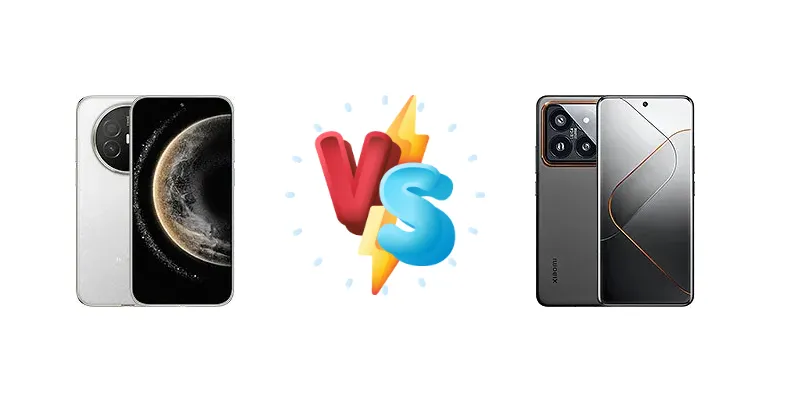
Huawei Mate 70 Air vs. Xiaomi 14 Pro: A Head-to-Head Flagship Battle
| Phones Images | |||||
|---|---|---|---|---|---|
|
🏆 Quick Verdict
For the average user prioritizing raw performance and charging speed, the Xiaomi 14 Pro is the clear winner. Its Snapdragon 8 Gen 3 chipset and 120W charging significantly outperform the Mate 70 Air’s Kirin 9020A and 66W charging. However, Huawei’s software experience and potential camera optimizations may appeal to specific users.
| PHONES | ||
|---|---|---|
| Phone Names | Huawei Mate 70 Air | Xiaomi 14 Pro |
| Network | ||
|---|---|---|
| 2G bands | GSM 850 / 900 / 1800 / 1900 | GSM 850 / 900 / 1800 / 1900 |
| 3G bands | HSDPA 800 / 850 / 900 / 1700(AWS) / 1900 / 2100 | HSDPA 800 / 850 / 900 / 1700(AWS) / 1900 / 2100 |
| 4G bands | LTE | 1, 3, 4, 5, 7, 8, 18, 19, 26, 28, 34, 38, 39, 40, 41, 42, 48, 66 |
| 5G bands | SA/NSA | 1, 3, 5, 7, 8, 28, 38, 40, 41, 48, 66, 77, 78, 79 SA/NSA |
| Speed | HSPA, LTE, 5G | HSPA, LTE, 5G |
| Technology | GSM / CDMA / HSPA / CDMA2000 / LTE / 5G | GSM / CDMA / HSPA / CDMA2000 / LTE / 5G |
| Launch | ||
|---|---|---|
| Announced | 2025, November 06 | 2023, October 26 |
| Status | Available. Released 2025, November 06 | Available. Released 2023, November 01 |
| Body | ||
|---|---|---|
| Build | - | Glass front, aluminum frame or titanium frame, glass back |
| Dimensions | 165 x 81.5 x 6.6 mm (6.50 x 3.21 x 0.26 in) | 161.4 x 75.3 x 8.5 mm |
| SIM | Nano-SIM + Nano-SIM | Nano-SIM + Nano-SIM |
| Weight | 208 g (7.34 oz) | 223 g or 230 g (7.87 oz) |
| Display | ||
|---|---|---|
| Protection | Kunlun Glass | Shatterproof glass |
| Resolution | 1320 x 2760 pixels, 19:9 ratio (~437 ppi density) | 1440 x 3200 pixels, 20:9 ratio (~522 ppi density) |
| Size | 7.0 inches, 123.0 cm2 (~91.5% screen-to-body ratio) | 6.73 inches, 108.9 cm2 (~89.6% screen-to-body ratio) |
| Type | LTPO OLED, 1B colors, 120Hz, 2160Hz PWM, HDR Vivid, 4000 nits (peak) | LTPO AMOLED, 68B colors, 120Hz, Dolby Vision, HDR10+, 3000 nits (peak) |
| Platform | ||
|---|---|---|
| CPU | Octa-core | Octa-core (1x3.3 GHz Cortex-X4 & 3x3.2 GHz Cortex-A720 & 2x3.0 GHz Cortex-A720 & 2x2.3 GHz Cortex-A520) |
| Chipset | Kirin 9020A (7 nm) - 12GB RAMKirin 9020B (7 nm) - 16GB RAM | Qualcomm SM8650-AB Snapdragon 8 Gen 3 (4 nm) |
| GPU | - | Adreno 750 |
| OS | HarmonyOS 5.1 | Android 14, HyperOS |
| Memory | ||
|---|---|---|
| Card slot | No | No |
| Internal | 256GB 12GB RAM, 256GB 16GB RAM, 512GB 12GB RAM, 512GB 16GB RAM | 256GB 12GB RAM, 512GB 16GB RAM, 1TB 16GB RAM |
| Main Camera | ||
|---|---|---|
| Features | Laser AF, color spectrum sensor, LED flash, panorama, HDR | Laser AF, color spectrum sensor, Leica lens, Dual-LED dual-tone flash, HDR, panorama |
| Triple | 50 MP, f/1.8, 24mm (wide), 1/1.3", PDAF, OIS 12 MP, f/2.4, 69mm (telephoto), PDAF, OIS, 3x optical zoom 8 MP, f/2.2, 16mm (ultrawide) | 50 MP, f/1.4-f/4.0, 23mm (wide), 1/1.31", 1.2µm, dual pixel PDAF, OIS 50 MP, f/2.0, 75mm (telephoto), PDAF (10cm - ∞), OIS, 3.2x optical zoom 50 MP, f/2.2, 14mm, 115˚ (ultrawide), AF |
| Video | 4K, 1080p, HDR, gyro-EIS, OIS | 8K@24fps (HDR), 4K@24/30/60fps (HDR10+, 10-bit Dolby Vision HDR, 10-bit LOG), 1080p@30/60/120/240/960fps, 720p@1920fps, gyro-EIS |
| Selfie camera | ||
|---|---|---|
| Features | HDR, panorama | HDR, panorama |
| Single | 10.7 MP, f/2.2, (wide) | 32 MP, f/2.0, 22mm (wide), 0.7µm |
| Video | 4K, 1080p | 4K@30/60fps, 1080p@30/60fps, gyro-EIS |
| Sound | ||
|---|---|---|
| 35mm jack | No | No |
| Loudspeaker | Yes, with stereo speakers | Yes, with stereo speakers |
| Comms | ||
|---|---|---|
| Bluetooth | 5.2, A2DP, LE, L2HC | 5.4, A2DP, LE, aptX HD, aptX Adaptive |
| Infrared port | Yes | Yes |
| NFC | Yes | Yes |
| Positioning | GPS (L1+L5), GLONASS (L1), BDS (B1I+B1c+B2a+B2b), GALILEO (E1+E5a+E5b), QZSS (L1+L5), NavIC | GPS (L1+L5), GLONASS (G1), BDS (B1I+B1c+B2a), GALILEO (E1+E5a), QZSS (L1+L5), NavIC (L5) |
| Radio | No | No |
| USB | USB Type-C 2.0, OTG | USB Type-C 3.2 Gen 2, OTG |
| WLAN | Wi-Fi 802.11 a/b/g/n/ac/6/7, dual-band, Wi-Fi Direct | Wi-Fi 802.11 a/b/g/n/ac/6e/7, dual-band, Wi-Fi Direct |
| Features | ||
|---|---|---|
| Sensors | Fingerprint (side-mounted), accelerometer, gyro, proximity, compass, barometer | Fingerprint (under display, optical), accelerometer, proximity, gyro, compass, barometer |
| Battery | ||
|---|---|---|
| Charging | 66W wired 5W reverse wired | 120W wired, PD3.0, QC4, 100% in 18 min 50W wireless, 100% in 40 min 10W reverse wireless |
| Type | Si/C Li-Ion 6500 mAh | Li-Po 4880 mAh |
| Misc | ||
|---|---|---|
| Colors | Black, White, Silver | Black, Silver, Titanium, Green |
| Models | SUP-AL90 | 23116PN5BC |
| Price | About 510 EUR | About 650 EUR |
Huawei Mate 70 Air
- Potentially refined Huawei software experience
- Kirin chipset offers solid performance
- Reverse wired charging
- Slower 66W charging
- Less powerful chipset compared to Snapdragon 8 Gen 3
- Limited information on camera capabilities
Xiaomi 14 Pro
- Blazing-fast 120W wired charging
- Powerful Snapdragon 8 Gen 3 chipset
- Advanced camera system with superior ISP
- MIUI software may not appeal to all users
- Potentially higher price point
- Faster charging can generate more heat
Display Comparison
While specific display specs are missing for the Mate 70 Air, both devices are expected to feature high-refresh-rate OLED panels. The Xiaomi 14 Pro’s likely use of LTPO technology allows for dynamic refresh rate scaling, potentially improving battery efficiency. The Snapdragon 8 Gen 3’s ISP is also optimized for display processing, potentially resulting in more accurate color reproduction. The Xiaomi 14 Pro’s charging speed also suggests a higher peak brightness capability to handle the power draw.
Camera Comparison
Without detailed camera specs for the Mate 70 Air, it’s difficult to make a direct comparison. However, the Xiaomi 14 Pro is expected to feature a high-resolution main sensor with advanced OIS, leveraging the Snapdragon 8 Gen 3’s powerful ISP for superior image processing. The Xiaomi 14 Pro’s ISP excels in low-light photography and dynamic range. Huawei historically focuses on computational photography, so the Mate 70 Air may offer unique image processing characteristics, but the Snapdragon’s hardware advantage is substantial. We anticipate the Xiaomi 14 Pro to offer more versatile video recording capabilities.
Performance
The Xiaomi 14 Pro’s Snapdragon 8 Gen 3 (4nm) represents a significant leap in performance and efficiency over the Huawei Mate 70 Air’s Kirin 9020A/9020B (7nm). The 4nm process node allows for higher transistor density and lower power consumption, translating to sustained performance under load. The Snapdragon 8 Gen 3’s Cortex-X4 prime core, clocked at 3.3 GHz, provides a substantial advantage in single-core tasks. The Mate 70 Air’s Kirin chip, while capable, will likely exhibit more thermal throttling during extended gaming sessions. The Xiaomi 14 Pro’s LPDDR5x RAM further enhances memory bandwidth, contributing to smoother multitasking.
Battery Life
The Xiaomi 14 Pro’s 120W wired charging is a game-changer, achieving a full charge in just 18 minutes. This drastically reduces downtime compared to the Mate 70 Air’s 66W charging. The Xiaomi 14 Pro also offers 50W wireless charging and 10W reverse wireless charging, providing greater flexibility. While battery capacity isn’t specified for either device, the Xiaomi 14 Pro’s superior charging speed effectively mitigates any potential capacity disadvantage. The Snapdragon 8 Gen 3’s efficiency also contributes to longer battery life during typical usage.
Buying Guide
Buy the Huawei Mate 70 Air if you prioritize a potentially more refined software experience and are invested in the Huawei ecosystem. Its Kirin chipset offers a solid, if not leading-edge, performance profile. Buy the Xiaomi 14 Pro if you demand the absolute fastest performance, blazing-fast charging, and a versatile camera system, and are comfortable with Xiaomi’s MIUI software.