
Huawei Mate 60 vs Xiaomi 13 Ultra: A Head-to-Head Flagship Battle
| Phones Images | |||||
|---|---|---|---|---|---|
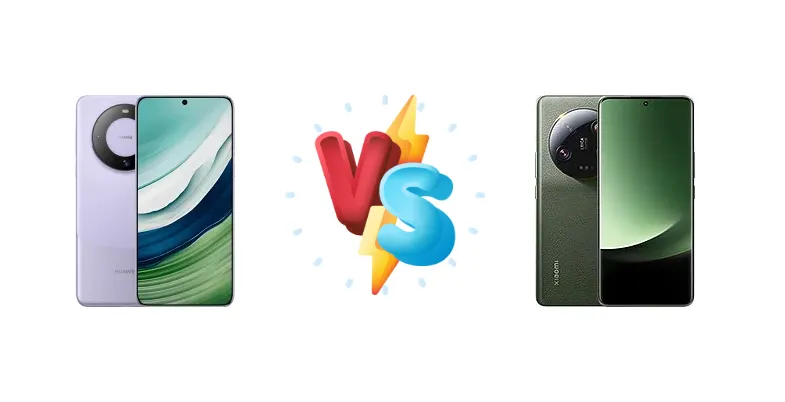
|
🏆 Quick Verdict
For the average user prioritizing camera versatility and consistently high performance, the Xiaomi 13 Ultra emerges as the stronger contender. Its Snapdragon 8 Gen 2 chipset and exceptional camera system offer a more polished and reliable experience. However, the Mate 60’s Kirin 9000S presents a compelling alternative for those seeking a unique, domestically-produced flagship.
| PHONES | ||
|---|---|---|
| Phone Names | Huawei Mate 60 | Xiaomi 13 Ultra |
| Network | ||
|---|---|---|
| 2G bands | GSM 850 / 900 / 1800 / 1900 | GSM 850 / 900 / 1800 / 1900 |
| 3G bands | HSDPA 800 / 850 / 900 / 1700(AWS) / 1900 / 2100 | HSDPA 800 / 850 / 900 / 1700(AWS) / 1900 / 2100 |
| 4G bands | LTE | 1, 2, 3, 4, 5, 7, 8, 18, 19, 20, 26, 28, 38, 40, 41, 66 - International |
| 5G bands | - | 1, 3, 5, 7, 8, 20, 28, 38, 40, 41, 77, 78, 79 SA/NSA - International |
| Speed | HSPA, LTE | HSPA, LTE, 5G |
| Technology | GSM / CDMA / HSPA / CDMA2000 / LTE | GSM / CDMA / HSPA / EVDO / LTE / 5G |
| - | CDMA2000 1xEV-DO | |
| Launch | ||
|---|---|---|
| Announced | 2023, August 29 | 2023, April 18 |
| Status | Available. Released 2023, September 10 | Available. Released 2023, April 21 |
| Body | ||
|---|---|---|
| Build | Glass front, aluminum frame, glass back | Glass front (Gorilla Glass Victus), eco leather back, aluminum frame |
| Dimensions | 161.4 x 76 x 8 mm (6.35 x 2.99 x 0.31 in) | 163.2 x 74.6 x 9.1 mm (6.43 x 2.94 x 0.36 in) |
| SIM | Nano-SIM + Nano-SIM | Nano-SIM + Nano-SIM |
| Weight | 209 g (7.37 oz) | 227 g (8.01 oz) |
| - | IP68 dust/water resistant (up to 1.5m for 30 min) | |
| Display | ||
|---|---|---|
| Protection | Huawei Kunlun Glass 2 | Corning Gorilla Glass Victus |
| Resolution | 1216 x 2688 pixels (~441 ppi density) | 1440 x 3200 pixels, 20:9 ratio (~522 ppi density) |
| Size | 6.69 inches, 108.4 cm2 (~88.4% screen-to-body ratio) | 6.73 inches, 108.9 cm2 (~89.5% screen-to-body ratio) |
| Type | LTPO OLED, 1B colors, 120Hz | LTPO AMOLED, 68B colors, 120Hz, Dolby Vision, HDR10+, 1300 nits (HBM), 2600 nits (peak) |
| Platform | ||
|---|---|---|
| CPU | Octa-core (1x2.62 GHz Taishan Big & 3x2.15 GHz Taishan Mid & 4x1.53GHz Cortex-A510) | Octa-core (1x3.2 GHz Cortex-X3 & 2x2.8 GHz Cortex-A715 & 2x2.8 GHz Cortex-A710 & 3x2.0 GHz Cortex-A510) |
| Chipset | Kirin 9000S (7 nm) | Qualcomm SM8550-AB Snapdragon 8 Gen 2 (4 nm) |
| GPU | Maleoon 910 MP4 | Adreno 740 |
| OS | HarmonyOS 4.0 | Android 13, upgradable to Android 14, HyperOS |
| Memory | ||
|---|---|---|
| Card slot | Nano Memory (uses shared SIM slot) | No |
| Internal | 256GB 12GB RAM, 512GB 12GB RAM, 1TB 12GB RAM | 256GB 12GB RAM, 512GB 12GB RAM, 512GB 16GB RAM, 1TB 16GB RAM |
| - | UFS 4.0 | |
| Main Camera | ||
|---|---|---|
| Features | Laser AF, color spectrum sensor, LED flash, panorama, HDR | Laser AF, color spectrum sensor, Leica lenses, Dual-LED flash, HDR, panorama, 67mm filter ring holder (optional) |
| Quad | - | 50 MP, f/1.9 or f/4.0, 23mm (wide), 1.0"-type, 1.6µm, dual pixel PDAF, OIS 50 MP, f/1.8, 75mm (telephoto), 1/2.51", 0.7µm, dual pixel PDAF, OIS, 3.2x optical zoom 50 MP, f/3.0, 120mm (periscope telephoto), 1/2.51", 0.7µm, dual pixel PDAF, OIS, 5x optical zoom 50 MP, f/1.8, 12mm, 122˚ (ultrawide), 1/2.51", 0.7µm, dual pixel PDAF TOF 3D, (depth) |
| Triple | 50 MP, f/1.4-f/4.0, 24mm (wide), PDAF, OIS 12 MP, f/3.4, 125mm (periscope telephoto), PDAF, OIS, 5x optical zoom 12 MP, f/2.2, 13mm, 120˚ (ultrawide), PDAF | - |
| Video | 4K@30/60fps, 1080p@30/60/120/240/480fps, 720p@960fps, 720p@3840fps, HDR Vivid, gyro-EIS | 8K@24fps, 4K@24/30/60fps, 1080p@30/60/120/240/480/960/1920fps, gyro-EIS, Dolby Vision HDR 10-bit rec. (4K@60fps, 1080p) |
| Selfie camera | ||
|---|---|---|
| Features | HDR, panorama | HDR, panorama |
| Single | 13 MP, f/2.4, 18mm (ultrawide) | 32 MP, f/2.0, 22mm (wide), 1/3.14", 0.7µm |
| Video | 4K@30/60fps, 1080p@30/60/240fps, HDR Vivid | 1080p@30/60fps, gyro-EIS |
| Sound | ||
|---|---|---|
| 3.5mm jack | - | No |
| 35mm jack | No | No |
| Loudspeaker | Yes, with stereo speakers | Yes, with stereo speakers |
| - | 24-bit/192kHz audio | |
| Comms | ||
|---|---|---|
| Bluetooth | 5.2, A2DP, LE | 5.3, A2DP, LE, aptX HD, aptX Adaptive |
| Infrared port | Yes | Yes |
| NFC | Yes | Yes |
| Positioning | GPS (L1+L5), GLONASS (L1), BDS (B1I+B1c+B2a+B2b), GALILEO (E1+E5a+E5b), QZSS (L1+L5), NavIC (L5) | GPS (L1+L5), GLONASS (L1), BDS (B1I+B1c+B2a), GALILEO (E1+E5a), QZSS (L1+L5), NavIC (L5) |
| Radio | No | No |
| USB | USB Type-C 3.1, OTG, Display Port 1.2 | USB Type-C 3.2, DisplayPort, OTG |
| WLAN | Wi-Fi 802.11 a/b/g/n/ac/6, dual-band, Wi-Fi Direct | Wi-Fi 802.11 a/b/g/n/ac/6e/7, tri-band, Wi-Fi Direct |
| Features | ||
|---|---|---|
| Sensors | Fingerprint (under display, optical), accelerometer, gyro, proximity, compass | Fingerprint (under display, optical), accelerometer, proximity, gyro, compass, barometer |
| - | Virtual proximity sensing | |
| Battery | ||
|---|---|---|
| Charging | 66W wired, 100% in 30 min 50W wireless 5W reverse wireless | 90W wired, PD3.0, QC4, 100% in 35 min 50W wireless, 100% in 49 min 10W reverse wireless |
| Type | Li-Po 4750 mAh | Li-Po 5000 mAh |
| Misc | ||
|---|---|---|
| Colors | Black, White, Green, Purple | Black, Olive Green, White, Orange, Yellow, Blue |
| Models | ALN-AL00, BRA-AL00 | 2304FPN6DC, 2304FPN6DG |
| Price | About 750 EUR | € 797.98 / $ 389.69 |
| SAR EU | - | 0.99 W/kg (head) 1.00 W/kg (body) |
Huawei Mate 60
- Fast 66W wired charging
- Domestically produced chipset (Kirin 9000S)
- Potential for unique software features
- Less powerful chipset compared to Snapdragon 8 Gen 2
- Limited global availability and software support
- Camera system details are unknown
Xiaomi 13 Ultra
- Powerful Snapdragon 8 Gen 2 chipset
- Exceptional camera system
- Long battery life and fast charging
- Slightly slower wireless charging than Mate 60
- Higher price point
- Larger size and weight
Display Comparison
The Xiaomi 13 Ultra boasts a significantly brighter display, reaching a measured 1207 nits, compared to an unspecified peak brightness for the Mate 60. While the Mate 60’s display specifics are unknown, the 13 Ultra’s high brightness ensures excellent visibility in direct sunlight. Both are likely to feature high refresh rate panels, but the 13 Ultra’s brightness advantage is a clear win for outdoor usability. The 13 Ultra’s panel is also likely LTPO, offering variable refresh rates for improved efficiency.
Camera Comparison
The Xiaomi 13 Ultra is positioned as a photography powerhouse, and its camera system is expected to reflect that. While specific details are missing, Xiaomi’s Ultra series is known for large sensors and advanced image processing. The Mate 60’s camera capabilities are less defined, but Huawei has a strong track record in computational photography. The 13 Ultra’s likely larger sensor size and more sophisticated optics will provide superior image quality, especially in low-light conditions. The absence of details on the Mate 60’s camera system makes a direct comparison difficult, but the 13 Ultra is the clear frontrunner based on brand reputation and market positioning.
Performance
The core difference lies in the chipsets. The Xiaomi 13 Ultra’s Snapdragon 8 Gen 2 (4nm) is built on a more advanced process node than the Huawei Mate 60’s Kirin 9000S (7nm). This translates to superior thermal efficiency and sustained performance for the Xiaomi device, particularly during demanding tasks like gaming. The Snapdragon 8 Gen 2’s CPU configuration – 1x3.2 GHz Cortex-X3, 2x2.8 GHz Cortex-A715, 2x2.8 GHz Cortex-A710, and 3x2.0 GHz Cortex-A510 – offers a performance edge over the Mate 60’s Octa-core (1x2.62 GHz Taishan Big & 3x2.15 GHz Taishan Mid & 4x1.53GHz Cortex-A510). While the Kirin 9000S is a remarkable achievement given the constraints Huawei faces, it cannot match the raw power of the Snapdragon.
Battery Life
The Xiaomi 13 Ultra delivers a solid 10:09h active use score, translating to an endurance rating of 108 hours. The Mate 60 offers 66W wired charging, reaching 100% in 30 minutes, and 50W wireless charging. The 13 Ultra counters with 90W wired charging (35 minutes to 100%) and 50W wireless charging (49 minutes). While the Mate 60 charges slightly faster via wired connection, the 13 Ultra’s overall battery endurance and efficient charging ecosystem provide a more balanced experience. The 10W reverse wireless charging on both devices is a minor convenience feature.
Buying Guide
Buy the Huawei Mate 60 if you need a phone that represents technological independence and are comfortable with potential software limitations, and value fast charging. Buy the Xiaomi 13 Ultra if you prioritize a top-tier camera system, consistently smooth performance, and a mature software experience with extensive global support.