
Huawei Mate 60 vs. Samsung Galaxy S23 Ultra: A Flagship Face-Off
| Phones Images | |||||
|---|---|---|---|---|---|
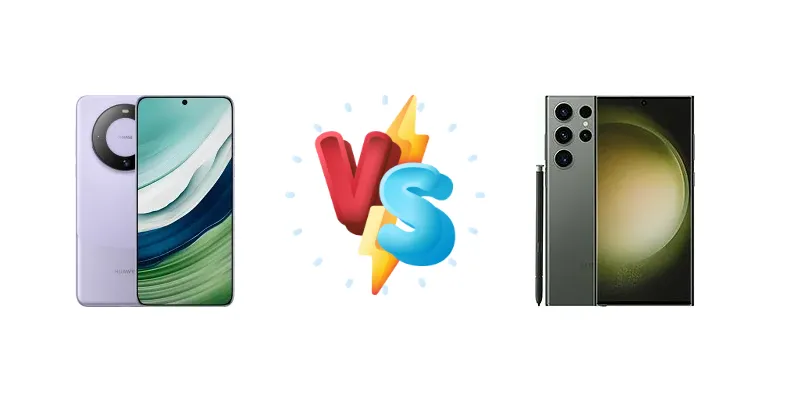
|
🏆 Quick Verdict
For the average user prioritizing consistent performance, a refined software experience, and exceptional battery life, the Samsung Galaxy S23 Ultra is the clear winner. However, the Huawei Mate 60’s Kirin 9000S offers a compelling alternative for those seeking a unique, domestically-produced chipset and faster wired charging.
| PHONES | ||
|---|---|---|
| Phone Names | Huawei Mate 60 | Samsung Galaxy S23 Ultra |
| Network | ||
|---|---|---|
| 2G bands | GSM 850 / 900 / 1800 / 1900 | GSM 850 / 900 / 1800 / 1900 |
| 3G bands | HSDPA 800 / 850 / 900 / 1700(AWS) / 1900 / 2100 | HSDPA 850 / 900 / 1700(AWS) / 1900 / 2100 |
| 4G bands | LTE | 1, 2, 3, 4, 5, 7, 8, 12, 13, 17, 18, 19, 20, 25, 26, 28, 32, 38, 39, 40, 41, 66 - International |
| 5G bands | - | 1, 2, 3, 5, 7, 8, 12, 20, 25, 28, 38, 40, 41, 66, 75, 77, 78 SA/NSA/Sub6 - International |
| Speed | HSPA, LTE | HSPA, LTE (up to 7CA), 5G |
| Technology | GSM / CDMA / HSPA / CDMA2000 / LTE | GSM / CDMA / HSPA / EVDO / LTE / 5G |
| - | 1, 7, 28, 41, 66, 71, 78, 258, 260, 261 SA/NSA/Sub6/mmWave - USA | |
| Launch | ||
|---|---|---|
| Announced | 2023, August 29 | 2023, February 01 |
| Status | Available. Released 2023, September 10 | Available. Released 2023, February 17 |
| Body | ||
|---|---|---|
| Build | Glass front, aluminum frame, glass back | Glass front (Gorilla Glass Victus 2), glass back (Gorilla Glass Victus 2), aluminum frame |
| Dimensions | 161.4 x 76 x 8 mm (6.35 x 2.99 x 0.31 in) | 163.4 x 78.1 x 8.9 mm (6.43 x 3.07 x 0.35 in) |
| SIM | Nano-SIM + Nano-SIM | · Nano-SIM + eSIM· Nano-SIM + Nano-SIM + eSIM (max 2 at a time) |
| Weight | 209 g (7.37 oz) | 234 g (8.25 oz) |
| - | IP68 dust/water resistant (up to 1.5m for 30 min) Armor aluminum frame with tougher drop and scratch resistance (advertised) Stylus (Bluetooth integration, accelerometer, gyro) | |
| Display | ||
|---|---|---|
| Protection | Huawei Kunlun Glass 2 | Corning Gorilla Glass Victus 2 |
| Resolution | 1216 x 2688 pixels (~441 ppi density) | 1440 x 3088 pixels, 19.3:9 ratio (~500 ppi density) |
| Size | 6.69 inches, 108.4 cm2 (~88.4% screen-to-body ratio) | 6.8 inches, 114.7 cm2 (~89.9% screen-to-body ratio) |
| Type | LTPO OLED, 1B colors, 120Hz | Dynamic AMOLED 2X, 120Hz, HDR10+, 1200 nits (HBM), 1750 nits (peak) |
| - | Always-on display | |
| Platform | ||
|---|---|---|
| CPU | Octa-core (1x2.62 GHz Taishan Big & 3x2.15 GHz Taishan Mid & 4x1.53GHz Cortex-A510) | Octa-core (1x3.36 GHz Cortex-X3 & 2x2.8 GHz Cortex-A715 & 2x2.8 GHz Cortex-A710 & 3x2.0 GHz Cortex-A510) |
| Chipset | Kirin 9000S (7 nm) | Qualcomm SM8550-AC Snapdragon 8 Gen 2 (4 nm) |
| GPU | Maleoon 910 MP4 | Adreno 740 |
| OS | HarmonyOS 4.0 | Android 13, up to 4 major Android upgrades, One UI 8 |
| Memory | ||
|---|---|---|
| Card slot | Nano Memory (uses shared SIM slot) | No |
| Internal | 256GB 12GB RAM, 512GB 12GB RAM, 1TB 12GB RAM | 256GB 8GB RAM, 256GB 12GB RAM, 512GB 12GB RAM, 1TB 12GB RAM |
| - | UFS 4.0 | |
| Main Camera | ||
|---|---|---|
| Features | Laser AF, color spectrum sensor, LED flash, panorama, HDR | Laser AF, LED flash, auto-HDR, panorama |
| Quad | - | 200 MP, f/1.7, 24mm (wide), 1/1.3", 0.6µm, multi-directional PDAF, OIS 10 MP, f/2.4, 70mm (telephoto), 1/3.52", 1.12µm, PDAF, OIS, 3x optical zoom 10 MP, f/4.9, 230mm (periscope telephoto), 1/3.52", 1.12µm, PDAF, OIS, 10x optical zoom 12 MP, f/2.2, 13mm, 120˚ (ultrawide), 1/2.55", 1.4µm, dual pixel PDAF, Super Steady video |
| Single | - | 12 MP, f/2.2, 26mm (wide), Dual Pixel PDAF |
| Triple | 50 MP, f/1.4-f/4.0, 24mm (wide), PDAF, OIS 12 MP, f/3.4, 125mm (periscope telephoto), PDAF, OIS, 5x optical zoom 12 MP, f/2.2, 13mm, 120˚ (ultrawide), PDAF | - |
| Video | 4K@30/60fps, 1080p@30/60/120/240/480fps, 720p@960fps, 720p@3840fps, HDR Vivid, gyro-EIS | 8K@24/30fps, 4K@30/60fps, 1080p@30/60/120/240fps, HDR10+, stereo sound rec., gyro-EIS |
| Selfie camera | ||
|---|---|---|
| Features | HDR, panorama | HDR, HDR10+ |
| Single | 13 MP, f/2.4, 18mm (ultrawide) | 12 MP, f/2.2, 26mm (wide), 1/3.2", 1.12µm, dual pixel PDAF |
| Video | 4K@30/60fps, 1080p@30/60/240fps, HDR Vivid | 4K@30/60fps, 1080p@30fps |
| Sound | ||
|---|---|---|
| 3.5mm jack | - | No |
| 35mm jack | No | No |
| Loudspeaker | Yes, with stereo speakers | Yes, with stereo speakers |
| - | 32-bit/384kHz audio Tuned by AKG | |
| Comms | ||
|---|---|---|
| Bluetooth | 5.2, A2DP, LE | 5.3, A2DP, LE |
| Infrared port | Yes | - |
| NFC | Yes | Yes |
| Positioning | GPS (L1+L5), GLONASS (L1), BDS (B1I+B1c+B2a+B2b), GALILEO (E1+E5a+E5b), QZSS (L1+L5), NavIC (L5) | GPS, GALILEO, GLONASS, BDS, QZSS |
| Radio | No | No |
| USB | USB Type-C 3.1, OTG, Display Port 1.2 | USB Type-C 3.2, OTG |
| WLAN | Wi-Fi 802.11 a/b/g/n/ac/6, dual-band, Wi-Fi Direct | Wi-Fi 802.11 a/b/g/n/ac/6e, tri-band, Wi-Fi Direct |
| Features | ||
|---|---|---|
| Sensors | Fingerprint (under display, optical), accelerometer, gyro, proximity, compass | Fingerprint (under display, ultrasonic), accelerometer, gyro, proximity, compass, barometer |
| - | Samsung DeX, Samsung Wireless DeX (desktop experience support) Bixby natural language commands and dictation Samsung Pay (Visa, MasterCard certified) Ultra Wideband (UWB) support | |
| Battery | ||
|---|---|---|
| Charging | 66W wired, 100% in 30 min 50W wireless 5W reverse wireless | 45W wired, PD3.0, 65% in 30 min 15W wireless (Qi) 4.5W reverse wireless |
| Type | Li-Po 4750 mAh | Li-Ion 5000 mAh |
| Misc | ||
|---|---|---|
| Colors | Black, White, Green, Purple | Phantom Black, Green, Cream, Lavender, Graphite, Sky Blue, Lime, Red, BMW M Edition |
| Models | ALN-AL00, BRA-AL00 | SM-S918B, SM-S918B/DS, SM-S918U, SM-S918U1, SM-S918W, SM-S918N, SM-S9180, SM-S918E, SM-S918E/DS |
| Price | About 750 EUR | € 549.90 / $ 454.99 / £ 433.00 |
| SAR | - | 1.12 W/kg (head) 0.92 W/kg (body) |
| SAR EU | - | 0.96 W/kg (head) 1.40 W/kg (body) |
| Tests | ||
|---|---|---|
| Battery life | - | Endurance rating 126h |
| Camera | - | Photo / Video |
| Display | - | Contrast ratio: Infinite (nominal) |
| Loudspeaker | - | -25.6 LUFS (Very good) |
| Performance | - | AnTuTu: 1241531 (v9) GeekBench: 4927 (v5.1) GFXBench: 67fps (ES 3.1 onscreen) |
Huawei Mate 60
- Faster 66W wired charging
- Domestically produced Kirin 9000S chipset
- 50W Wireless Charging
- Less efficient 7nm chipset
- Software ecosystem less mature than Samsung
- Limited global availability
Samsung Galaxy S23 Ultra
- Superior performance with Snapdragon 8 Gen 2
- Exceptional battery life and endurance
- Mature software ecosystem and long-term support
- Slower 45W wired charging
- Slower 15W wireless charging
- Higher price point
Display Comparison
The Samsung Galaxy S23 Ultra boasts a significantly brighter display, reaching a measured 1274 nits, compared to an unspecified peak brightness for the Mate 60. While the Mate 60’s display quality isn’t detailed in the provided data, Samsung’s Dynamic AMOLED 2X panel with its infinite contrast ratio is renowned for its vibrant colors and excellent viewing angles. The S23 Ultra’s LTPO technology dynamically adjusts the refresh rate, contributing to improved battery efficiency, a feature not confirmed for the Mate 60. Bezels are likely comparable, but Samsung’s display is a clear advantage in terms of peak brightness and adaptive refresh rate.
Camera Comparison
Both devices are equipped with advanced camera systems, but the provided data lacks specifics beyond 'Photo / Video' capabilities. However, given Samsung’s history, the S23 Ultra likely features a larger main sensor and more sophisticated image processing algorithms. The S23 Ultra’s camera system is known for its versatility, offering exceptional zoom capabilities and low-light performance. The Mate 60’s camera performance remains largely unknown without detailed sensor specifications and software analysis. It’s reasonable to assume Samsung’s established camera expertise provides a more refined and consistent photographic experience.
Performance
The core difference lies in the chipsets. The Samsung Galaxy S23 Ultra utilizes the 4nm Qualcomm Snapdragon 8 Gen 2, known for its exceptional performance and efficiency. Its octa-core configuration, featuring the Cortex-X3 prime core clocked at 3.36 GHz, delivers superior CPU performance compared to the Huawei Mate 60’s 7nm Kirin 9000S. The Kirin 9000S, while utilizing a Taishan architecture, operates on a larger node, potentially leading to higher power consumption and thermal throttling under sustained loads. The Snapdragon 8 Gen 2’s LPDDR5x RAM support further enhances memory bandwidth, benefiting multitasking and demanding applications. While the Kirin 9000S is a technological achievement given the circumstances, the Snapdragon 8 Gen 2 holds a clear performance advantage.
Battery Life
The Samsung Galaxy S23 Ultra achieves an impressive endurance rating of 126 hours and provides 13:24 hours of active use, demonstrating excellent battery life. While the Mate 60 offers faster 66W wired charging (100% in 30 minutes) compared to the S23 Ultra’s 45W charging (65% in 30 minutes), the S23 Ultra’s larger battery capacity and more efficient chipset contribute to longer overall usage. The Mate 60’s 50W wireless charging is faster than the S23 Ultra’s 15W Qi wireless charging, but the S23 Ultra’s overall battery endurance is superior.
Buying Guide
Buy the Huawei Mate 60 if you need a phone that showcases cutting-edge Chinese technology, prioritize fast 66W wired charging, and are comfortable with a potentially different software experience. Buy the Samsung Galaxy S23 Ultra if you prefer a mature, feature-rich ecosystem, industry-leading camera capabilities, and all-day battery life with a proven track record of software updates and support.