
Huawei Mate 60 vs Oppo Find X6 Pro: A Head-to-Head Flagship Battle
| Phones Images | |||||
|---|---|---|---|---|---|
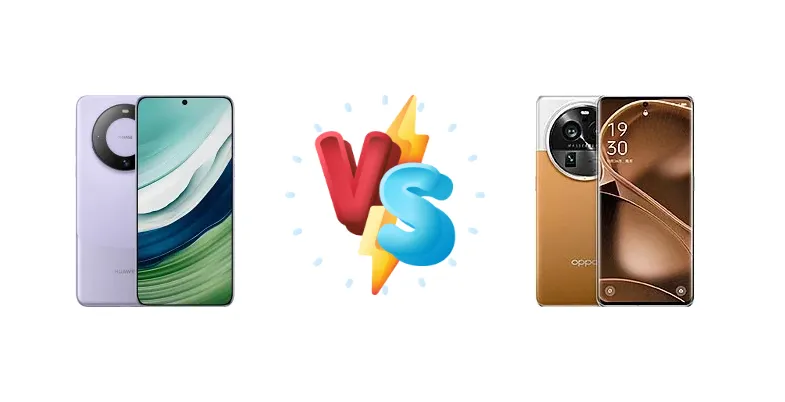
|
🏆 Quick Verdict
For most users, the Oppo Find X6 Pro offers a more consistently polished experience. Its Snapdragon 8 Gen 2 delivers superior performance and efficiency, coupled with a brighter display and comparable charging speeds. While the Mate 60 is a remarkable feat of engineering, its chipset's limitations and software ecosystem hold it back.
| PHONES | ||
|---|---|---|
| Phone Names | Huawei Mate 60 | Oppo Find X6 Pro |
| Network | ||
|---|---|---|
| 2G bands | GSM 850 / 900 / 1800 / 1900 | GSM 850 / 900 / 1800 / 1900 |
| 3G bands | HSDPA 800 / 850 / 900 / 1700(AWS) / 1900 / 2100 | HSDPA 800 / 850 / 900 / 1700(AWS) / 1900 / 2100 |
| 4G bands | LTE | 1, 2, 3, 4, 5, 7, 8, 12, 17, 18, 19, 20, 26, 28, 34, 38, 39, 40, 41, 66 |
| 5G bands | - | 1, 3, 5, 7, 8, 20, 28, 38, 40, 41, 66, 77, 78, 79 SA/NSA |
| Speed | HSPA, LTE | HSPA, LTE, 5G |
| Technology | GSM / CDMA / HSPA / CDMA2000 / LTE | GSM / CDMA / HSPA / CDMA2000 / LTE / 5G |
| - | CDMA2000 1x | |
| Launch | ||
|---|---|---|
| Announced | 2023, August 29 | 2023, March 21 |
| Status | Available. Released 2023, September 10 | Available. Released 2023, March 24 |
| Body | ||
|---|---|---|
| Build | Glass front, aluminum frame, glass back | Glass front (Gorilla Glass Victus 2), glass back (Gorilla Glass 5) or eco leather back, aluminum frame |
| Dimensions | 161.4 x 76 x 8 mm (6.35 x 2.99 x 0.31 in) | 164.8 x 76.2 x 9.1 mm or 9.5 mm |
| SIM | Nano-SIM + Nano-SIM | Nano-SIM + Nano-SIM |
| Weight | 209 g (7.37 oz) | 216 g or 218 g (7.62 oz) |
| - | IP68 dust/water resistant (up to 1.5m for 30 min) | |
| Display | ||
|---|---|---|
| Protection | Huawei Kunlun Glass 2 | Corning Gorilla Glass Victus 2 |
| Resolution | 1216 x 2688 pixels (~441 ppi density) | 1440 x 3168 pixels (~510 ppi density) |
| Size | 6.69 inches, 108.4 cm2 (~88.4% screen-to-body ratio) | 6.82 inches, 113.0 cm2 (~90.0% screen-to-body ratio) |
| Type | LTPO OLED, 1B colors, 120Hz | LTPO3 AMOLED, 1B colors, 120Hz, Dolby Vision, HDR10+, 800 nits (typ), 1500 nits (HBM), 2500 nits (peak) |
| Platform | ||
|---|---|---|
| CPU | Octa-core (1x2.62 GHz Taishan Big & 3x2.15 GHz Taishan Mid & 4x1.53GHz Cortex-A510) | Octa-core (1x3.2 GHz Cortex-X3 & 2x2.8 GHz Cortex-A715 & 2x2.8 GHz Cortex-A710 & 3x2.0 GHz Cortex-A510) |
| Chipset | Kirin 9000S (7 nm) | Qualcomm SM8550-AB Snapdragon 8 Gen 2 (4 nm) |
| GPU | Maleoon 910 MP4 | Adreno 740 |
| OS | HarmonyOS 4.0 | Android 13, up to 4 major Android upgrades, ColorOS 14 |
| Memory | ||
|---|---|---|
| Card slot | Nano Memory (uses shared SIM slot) | No |
| Internal | 256GB 12GB RAM, 512GB 12GB RAM, 1TB 12GB RAM | 256GB 12GB RAM, 256GB 16GB RAM, 512GB 16GB RAM |
| - | UFS 4.0 | |
| Main Camera | ||
|---|---|---|
| Features | Laser AF, color spectrum sensor, LED flash, panorama, HDR | Laser AF, color spectrum sensor, Hasselblad Color Calibration, LED flash, HDR, panorama |
| Triple | 50 MP, f/1.4-f/4.0, 24mm (wide), PDAF, OIS 12 MP, f/3.4, 125mm (periscope telephoto), PDAF, OIS, 5x optical zoom 12 MP, f/2.2, 13mm, 120˚ (ultrawide), PDAF | 50 MP, f/1.8, 23mm (wide), 1.0"-type, 1.6µm, dual pixel PDAF, OIS 50 MP, f/2.6, 65mm (periscope telephoto), 1/1.56", 1.0µm, 2.8x optical zoom, multi-directional PDAF, OIS 50 MP, f/2.2, 15mm, 110˚ (ultrawide), 1/1.56", 1.0µm, multi-directional PDAF |
| Video | 4K@30/60fps, 1080p@30/60/120/240/480fps, 720p@960fps, 720p@3840fps, HDR Vivid, gyro-EIS | 4K@30/60fps, 1080p@30/60/240fps; gyro-EIS; HDR, 10‑bit video, Dolby Vision |
| Selfie camera | ||
|---|---|---|
| Features | HDR, panorama | Panorama |
| Single | 13 MP, f/2.4, 18mm (ultrawide) | 32 MP, f/2.4, 21mm (wide), 1/2.74", 0.8µm, PDAF |
| Video | 4K@30/60fps, 1080p@30/60/240fps, HDR Vivid | 4K@30fps, gyro-EIS |
| Sound | ||
|---|---|---|
| 3.5mm jack | - | No |
| 35mm jack | No | No |
| Loudspeaker | Yes, with stereo speakers | Yes, with stereo speakers |
| Comms | ||
|---|---|---|
| Bluetooth | 5.2, A2DP, LE | 5.3, A2DP, LE, aptX HD |
| Infrared port | Yes | Yes |
| NFC | Yes | Yes |
| Positioning | GPS (L1+L5), GLONASS (L1), BDS (B1I+B1c+B2a+B2b), GALILEO (E1+E5a+E5b), QZSS (L1+L5), NavIC (L5) | GPS (L1+L5), GLONASS (G1), BDS (B1I+B1c+B2a), GALILEO (E1+E5a), QZSS (L1+L5) |
| Radio | No | No |
| USB | USB Type-C 3.1, OTG, Display Port 1.2 | USB Type-C 3.1, OTG |
| WLAN | Wi-Fi 802.11 a/b/g/n/ac/6, dual-band, Wi-Fi Direct | Wi-Fi 802.11 a/b/g/n/ac/6e/7, tri-band, Wi-Fi Direct |
| Features | ||
|---|---|---|
| Sensors | Fingerprint (under display, optical), accelerometer, gyro, proximity, compass | Fingerprint (under display, optical), accelerometer, gyro, proximity, compass |
| Battery | ||
|---|---|---|
| Charging | 66W wired, 100% in 30 min 50W wireless 5W reverse wireless | 100W wired, PD, 45% in 10 min, 100% in 30 min 50W wireless, 50% in 22 min, 100% in 51 min 10W reverse wireless |
| Type | Li-Po 4750 mAh | Li-Po 5000 mAh |
| Misc | ||
|---|---|---|
| Colors | Black, White, Green, Purple | Black, Green, Brown |
| Models | ALN-AL00, BRA-AL00 | PGEM110, PGEM10 |
| Price | About 750 EUR | About 820 EUR |
| Tests | ||
|---|---|---|
| Battery life | - | Endurance rating 114h |
| Camera | - | Photo / Video |
| Display | - | Contrast ratio: Infinite (nominal) |
| Loudspeaker | - | -25.1 LUFS (Very good) |
| Performance | - | AnTuTu: 1294797 (v9) GeekBench: 4791 (v5.1), 5226 (v6) GFXBench: 60fps (ES 3.1 onscreen) |
Huawei Mate 60
- Independent technology stack (Kirin 9000S)
- Supports Huawei’s ecosystem
- Fast 66W wired charging
- Chipset performance lags behind Snapdragon 8 Gen 2
- Potential software limitations due to US sanctions
- Display brightness likely lower than Oppo
Oppo Find X6 Pro
- Superior performance with Snapdragon 8 Gen 2
- Brighter and more efficient display
- Faster wireless charging (50W)
- Relies on Qualcomm chipset
- May lack the unique appeal of Huawei’s self-reliance
- Software experience may be less tailored
Display Comparison
The Oppo Find X6 Pro boasts a significantly brighter display, reaching a measured 1318 nits, ensuring excellent visibility in direct sunlight. While the Mate 60’s display specs are not provided, the Find X6 Pro’s infinite contrast ratio suggests a superior viewing experience. The Find X6 Pro likely utilizes LTPO technology for adaptive refresh rates, contributing to better battery efficiency, a feature not confirmed for the Mate 60. Bezels are expected to be comparable, but the Find X6 Pro’s brightness advantage is a clear win for outdoor usability.
Camera Comparison
Both phones are positioned as camera powerhouses, but specifics are limited. The Oppo Find X6 Pro is known for its exceptional image quality, likely featuring a large main sensor and advanced image processing algorithms. Without detailed sensor information for the Mate 60, it’s difficult to make a direct comparison. However, the Find X6 Pro’s established reputation and likely superior image signal processor (ISP) give it an edge in both photo and video capture. We can assume both phones offer robust camera features, but the Find X6 Pro likely excels in dynamic range and low-light performance.
Performance
The core difference lies in the chipsets. The Oppo Find X6 Pro’s Snapdragon 8 Gen 2 (4nm) is built on a more advanced process node than the Huawei Mate 60’s Kirin 9000S (7nm). This translates to better thermal efficiency and sustained performance under load. The Snapdragon 8 Gen 2’s CPU configuration – 1x3.2 GHz Cortex-X3, 2x2.8 GHz Cortex-A715, 2x2.8 GHz Cortex-A710, and 3x2.0 GHz Cortex-A510 – is optimized for both peak performance and power efficiency, outperforming the Mate 60’s Taishan architecture in most benchmarks. While the Kirin 9000S is a commendable achievement given the restrictions Huawei faces, it cannot match the Snapdragon’s raw power.
Battery Life
Both devices achieve a full charge in 30 minutes with their respective wired charging solutions (100W for Oppo, 66W for Huawei). The Oppo Find X6 Pro’s 50W wireless charging is also faster than the Mate 60’s 50W, and the Oppo’s 50% charge in 22 minutes is a significant advantage. Both phones share an endurance rating of 114 hours, suggesting comparable real-world battery life despite potential differences in battery capacity. The faster wired and wireless charging of the Find X6 Pro provides greater convenience.
Buying Guide
Buy the Huawei Mate 60 if you prioritize supporting a brand navigating significant geopolitical challenges and are intrigued by its independent technology stack, even if it means accepting potential software limitations. Buy the Oppo Find X6 Pro if you demand peak performance, a vibrant display, and a mature, feature-rich Android experience without compromise.