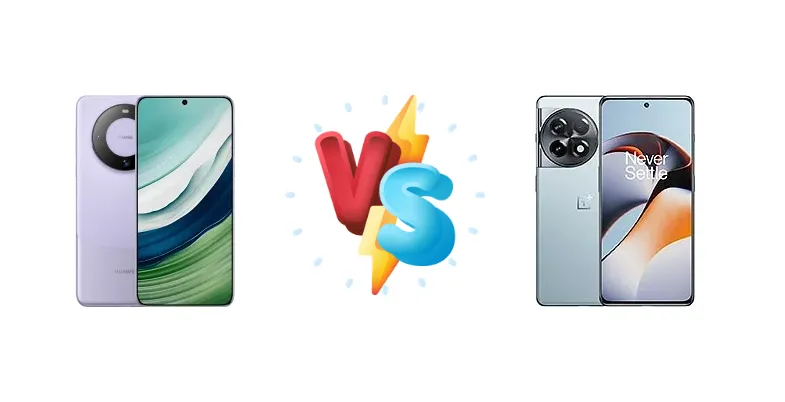
The Huawei Mate 60 and OnePlus 11R represent compelling options in a crowded smartphone market. The Mate 60, powered by Huawei’s domestically produced Kirin 9000S, aims to deliver flagship-level performance despite geopolitical constraints. The OnePlus 11R, leveraging the proven Qualcomm Snapdragon 8+ Gen 1, focuses on delivering a smooth, fast experience at a competitive price. This comparison dissects their key differences to determine which device best suits your needs.
🏆 Quick Verdict
For most users, the OnePlus 11R offers a more straightforward and readily available experience. Its Snapdragon 8+ Gen 1 chipset provides excellent performance and efficiency, coupled with blazing-fast 100W charging. While the Mate 60’s Kirin 9000S is intriguing, its availability and software ecosystem remain concerns.
| Network |
|---|
| 2G bands | GSM 850 / 900 / 1800 / 1900 | GSM 850 / 900 / 1800 / 1900 |
| 3G bands | HSDPA 800 / 850 / 900 / 1700(AWS) / 1900 / 2100 | HSDPA 850 / 900 / 1700(AWS) / 2100 |
| 4G bands | LTE | 1, 3, 4, 5, 8, 28, 34, 38, 39, 40, 41 |
| 5G bands | - | 1, 3, 5, 8, 28, 40, 41, 77, 78 SA/NSA |
| Speed | HSPA, LTE | HSPA, LTE (3CA), 5G |
| Technology | GSM / CDMA / HSPA / CDMA2000 / LTE | GSM / CDMA / HSPA / LTE / 5G |
| | - | CDMA 800 |
| Launch |
|---|
| Announced | 2023, August 29 | 2023, February 07 |
| Status | Available. Released 2023, September 10 | Available. Released 2023, February 21 |
| Body |
|---|
| Build | Glass front, aluminum frame, glass back | Glass front, glass back (Gorilla Glass 5), plastic frame |
| Dimensions | 161.4 x 76 x 8 mm (6.35 x 2.99 x 0.31 in) | 163.4 x 74.3 x 8.7 mm (6.43 x 2.93 x 0.34 in) |
| SIM | Nano-SIM + Nano-SIM | Nano-SIM + Nano-SIM |
| Weight | 209 g (7.37 oz) | 204 g (7.20 oz) |
| Display |
|---|
| Protection | Huawei Kunlun Glass 2 | - |
| Resolution | 1216 x 2688 pixels (~441 ppi density) | 1240 x 2772 pixels, 20:9 ratio (~451 ppi density) |
| Size | 6.69 inches, 108.4 cm2 (~88.4% screen-to-body ratio) | 6.74 inches, 109.2 cm2 (~90.0% screen-to-body ratio) |
| Type | LTPO OLED, 1B colors, 120Hz | Fluid AMOLED, 1B colors, 120Hz, HDR10+, 1450 nits (peak) |
| Platform |
|---|
| CPU | Octa-core (1x2.62 GHz Taishan Big & 3x2.15 GHz Taishan Mid & 4x1.53GHz Cortex-A510) | Octa-core (1x3.0 GHz Cortex-X2 & 3x2.5 GHz Cortex-A710 & 4x1.80 GHz Cortex-A510) |
| Chipset | Kirin 9000S (7 nm) | Qualcomm SM8475 Snapdragon 8+ Gen 1 (4 nm) |
| GPU | Maleoon 910 MP4 | Adreno 730 |
| OS | HarmonyOS 4.0 | Android 13, upgradable to Android 15, OxygenOS 15 |
| Memory |
|---|
| Card slot | Nano Memory (uses shared SIM slot) | No |
| Internal | 256GB 12GB RAM, 512GB 12GB RAM, 1TB 12GB RAM | 128GB 8GB RAM, 256GB 16GB RAM, 512GB 18GB RAM |
| | - | UFS 3.1 |
| Main Camera |
|---|
| Features | Laser AF, color spectrum sensor, LED flash, panorama, HDR | Color spectrum sensor, LED flash, HDR, panorama |
| Single | - | 16 MP, f/2.4, 24mm (wide), 1/3.09", 1.0µm |
| Triple | 50 MP, f/1.4-f/4.0, 24mm (wide), PDAF, OIS
12 MP, f/3.4, 125mm (periscope telephoto), PDAF, OIS, 5x optical zoom
12 MP, f/2.2, 13mm, 120˚ (ultrawide), PDAF | 50 MP, f/1.8, 24mm (wide), 1/1.56", 1.0µm, multi-directional PDAF, OIS
8 MP, f/2.2, 120˚ (ultrawide), 1/4.0", 1.12µm
2 MP (macro) |
| Video | 4K@30/60fps, 1080p@30/60/120/240/480fps, 720p@960fps, 720p@3840fps, HDR Vivid, gyro-EIS | 4K@30/60fps, 1080p@30/60/240fps, gyro-EIS |
| Selfie camera |
|---|
| Features | HDR, panorama | HDR |
| Single | 13 MP, f/2.4, 18mm (ultrawide) | 16 MP, f/2.4, 24mm (wide), 1/3.09", 1.0µm |
| Video | 4K@30/60fps, 1080p@30/60/240fps, HDR Vivid | 1080p@30fps |
| Sound |
|---|
| 3.5mm jack | - | No |
| 35mm jack | No | No |
| Loudspeaker | Yes, with stereo speakers | Yes, with stereo speakers |
| | - | 24-bit/192kHz audio |
| Comms |
|---|
| Bluetooth | 5.2, A2DP, LE | 5.3, A2DP, LE, aptX HD |
| Infrared port | Yes | Yes |
| NFC | Yes | Yes |
| Positioning | GPS (L1+L5), GLONASS (L1), BDS (B1I+B1c+B2a+B2b), GALILEO (E1+E5a+E5b), QZSS (L1+L5), NavIC (L5) | GPS (L1+L5), GLONASS (G1), BDS (B1I+B1c+B2a), GALILEO (E1+E5a), QZSS (L1+L5) |
| Radio | No | No |
| USB | USB Type-C 3.1, OTG, Display Port 1.2 | USB Type-C 2.0 |
| WLAN | Wi-Fi 802.11 a/b/g/n/ac/6, dual-band, Wi-Fi Direct | Wi-Fi 802.11 a/b/g/n/ac/6, dual-band |
| Features |
|---|
| Sensors | Fingerprint (under display, optical), accelerometer, gyro, proximity, compass | Fingerprint (under display, optical), accelerometer, gyro, proximity, compass |
| Battery |
|---|
| Charging | 66W wired, 100% in 30 min
50W wireless
5W reverse wireless | 100W wired |
| Type | Li-Po 4750 mAh | Li-Po 5000 mAh |
| Misc |
|---|
| Colors | Black, White, Green, Purple | Galactic Silver, Sonic Black, Solar Red |
| Models | ALN-AL00, BRA-AL00 | CPH2487 |
| Price | About 750 EUR | About 600 EUR |
| SAR | - | 1.16 W/kg (head) 0.61 W/kg (body) |
Huawei Mate 60
- Unique Kirin 9000S chipset
- 66W wired and 50W wireless charging
- Potential for strong camera performance (Huawei's history)
- Supports reverse wireless charging
- Limited global availability
- Software ecosystem concerns (Huawei Mobile Services)
- Less established chipset performance data
OnePlus 11R
- Proven Snapdragon 8+ Gen 1 performance
- Blazing-fast 100W wired charging
- Globally available and supported
- Smooth and responsive user experience
- No wireless charging
- 2MP macro camera is largely unnecessary
- Less unique design compared to Mate 60
Display Comparison
Neither device boasts a standout display. While specific panel details (OLED type, peak brightness) are missing for the Mate 60, its market positioning suggests a high-quality panel. The OnePlus 11R features a 6.72-inch 120Hz AMOLED display. The key difference lies in charging convenience; the Mate 60 adds 50W wireless charging and 5W reverse wireless, features absent on the 11R. This caters to users who prefer cable-free power-ups.
Camera Comparison
Detailed camera specs for the Mate 60 are limited. However, Huawei traditionally excels in computational photography. The OnePlus 11R features a 50MP Sony IMX890 main sensor with OIS, a 8MP ultrawide, and a 2MP macro lens. The IMX890 is a capable sensor, but the 2MP macro lens is largely a marketing feature. The Mate 60’s image processing will likely prioritize vibrant colors and strong contrast, while the OnePlus 11R aims for a more natural look. Without detailed sensor information for the Mate 60, it’s difficult to definitively declare a winner, but Huawei’s history suggests a strong contender.
Performance
The core battleground is the chipset. The OnePlus 11R’s Snapdragon 8+ Gen 1 (4nm) is a known quantity, offering a robust combination of CPU and GPU power. Its Cortex-X2 prime core clocks at 3.0 GHz, providing a performance edge over the Mate 60’s Kirin 9000S. The Kirin 9000S (7nm) utilizes a tri-cluster Taishan architecture, which is less familiar in Western markets. While the Kirin’s architecture is interesting, the 4nm process of the Snapdragon 8+ Gen 1 generally translates to better thermal efficiency and sustained performance under heavy load. The 11R’s LPDDR5X RAM further enhances its responsiveness.
Battery Life
The OnePlus 11R’s 100W SuperVOOC charging is a significant advantage, achieving a full charge in approximately 25 minutes. The Mate 60 offers 66W wired charging, taking around 30 minutes for a full charge. While the Mate 60 adds 50W wireless charging, the 11R’s sheer wired charging speed is more practical for most users. Battery capacity is not specified for the Mate 60, but the 11R packs a 5000mAh cell, providing all-day battery life for moderate usage.
Buying Guide
Buy the Huawei Mate 60 if you prioritize supporting Huawei’s technological independence and are comfortable navigating potential software limitations. Its 66W wired and 50W wireless charging are attractive, and the Kirin 9000S offers a unique performance profile. Buy the OnePlus 11R if you value a proven, globally supported platform with exceptional fast charging (100W) and a consistently smooth user experience. It’s the safer bet for gamers and those who rely on Google services.
Frequently Asked Questions
❓ Does the Kirin 9000S chipset in the Mate 60 suffer from throttling under sustained load?
The 7nm process node of the Kirin 9000S, combined with Huawei’s thermal management, is a key factor. While independent testing is limited, early reports suggest it can manage heat reasonably well, but likely won't match the sustained performance of the Snapdragon 8+ Gen 1's 4nm process, especially during extended gaming sessions.
❓ Is the lack of Google Mobile Services (GMS) on the Huawei Mate 60 a significant drawback?
Yes, for many users, the absence of GMS is a major limitation. It means no direct access to the Google Play Store, requiring users to rely on Huawei’s AppGallery and sideloading apps. While AppGallery has expanded, it still lacks many popular apps, and sideloading can be cumbersome and pose security risks.
❓ How does the OnePlus 11R perform in graphically demanding games like Genshin Impact or PUBG?
The Snapdragon 8+ Gen 1 in the OnePlus 11R handles graphically intensive games with ease. Expect consistently high frame rates at maximum settings. The phone’s efficient thermal design prevents significant throttling, ensuring a smooth gaming experience even during prolonged sessions.
❓ What is the real-world difference between 66W and 100W charging?
While both are considered fast charging, 100W (OnePlus 11R) is significantly quicker. A full charge from 0% to 100% takes approximately 25 minutes with the 11R, while the Mate 60’s 66W charging takes around 30 minutes. This difference is noticeable for users who frequently need to top up their battery quickly.