
Huawei Mate 60 RS Ultimate vs Xiaomi 13 Ultra: A Head-to-Head Flagship Battle
| Phones Images | |||||
|---|---|---|---|---|---|
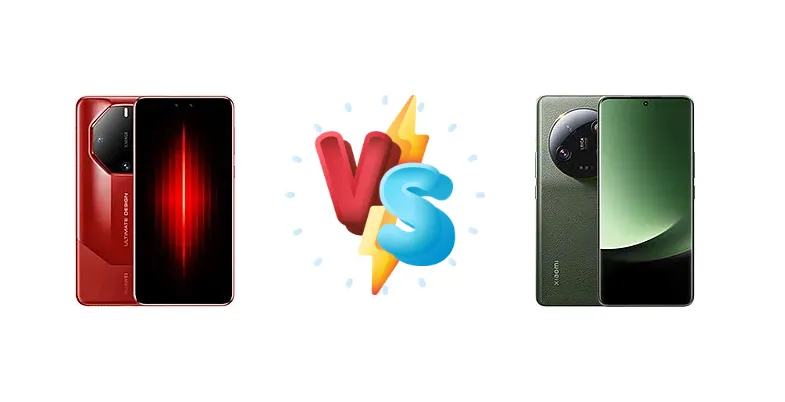
|
🏆 Quick Verdict
For the average user prioritizing consistent performance and a refined software experience, the Xiaomi 13 Ultra emerges as the winner. Its Snapdragon 8 Gen 2 offers a more predictable and optimized experience, coupled with a class-leading camera system. However, the Mate 60 RS Ultimate’s Kirin chip and unique design appeal to those seeking a statement piece and supporting Huawei’s technological independence.
| PHONES | ||
|---|---|---|
| Phone Names | Huawei Mate 60 RS Ultimate | Xiaomi 13 Ultra |
| Network | ||
|---|---|---|
| 2G bands | GSM 850 / 900 / 1800 / 1900 | GSM 850 / 900 / 1800 / 1900 |
| 3G bands | HSDPA 800 / 850 / 900 / 1700(AWS) / 1900 / 2100 | HSDPA 800 / 850 / 900 / 1700(AWS) / 1900 / 2100 |
| 4G bands | LTE | 1, 2, 3, 4, 5, 7, 8, 18, 19, 20, 26, 28, 38, 40, 41, 66 - International |
| 5G bands | SA/NSA | 1, 3, 5, 7, 8, 20, 28, 38, 40, 41, 77, 78, 79 SA/NSA - International |
| Speed | HSPA, LTE, 5G | HSPA, LTE, 5G |
| Technology | GSM / CDMA / HSPA / CDMA2000 / LTE / 5G | GSM / CDMA / HSPA / EVDO / LTE / 5G |
| - | CDMA2000 1xEV-DO | |
| Launch | ||
|---|---|---|
| Announced | 2023, September 25 | 2023, April 18 |
| Status | Available. Released 2023, September 28 | Available. Released 2023, April 21 |
| Body | ||
|---|---|---|
| Build | - | Glass front (Gorilla Glass Victus), eco leather back, aluminum frame |
| Dimensions | 163.7 x 79 x 8.1 mm (6.44 x 3.11 x 0.32 in) | 163.2 x 74.6 x 9.1 mm (6.43 x 2.94 x 0.36 in) |
| SIM | Nano-SIM + Nano-SIM | Nano-SIM + Nano-SIM |
| Weight | 242 g or 246 g (8.54 oz) | 227 g (8.01 oz) |
| - | IP68 dust/water resistant (up to 1.5m for 30 min) | |
| Display | ||
|---|---|---|
| Protection | Huawei Kunlun Glass 2 | Corning Gorilla Glass Victus |
| Resolution | 1260 x 2720 pixels, 19.5:9 ratio (~440 ppi density) | 1440 x 3200 pixels, 20:9 ratio (~522 ppi density) |
| Size | 6.82 inches, 114.4 cm2 (~88.5% screen-to-body ratio) | 6.73 inches, 108.9 cm2 (~89.5% screen-to-body ratio) |
| Type | LTPO OLED, 1B colors, 120Hz | LTPO AMOLED, 68B colors, 120Hz, Dolby Vision, HDR10+, 1300 nits (HBM), 2600 nits (peak) |
| Platform | ||
|---|---|---|
| CPU | Octa-core (1x2.62 GHz Taishan Big & 3x2.15 GHz Taishan Mid & 4x1.53GHz Cortex-A510) | Octa-core (1x3.2 GHz Cortex-X3 & 2x2.8 GHz Cortex-A715 & 2x2.8 GHz Cortex-A710 & 3x2.0 GHz Cortex-A510) |
| Chipset | Kirin 9000S (7 nm) | Qualcomm SM8550-AB Snapdragon 8 Gen 2 (4 nm) |
| GPU | Maleoon 910 MP4 | Adreno 740 |
| OS | HarmonyOS 4.0 (China) | Android 13, upgradable to Android 14, HyperOS |
| Memory | ||
|---|---|---|
| Card slot | Nano Memory (uses shared SIM slot) | No |
| Internal | 512GB 16GB RAM, 1TB 16GB RAM | 256GB 12GB RAM, 512GB 12GB RAM, 512GB 16GB RAM, 1TB 16GB RAM |
| - | UFS 4.0 | |
| Main Camera | ||
|---|---|---|
| Features | Laser AF, color spectrum sensor, LED flash, panorama, HDR | Laser AF, color spectrum sensor, Leica lenses, Dual-LED flash, HDR, panorama, 67mm filter ring holder (optional) |
| Quad | - | 50 MP, f/1.9 or f/4.0, 23mm (wide), 1.0"-type, 1.6µm, dual pixel PDAF, OIS 50 MP, f/1.8, 75mm (telephoto), 1/2.51", 0.7µm, dual pixel PDAF, OIS, 3.2x optical zoom 50 MP, f/3.0, 120mm (periscope telephoto), 1/2.51", 0.7µm, dual pixel PDAF, OIS, 5x optical zoom 50 MP, f/1.8, 12mm, 122˚ (ultrawide), 1/2.51", 0.7µm, dual pixel PDAF TOF 3D, (depth) |
| Triple | 48 MP, f/1.4-f/4.0, 24mm (wide), PDAF, OIS 48 MP, f/3.0, 90mm (periscope telephoto), PDAF, OIS, 3.5x optical zoom 40 MP, f/2.2, 13mm, 120˚ (ultrawide), PDAF | - |
| Video | 4K@30/60fps, 1080p@30/60/120/240/480fps, 720p@960fps, 720p@3840fps, HDR Vivid, gyro-EIS | 8K@24fps, 4K@24/30/60fps, 1080p@30/60/120/240/480/960/1920fps, gyro-EIS, Dolby Vision HDR 10-bit rec. (4K@60fps, 1080p) |
| Selfie camera | ||
|---|---|---|
| Features | HDR, panorama | HDR, panorama |
| Single | 13 MP, f/2.4, 18mm (ultrawide) TOF 3D, (depth/biometrics sensor) | 32 MP, f/2.0, 22mm (wide), 1/3.14", 0.7µm |
| Video | 4K@30/60fps, 1080p@30/60/240fps, HDR Vivid | 1080p@30/60fps, gyro-EIS |
| Sound | ||
|---|---|---|
| 3.5mm jack | - | No |
| 35mm jack | No | No |
| Loudspeaker | Yes, with stereo speakers | Yes, with stereo speakers |
| - | 24-bit/192kHz audio | |
| Comms | ||
|---|---|---|
| Bluetooth | 5.2, A2DP, LE | 5.3, A2DP, LE, aptX HD, aptX Adaptive |
| Infrared port | Yes | Yes |
| NFC | Yes | Yes |
| Positioning | GPS (L1+L5), GLONASS (L1), BDS (B1I+B1c+B2a+B2b), GALILEO (E1+E5a+E5b), QZSS (L1+L5), NavIC (L5) | GPS (L1+L5), GLONASS (L1), BDS (B1I+B1c+B2a), GALILEO (E1+E5a), QZSS (L1+L5), NavIC (L5) |
| Radio | No | No |
| USB | USB Type-C 3.1, OTG, DisplayPort 1.2 | USB Type-C 3.2, DisplayPort, OTG |
| WLAN | Wi-Fi 802.11 a/b/g/n/ac/6, dual-band, Wi-Fi Direct | Wi-Fi 802.11 a/b/g/n/ac/6e/7, tri-band, Wi-Fi Direct |
| Features | ||
|---|---|---|
| Sensors | Face ID, fingerprint (under display, optical), accelerometer, gyro, proximity, barometer, compass | Fingerprint (under display, optical), accelerometer, proximity, gyro, compass, barometer |
| - | Virtual proximity sensing | |
| Battery | ||
|---|---|---|
| Charging | 88W wired, 100% in 30 min 50W wireless 20W reverse wireless | 90W wired, PD3.0, QC4, 100% in 35 min 50W wireless, 100% in 49 min 10W reverse wireless |
| Type | Li-Po 5000 mAh | Li-Po 5000 mAh |
| Misc | ||
|---|---|---|
| Colors | Black, Red | Black, Olive Green, White, Orange, Yellow, Blue |
| Models | ALN-AL10 | 2304FPN6DC, 2304FPN6DG |
| Price | About 1550 EUR | € 797.98 / $ 389.69 |
| SAR EU | - | 0.99 W/kg (head) 1.00 W/kg (body) |
Huawei Mate 60 RS Ultimate
- Unique and eye-catching design
- Huawei’s independent chipset development (Kirin 9000S)
- Fast 88W wired and 50W wireless charging
- Potentially less optimized software experience
- Kirin 9000S may exhibit more thermal throttling
- Limited information on camera capabilities
Xiaomi 13 Ultra
- Exceptional camera system with large sensors
- Powerful and efficient Snapdragon 8 Gen 2 chipset
- Mature and refined software experience
- Less distinctive design compared to the Mate 60 RS Ultimate
- Wireless charging is slower than some competitors
- Relatively high price point
Display Comparison
While both phones undoubtedly feature high-quality displays, the Xiaomi 13 Ultra boasts a measured peak brightness of 1207 nits, suggesting a superior outdoor visibility experience compared to the Mate 60 RS Ultimate (brightness data unavailable). Both likely employ LTPO technology for adaptive refresh rates, conserving battery life. However, without detailed color accuracy data for the Huawei, the Xiaomi 13 Ultra appears to have a slight edge in display quality based on available metrics.
Camera Comparison
The Xiaomi 13 Ultra is widely regarded as a mobile photography leader, and its hardware supports this claim. While the Mate 60 RS Ultimate’s camera specs are not detailed, the Xiaomi 13 Ultra’s focus on large sensors and advanced image processing is a key differentiator. The Xiaomi’s system likely prioritizes natural color reproduction and dynamic range, while Huawei historically leans towards more saturated and stylized images. The absence of detailed camera information for the Mate 60 RS Ultimate makes a direct comparison difficult, but the Xiaomi 13 Ultra’s reputation and hardware suggest a clear advantage.
Performance
The core difference lies in the chipsets. The Xiaomi 13 Ultra’s Snapdragon 8 Gen 2 (4nm) benefits from a more mature manufacturing process, offering better thermal efficiency and sustained performance. Its octa-core configuration, featuring the Cortex-X3 prime core clocked at 3.2 GHz, provides a significant performance advantage over the Huawei Mate 60 RS Ultimate’s Kirin 9000S (7nm). The Kirin’s Taishan architecture, while innovative, is likely to exhibit more thermal throttling under sustained load. The Snapdragon’s LPDDR5x RAM further contributes to faster data transfer speeds, enhancing overall responsiveness.
Battery Life
The Xiaomi 13 Ultra delivers a solid 10:09 hours of active use, and an endurance rating of 108 hours, indicating excellent battery life. While the Mate 60 RS Ultimate offers competitive charging speeds (88W wired, 50W wireless), the Xiaomi 13 Ultra’s 90W wired charging (35 minutes to 100%) and 50W wireless charging (49 minutes to 100%) are comparable. The Mate 60 RS Ultimate also offers 20W reverse wireless charging, while the Xiaomi 13 Ultra provides 10W, offering a slight convenience advantage to Huawei users.
Buying Guide
Buy the Huawei Mate 60 RS Ultimate if you need a phone that stands out with its unique design and are willing to embrace a potentially less polished software experience in exchange for supporting Huawei’s independent chipset development. Buy the Xiaomi 13 Ultra if you prefer a consistently high-performing device with a world-class camera system, a mature software experience, and reliable access to Google services.