
Huawei Mate 60 RS Ultimate vs Oppo Find X6 Pro: A Flagship Face-Off
| Phones Images | |||||
|---|---|---|---|---|---|
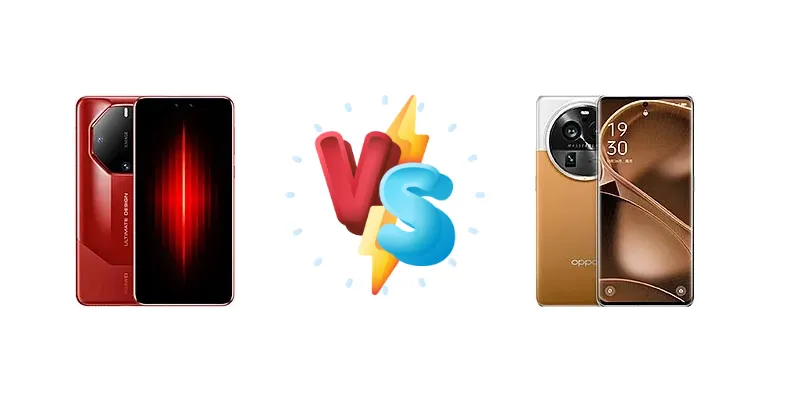
|
🏆 Quick Verdict
For the average user prioritizing consistent performance and a proven camera system, the Oppo Find X6 Pro is the stronger choice. Its Snapdragon 8 Gen 2 offers a more mature software ecosystem and demonstrably better thermal management. However, the Mate 60 RS Ultimate’s unique design and Kirin chip appeal to those seeking a statement piece and supporting Huawei’s technological independence.
| PHONES | ||
|---|---|---|
| Phone Names | Huawei Mate 60 RS Ultimate | Oppo Find X6 Pro |
| Network | ||
|---|---|---|
| 2G bands | GSM 850 / 900 / 1800 / 1900 | GSM 850 / 900 / 1800 / 1900 |
| 3G bands | HSDPA 800 / 850 / 900 / 1700(AWS) / 1900 / 2100 | HSDPA 800 / 850 / 900 / 1700(AWS) / 1900 / 2100 |
| 4G bands | LTE | 1, 2, 3, 4, 5, 7, 8, 12, 17, 18, 19, 20, 26, 28, 34, 38, 39, 40, 41, 66 |
| 5G bands | SA/NSA | 1, 3, 5, 7, 8, 20, 28, 38, 40, 41, 66, 77, 78, 79 SA/NSA |
| Speed | HSPA, LTE, 5G | HSPA, LTE, 5G |
| Technology | GSM / CDMA / HSPA / CDMA2000 / LTE / 5G | GSM / CDMA / HSPA / CDMA2000 / LTE / 5G |
| - | CDMA2000 1x | |
| Launch | ||
|---|---|---|
| Announced | 2023, September 25 | 2023, March 21 |
| Status | Available. Released 2023, September 28 | Available. Released 2023, March 24 |
| Body | ||
|---|---|---|
| Build | - | Glass front (Gorilla Glass Victus 2), glass back (Gorilla Glass 5) or eco leather back, aluminum frame |
| Dimensions | 163.7 x 79 x 8.1 mm (6.44 x 3.11 x 0.32 in) | 164.8 x 76.2 x 9.1 mm or 9.5 mm |
| SIM | Nano-SIM + Nano-SIM | Nano-SIM + Nano-SIM |
| Weight | 242 g or 246 g (8.54 oz) | 216 g or 218 g (7.62 oz) |
| - | IP68 dust/water resistant (up to 1.5m for 30 min) | |
| Display | ||
|---|---|---|
| Protection | Huawei Kunlun Glass 2 | Corning Gorilla Glass Victus 2 |
| Resolution | 1260 x 2720 pixels, 19.5:9 ratio (~440 ppi density) | 1440 x 3168 pixels (~510 ppi density) |
| Size | 6.82 inches, 114.4 cm2 (~88.5% screen-to-body ratio) | 6.82 inches, 113.0 cm2 (~90.0% screen-to-body ratio) |
| Type | LTPO OLED, 1B colors, 120Hz | LTPO3 AMOLED, 1B colors, 120Hz, Dolby Vision, HDR10+, 800 nits (typ), 1500 nits (HBM), 2500 nits (peak) |
| Platform | ||
|---|---|---|
| CPU | Octa-core (1x2.62 GHz Taishan Big & 3x2.15 GHz Taishan Mid & 4x1.53GHz Cortex-A510) | Octa-core (1x3.2 GHz Cortex-X3 & 2x2.8 GHz Cortex-A715 & 2x2.8 GHz Cortex-A710 & 3x2.0 GHz Cortex-A510) |
| Chipset | Kirin 9000S (7 nm) | Qualcomm SM8550-AB Snapdragon 8 Gen 2 (4 nm) |
| GPU | Maleoon 910 MP4 | Adreno 740 |
| OS | HarmonyOS 4.0 (China) | Android 13, up to 4 major Android upgrades, ColorOS 14 |
| Memory | ||
|---|---|---|
| Card slot | Nano Memory (uses shared SIM slot) | No |
| Internal | 512GB 16GB RAM, 1TB 16GB RAM | 256GB 12GB RAM, 256GB 16GB RAM, 512GB 16GB RAM |
| - | UFS 4.0 | |
| Main Camera | ||
|---|---|---|
| Features | Laser AF, color spectrum sensor, LED flash, panorama, HDR | Laser AF, color spectrum sensor, Hasselblad Color Calibration, LED flash, HDR, panorama |
| Triple | 48 MP, f/1.4-f/4.0, 24mm (wide), PDAF, OIS 48 MP, f/3.0, 90mm (periscope telephoto), PDAF, OIS, 3.5x optical zoom 40 MP, f/2.2, 13mm, 120˚ (ultrawide), PDAF | 50 MP, f/1.8, 23mm (wide), 1.0"-type, 1.6µm, dual pixel PDAF, OIS 50 MP, f/2.6, 65mm (periscope telephoto), 1/1.56", 1.0µm, 2.8x optical zoom, multi-directional PDAF, OIS 50 MP, f/2.2, 15mm, 110˚ (ultrawide), 1/1.56", 1.0µm, multi-directional PDAF |
| Video | 4K@30/60fps, 1080p@30/60/120/240/480fps, 720p@960fps, 720p@3840fps, HDR Vivid, gyro-EIS | 4K@30/60fps, 1080p@30/60/240fps; gyro-EIS; HDR, 10‑bit video, Dolby Vision |
| Selfie camera | ||
|---|---|---|
| Features | HDR, panorama | Panorama |
| Single | 13 MP, f/2.4, 18mm (ultrawide) TOF 3D, (depth/biometrics sensor) | 32 MP, f/2.4, 21mm (wide), 1/2.74", 0.8µm, PDAF |
| Video | 4K@30/60fps, 1080p@30/60/240fps, HDR Vivid | 4K@30fps, gyro-EIS |
| Sound | ||
|---|---|---|
| 3.5mm jack | - | No |
| 35mm jack | No | No |
| Loudspeaker | Yes, with stereo speakers | Yes, with stereo speakers |
| Comms | ||
|---|---|---|
| Bluetooth | 5.2, A2DP, LE | 5.3, A2DP, LE, aptX HD |
| Infrared port | Yes | Yes |
| NFC | Yes | Yes |
| Positioning | GPS (L1+L5), GLONASS (L1), BDS (B1I+B1c+B2a+B2b), GALILEO (E1+E5a+E5b), QZSS (L1+L5), NavIC (L5) | GPS (L1+L5), GLONASS (G1), BDS (B1I+B1c+B2a), GALILEO (E1+E5a), QZSS (L1+L5) |
| Radio | No | No |
| USB | USB Type-C 3.1, OTG, DisplayPort 1.2 | USB Type-C 3.1, OTG |
| WLAN | Wi-Fi 802.11 a/b/g/n/ac/6, dual-band, Wi-Fi Direct | Wi-Fi 802.11 a/b/g/n/ac/6e/7, tri-band, Wi-Fi Direct |
| Features | ||
|---|---|---|
| Sensors | Face ID, fingerprint (under display, optical), accelerometer, gyro, proximity, barometer, compass | Fingerprint (under display, optical), accelerometer, gyro, proximity, compass |
| Battery | ||
|---|---|---|
| Charging | 88W wired, 100% in 30 min 50W wireless 20W reverse wireless | 100W wired, PD, 45% in 10 min, 100% in 30 min 50W wireless, 50% in 22 min, 100% in 51 min 10W reverse wireless |
| Type | Li-Po 5000 mAh | Li-Po 5000 mAh |
| Misc | ||
|---|---|---|
| Colors | Black, Red | Black, Green, Brown |
| Models | ALN-AL10 | PGEM110, PGEM10 |
| Price | About 1550 EUR | About 820 EUR |
| Tests | ||
|---|---|---|
| Battery life | - | Endurance rating 114h |
| Camera | - | Photo / Video |
| Display | - | Contrast ratio: Infinite (nominal) |
| Loudspeaker | - | -25.1 LUFS (Very good) |
| Performance | - | AnTuTu: 1294797 (v9) GeekBench: 4791 (v5.1), 5226 (v6) GFXBench: 60fps (ES 3.1 onscreen) |
Huawei Mate 60 RS Ultimate
- Unique and eye-catching design
- Potentially faster wireless charging (50W)
- Supports Huawei’s technological independence
- Kirin 9000S chipset may throttle under sustained load
- Software ecosystem may be less mature
- Limited information on camera specifications
Oppo Find X6 Pro
- Snapdragon 8 Gen 2 offers superior performance and efficiency
- Proven camera system with excellent image quality
- Brighter display for better outdoor visibility
- Less distinctive design
- Slower initial wireless charging speed
- Relies on Qualcomm’s chipset
Display Comparison
The Oppo Find X6 Pro boasts a significantly brighter display, reaching a measured 1318 nits, making it more legible in direct sunlight compared to the Mate 60 RS Ultimate (brightness data unavailable). Both likely employ LTPO technology for adaptive refresh rates, conserving battery life. While the Find X6 Pro’s contrast ratio is listed as infinite (nominal), the real-world difference in viewing experience will likely be minimal. The Mate 60 RS Ultimate’s display quality remains unknown, but Huawei typically delivers excellent color accuracy in its flagship devices.
Camera Comparison
Both devices are positioned as camera powerhouses, but specifics beyond 'Photo/Video' capabilities are limited for the Mate 60 RS Ultimate. The Oppo Find X6 Pro is expected to feature a sophisticated multi-camera system, likely including a large main sensor with OIS. The Find X6 Pro’s image processing is known for its natural color reproduction and excellent dynamic range. Without detailed camera specs for the Mate 60 RS Ultimate, it’s difficult to assess its capabilities, but Huawei has a strong track record in computational photography. The absence of details regarding sensor sizes and lens apertures on the Mate 60 RS Ultimate makes a direct comparison challenging.
Performance
The core difference lies in the chipsets. The Oppo Find X6 Pro’s Snapdragon 8 Gen 2 (4nm) benefits from a more advanced fabrication process than the Huawei Mate 60 RS Ultimate’s Kirin 9000S (7nm). This translates to better power efficiency and potentially lower sustained temperatures under heavy load. The Snapdragon 8 Gen 2’s CPU configuration – 1x3.2 GHz Cortex-X3, 2x2.8 GHz Cortex-A715, 2x2.8 GHz Cortex-A710, and 3x2.0 GHz Cortex-A510 – is optimized for both peak performance and efficiency. The Kirin 9000S, with its Taishan architecture, aims to replicate the performance of ARM’s Cortex cores, but its 7nm process may limit its ability to compete with the Snapdragon in sustained workloads. Both phones likely utilize LPDDR5x RAM, but the Snapdragon’s superior GPU will provide a noticeable advantage in gaming.
Battery Life
Both phones offer 30-minute full charge capabilities with their respective wired charging solutions (88W for Huawei, 100W for Oppo). The Oppo Find X6 Pro’s 100W charging, with 45% charge in 10 minutes, is slightly faster initially. Both also support wireless charging, with the Mate 60 RS Ultimate offering a higher 50W wireless charging speed compared to the Oppo’s 50W. Both have an endurance rating of 114h, suggesting similar real-world battery life despite potential differences in battery capacity (data unavailable for Mate 60 RS Ultimate). The Oppo also offers 10W reverse wireless charging, while the Huawei offers 20W.
Buying Guide
Buy the Huawei Mate 60 RS Ultimate if you need a phone that stands out with its unique design and are willing to embrace a potentially less refined software experience in exchange for supporting Huawei’s independent technology development. Buy the Oppo Find X6 Pro if you prefer a polished, reliable experience with a top-tier camera system and the assurance of Qualcomm’s Snapdragon 8 Gen 2’s performance and efficiency.